Credit: Regenstrief Institute
INDIANAPOLIS – While the importance of trusted relationships between patients and their physicians is taken for granted, little attention has been given to the relationships among physicians themselves. Yet the interactions between, for example, a patient’s primary care physician and cardiologist or between a patient’s pediatrician and an oncology team, are essential to the safety and quality of care for patients and the resilience of physicians and other healthcare professionals.
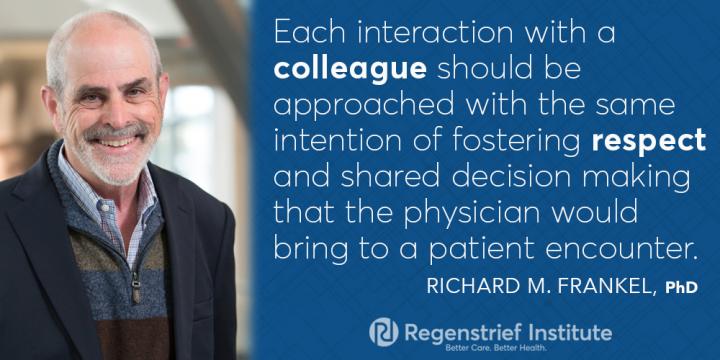
In a Viewpoint article,” Physicians’ Trust in One Another,” published online March 22 and in the April 9 print edition of JAMA, authors Richard M. Frankel, Ph.D. of the Regenstrief Institute; Virginia P. Tilden, Ph.D. of Oregon Health & Science University and Anthony Suchman, M.D. of the University of Rochester write that while trust in the physician to physician relationship hasn’t been closely examined, it appears increasingly to be at risk.
“If doctors don’t value and trust one another, the safety and quality of patient care is potentially at risk of being compromised,” said Dr. Frankel, a health services researcher and medical sociologist, who is first author of the article. “Trust is important for any well-functioning system, and we know that for the healthcare system to work successfully, trust has to be invested at every level in that system.”
Where does this apparent lack of trust originate? Dr. Frankel looks back to the competitiveness of medical school and as medical school ends, the competition for residencies. Do those who enter the most selective (and in the United States, the most highly paid) specialties look down on their primary care colleagues? Do specialists have a lack of trust in their primary care peers’ judgements simply because they chose a less specialized medical career like pediatrics or family practice?
Noting that the use of electronic medical records and the development of specialties such as hospital medicine have removed much of the interpersonal interaction that used to take place between primary care physicians and specialists — the phone call to discuss a case or the hallway update — Dr. Frankel voices concern that, in addition to having a potentially negative impact on patient care, the lack of interpersonal interaction may also be contributing to the increase in physician burnout and decreased resilience.
“Diversity of opinions, a critical eye and skepticism are all healthy and enable you to provide good care as well as to uncover errors when they do occur,” Dr. Frankel said. “But if a physician does not have confidence in colleagues and, instead, develops attitudes that are inherently cynical and distrustful of others, you have a system that is at risk to do harm to patients, and equally importantly, those who provide care on a day to day basis.”
The JAMA authors highlight three initial principles to bolster physician to physician relationships:
- Recognize that physician-physician relationships are consequential and should be given the same level of attention and intention as patient-physician and interpersonal (doctor-nurse, for example) relationships
- Value differences in perspective; harness them as a resource
- Notice the quality of relationships in each moment; be accountable for creating patterns of respect and hold others accountable for creating patterns of respect and collaboration
“We need a lot more focus on physicians’ trust in one another to both (1) better understand how the medical system is succeeding or failing us — and I believe at present it is failing — and (2) to help devise a prescription for building, and in some cases re-building physician to physician trust,” Dr. Frankel said. “Given the climbing rates of medical errors in the United States, physicians clearly need better ways of relating to each other and working together.”
He believes that the problem needs to be addressed across the spectrum from medical school students to practicing primary care and specialist physicians.
###
In addition to his appointment as a Regenstrief Institute research scientist, Dr. Frankel is a professor of medicine at Indiana University School of Medicine and a research sociologist at the Center for Healthcare Information and Communication at the Richard L. Roudebush VA Medical Center.
Media Contact
Cindy Fox Aisen
[email protected]
Related Journal Article
http://dx.