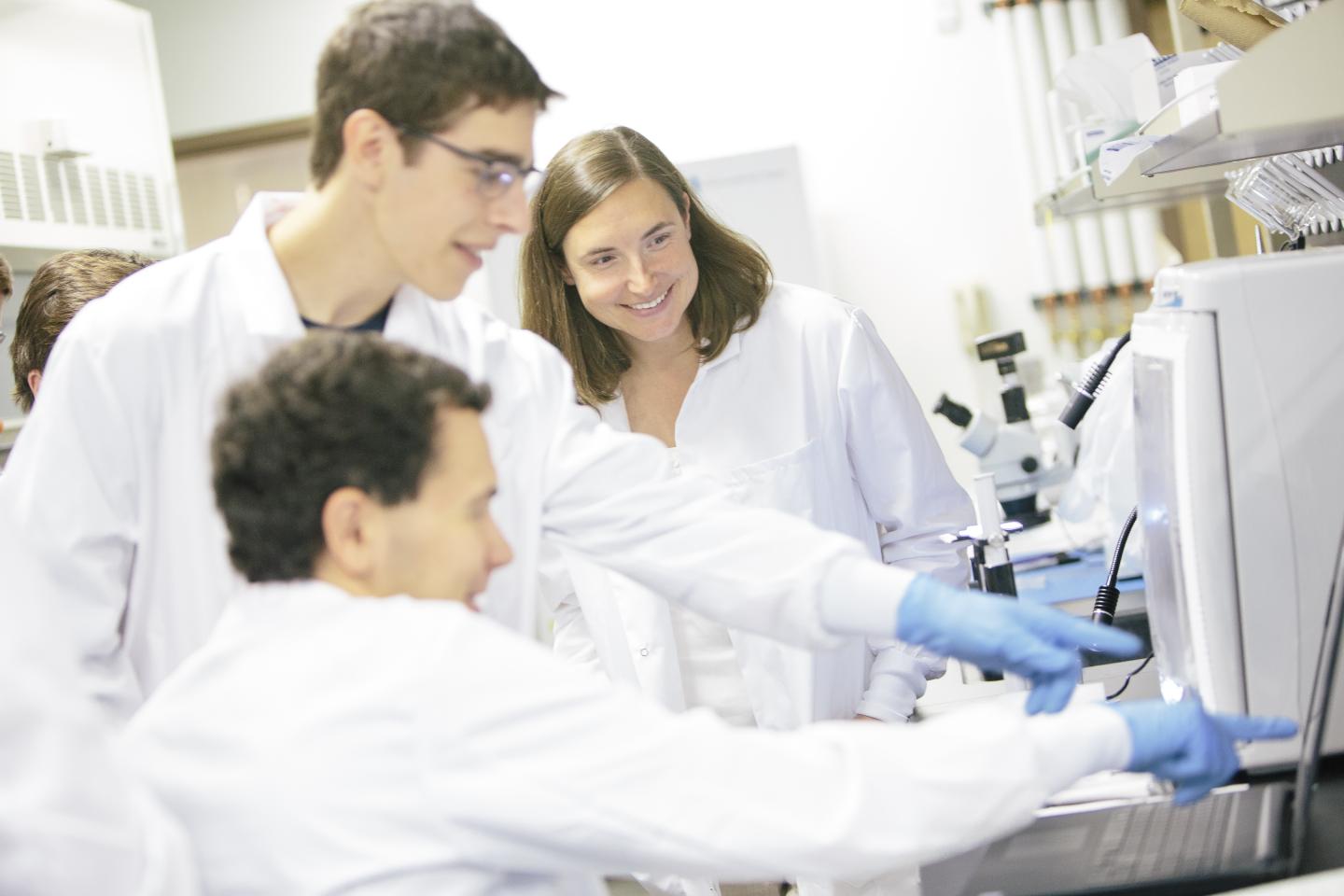
Credit: Montana State photo by Adrian Sanchez-Gonzalez
BOZEMAN — Some electrical engineers design the giant dynamos and transmission lines that power society. Others apply their prowess to electronics in cars and televisions, or — still smaller — the microprocessors in phones and watches.
Montana State University’s Anja Kunze, assistant professor in the Department of Electrical and Computer Engineering, studies the tiny electrochemical signals that occur between individual brain cells to produce thought and awareness.
“We are actually very versatile,” Kunze said of electrical engineers.
Her research, which involves using precisely applied magnetic forces to gently massage brain cells in the lab, could one day lead to effective treatments for Alzheimer’s disease and other degenerative brain conditions. And it is already opening up new avenues for brain research.
Now, backed by a grant of more than $500,000 from the National Science Foundation, Kunze’s team can be even more ambitious, she said. The CAREER grant is considered the premier award for early-career researchers.
“It’s very exciting to see this link between electrical engineering and biology,” said Todd Kaiser, head of the electrical and computer engineering department in the Norm Asbjornson College of Engineering. “It really expands the research horizon.”
According to Kunze, her CAREER-funded research aims to tease apart the interrelated mechanisms that brain cells called neurons use to communicate with each other. Scientists know that neurons function through combinations of mechanical force, electrical charge and biochemical transfer, but what’s not fully understood is how those pieces fit together, Kunze said.
In Kunze’s lab, the researchers — which include multiple undergraduate students — infuse neurons with a liquid solution containing pieces of iron so small that they are measured by the nanometer, roughly 100,000 times smaller than humans can see with the unaided eye. By then applying precise magnetic forces, Kunze’s team can stretch the tentacled cells much the way they would grow in a healthy brain.
The magnetic stretching further mimics natural brain activity by opening tiny gates in the cell wall. Normally, the gates are controlled by neighboring brain cells exerting mechanical force or electrical charge. “It’s like we’re tricking the cell,” Kunze said.
The opened gates allow an influx of electrically charged calcium ions, which triggers yet more neuron signaling. By first injecting the neurons with a special dye that becomes fluorescent in the presence of calcium, the researchers can see when cells have been stimulated by the magnetic stretching.
Furthermore, by applying the magnetic forces to some neurons and then seeing which others light up, “it gives us a very precise picture of how the cells are connected to each other,” Kunze said.
So far, Kunze’s team has demonstrated this process for relatively small networks of neurons over periods of seconds or minutes. The next step is to track the interactions within larger neuron networks for hours or even days.
One major question is whether stimulating a small number of neurons with the nanoparticles has cascading effects throughout the neural network, Kunze said.
That would have implications for applying the science to treating Alzheimer’s, which is linked to calcium levels in the brain. Possibly, stimulating a small portion of the brain for a short period would be enough to jump-start the calcium signal and bring brain activity back to normal, Kunze said.
Eventually, the research could lead to medical devices that are less invasive than the surgically implanted electrical stimulation tools used to treat Parkinson’s disease, another degenerative brain condition, according to Kunze. Patients might ingest the magnetic nanoparticles and then an MRI or a similar device could be used to massage the neurons and stimulate healthy brain regeneration.
“The questions we are asking are very fundamental, and the tools we’re developing are prototypes,” Kunze said. “But they are showing the proof of concept.”
###
Media Contact
Anja Kunze
[email protected]
Original Source
http://www.