The paper, published in SPIE’s Journal of Medical Imaging, offers an initial evaluation of 3D-printed coronary phantoms as a viable, non-invasive method that reproduces patient CT-FFR results
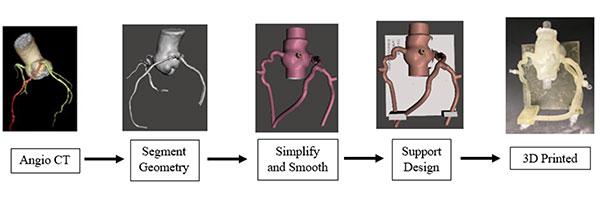
Credit: The authors
BELLINGHAM, Washington, USA and CARDIFF, UK – In an article published in SPIE’s Journal of Medical Imaging (JMI), researchers announce critical advances in the use of 3D-printed coronary phantoms with diagnostic software, further developing a non-invasive diagnostic method for Coronary Artery Disease (CAD) risk assessment.
Physicians already use the non-invasive methods of Computer Tomography-Fractional Flow Reserve (CT-FFR) diagnostic software to characterize blood flow in order to assess the risk of CAD. CT-FFR uses CT images of the heart in combination with computational methods to estimate blood flow conditions in the arteries. One key shortcoming of CT-FFR lies in validating the CT-FFR diagnostic software which requires large clinical trials with ground truth. The phantom models discussed in this new paper replicate vasculature from real patients, allowing for physiological testing of actual blood flow with the provision of elastic properties, and can be used to efficiently validate CT-FFR software.
The research, delineated in the open-access article, “Initial evaluation of 3D printed patient-specific coronary phantoms for CT-FFR software validation,” demonstrates the utilization of coronary phantoms to accurately assess intermediate-risk patients’ Fractional Flow Reserve (FFR), the measurement that determines CAD severity. The research also expands on the current applications of 3D printing to further develop cardiac phantoms with structures closely mimicking patient anatomies, allowing for accurate CT imaging of coronary flow.
In this study, CT scans of these phantom cardiac models were accurate to within 1mm diameter of the actual patients’ hearts, and the research team expects that accuracy to increase as the resolution of CT scanners and 3D printers improve.
“This exceptional paper highlights an important step forward in the use of 3D-printing of patient-specific coronary models and their contribution to assessing vasculature blood flow. It provides a critical requirement to validate the CT-FFR calculation using a phantom, thus enabling an efficient mechanism to ascertain the accuracy and reliability of CT-FFR estimation methods. This lends a strong support to the ongoing paradigm shift in CAD risk assessment via CT-FFR,” says Dr. Ehsan Samei, JMI Associate Editor, SPIE Fellow, and Professor of Radiology at Duke University.
As acknowledged in the paper, this work is a continuation of research presented at the 2018 SPIE Medical Imaging conference – and published in the conference – proceedings entitled “CT investigation of patient-specific phantoms with coronary artery disease.”
###
The article authors are Lauren M. Shepard and Kelsey N. Sommer of the University Department of Biomedical Engineering, University at Buffalo, Buffalo, NY, and the Canon Stroke and Vascular Research Center, Buffalo, NY; Erin Angel of Canon Medical Systems USA, Tustin, CA; Vijay Iyer and Michael F. Wilson of Interventional Cardiology, University at Buffalo Medicine, UBMD, Buffalo, NY; Frank J. Rybicki and Dimitrios Mitsouras of the Ottawa Hospital Research Institute and the Department of Radiology, University of Ottawa, Ottawa, Ontario, Canada; Sabee Molloi of the University Department of Radiological Sciences, University of California, Irvine, Irvine, CA; and Ciprian N. Ionita, University Department of Biomedical Engineering, University at Buffalo, Canon Stroke and Vascular Research Center, Buffalo, University Department of Radiological Sciences, University of California, Irvine, and University Department of Neurosurgery, University of Buffalo.
Maryellen L. Giger, an SPIE Fellow and A.N. Pritzker Professor of Radiology/Medical Physics at the University of Chicago, is the editor-in-chief of the Journal of Medical Imaging. The journal is published in print and digitally by SPIE in the SPIE Digital Library, which contains more than 500,000 publications from SPIE journals, proceedings, and books, with approximately 18,000 new research papers added each year.
About SPIE
SPIE is the international society for optics and photonics, an educational not-for-profit organization founded in 1955 to advance light-based science, engineering, and technology. The Society serves 257,000 constituents from 173 countries, offering conferences and their published proceedings, continuing education, books, journals, and the SPIE Digital Library. In 2018, SPIE provided more than $4 million in community support including scholarships and awards, outreach and advocacy programs, travel grants, public policy, and educational resources. http://www.
Contact:
Daneet Steffens
Public Relations Manager
[email protected]
+1 360 685 5478
@SPIEtweets
Media Contact
Daneet Steffens
[email protected]
Related Journal Article
http://dx.