• HOME
  • NEWS
  • EXPLORE
    • CAREER
      • Companies
      • Jobs
    • EVENTS
    • iGEM
      • News
      • Team
    • PHOTOS
    • VIDEO
    • WIKI
  • BLOG
  • COMMUNITY
    • FACEBOOK
    • INSTAGRAM
    • TWITTER
Friday, March 27, 2026
BIOENGINEER.ORG
No Result
View All Result
  • Login
  • HOME
  • NEWS
  • EXPLORE
    • CAREER
      • Companies
      • Jobs
        • Lecturer
        • PhD Studentship
        • Postdoc
        • Research Assistant
    • EVENTS
    • iGEM
      • News
      • Team
    • PHOTOS
    • VIDEO
    • WIKI
  • BLOG
  • COMMUNITY
    • FACEBOOK
    • INSTAGRAM
    • TWITTER
  • HOME
  • NEWS
  • EXPLORE
    • CAREER
      • Companies
      • Jobs
        • Lecturer
        • PhD Studentship
        • Postdoc
        • Research Assistant
    • EVENTS
    • iGEM
      • News
      • Team
    • PHOTOS
    • VIDEO
    • WIKI
  • BLOG
  • COMMUNITY
    • FACEBOOK
    • INSTAGRAM
    • TWITTER
No Result
View All Result
Bioengineer.org
No Result
View All Result
Home NEWS Science News Biology

Teenage T. rex was already chomping on prey, new UW Oshkosh research shows

Bioengineer by Bioengineer
March 11, 2019
in Biology
Reading Time: 2 mins read
0
IMAGE
Share on FacebookShare on TwitterShare on LinkedinShare on RedditShare on Telegram

IMAGE

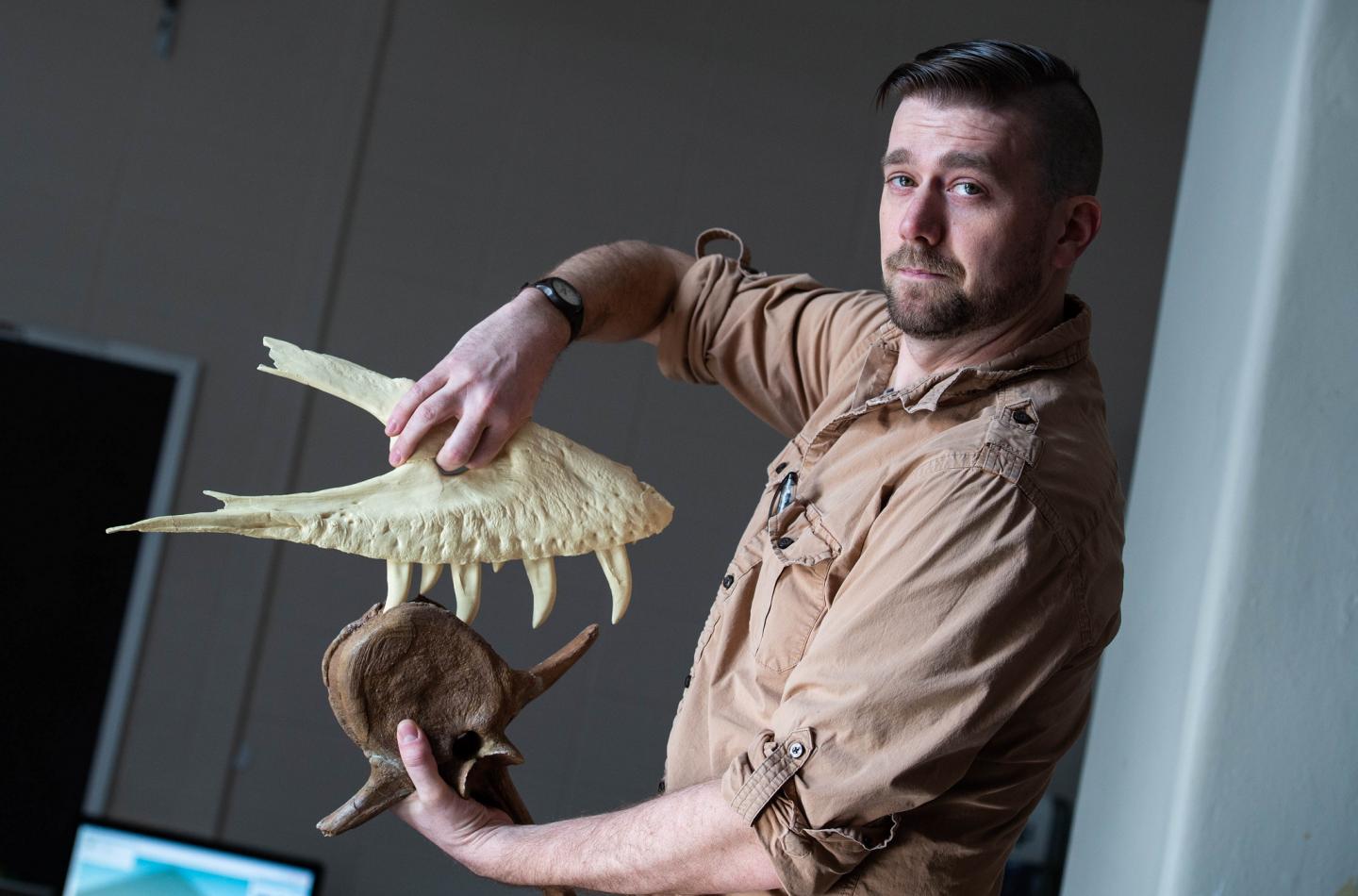
Credit: Patrick Flood, UW Oshkosh

New research from the University of Wisconsin Oshkosh indicates that even as a teenager the Tyrannosaurus rex showed signs that it would grow up to be a ferocious predator.

In a study published last week in the peer-reviewed journal Peerj–the Journal of Life and Environmental Sciences, UWO scientists reported evidence that a juvenile T. rex fed on a large plant-eating dinosaur, even though it lacked the bone-crushing abilities it would develop as an adult.

While studying fossils from an Edmontosaurus–a plant-eating Hadrosaurid or duck-billed dinosaur, UWO vertebrate paleontologist Joseph Peterson noticed three large, v-shaped, bite marks on a tail bone and wondered, “Who made these?”

Peterson knew that T. rex–a member of the meat-eating dinosaur suborder known as Theropoda–was “a likely culprit.”

“We suspected that T. rex was responsible for the bit marks, because in the upper Cretaceous rock formation, where the hadrosaur was discovered, there are only a few carnivorous dinosaurs and other reptiles in the fossil record. Crocodile fossils are found there, but such a crocodile would have left tooth marks that are round rather than the elliptical punctures we found on the vertebra,” Peterson explained.

“There also were small Velociraptor-like dinosaurs, but their teeth are too small to have made the marks. Finally, an adult T. rex would have made punctures that would have been too large! That’s when we started considering a juvenile tyrannosaur.”

To test the hypothesis, Peterson and geology student Karsen Daus, of Suamico, coated the fossil with a silicon rubber to make a silicone peel of the puncture marks.

They found that the dimensions of the “teeth” better matched a late-stage juvenile T. rex (11 to 12 years) than an adult (approximately 30 years).

“Although this T. rex was young, it really packed a punch,” Peterson said.

“This is significant to paleontology because it demonstrates how T. rex–the most popular dinosaur of all time–may have developed changes in diet and feeding abilities while growing,” he said. “This is part of a larger, ongoing research initiative by many paleontologists to better understand how T. rex grew and functioned as a living creature over 65 million years ago.”

Most theropod feeding traces and bite marks are attributed to adults; juvenile tooth marks rarely have been reported in the literature, he added.

“We really are in the ‘Golden Age’ of paleontology,” Peterson said. “We are learning more now than we ever thought we would know about dinosaurs. And, we’re learn more about how they grew up.”

###

Media Contact
Natalie Johnson
[email protected]

Original Source

https://uwosh.edu/today/72806/teenage-t-rex-was-already-chomping-on-prey-new-uwo-research-shows/

Related Journal Article

http://dx.doi.org/10.7717/peerj.6573

Tags: ArchaeologyBiologyEvolutionPaleontology
Share12Tweet8Share2ShareShareShare2

Related Posts

How to sway group opinions: Encourage opponents to stay undecided

How to sway group opinions: Encourage opponents to stay undecided

March 23, 2026
Deep Learning Model Maps How Individual Cells Shape Disease Outcomes

Deep Learning Model Maps How Individual Cells Shape Disease Outcomes

March 20, 2026

Removing only 15 female sharks annually could endanger the entire population, scientists warn

March 20, 2026

Scientists Urge Fragrance Industry to Transition from Sustainability Talk to Active Funding of Plant Conservation

March 20, 2026
Please login to join discussion

POPULAR NEWS

  • blank

    Revolutionary AI Model Enhances Precision in Detecting Food Contamination

    96 shares
    Share 38 Tweet 24
  • Imagine a Social Media Feed That Challenges Your Views Instead of Reinforcing Them

    1003 shares
    Share 397 Tweet 248
  • Uncovering Functions of Cavernous Malformation Proteins in Organoids

    54 shares
    Share 22 Tweet 14
  • Promising Outcomes from First Clinical Trials of Gene Regulation in Epilepsy

    51 shares
    Share 20 Tweet 13

About

We bring you the latest biotechnology news from best research centers and universities around the world. Check our website.

Follow us

Recent News

In-Sensor Cryptography Links Physical Process to Digital Identity

Can Psychosocial Factors Influence Cancer Risk?

Depression Factors in Elderly: Pre vs. Post-COVID Analysis

Subscribe to Blog via Email

Success! An email was just sent to confirm your subscription. Please find the email now and click 'Confirm' to start subscribing.

Join 78 other subscribers
  • Contact Us

Bioengineer.org © Copyright 2023 All Rights Reserved.

Welcome Back!

Login to your account below

Forgotten Password?

Retrieve your password

Please enter your username or email address to reset your password.

Log In
No Result
View All Result
  • Homepages
    • Home Page 1
    • Home Page 2
  • News
  • National
  • Business
  • Health
  • Lifestyle
  • Science

Bioengineer.org © Copyright 2023 All Rights Reserved.