• HOME
  • NEWS
  • EXPLORE
    • CAREER
      • Companies
      • Jobs
    • EVENTS
    • iGEM
      • News
      • Team
    • PHOTOS
    • VIDEO
    • WIKI
  • BLOG
  • COMMUNITY
    • FACEBOOK
    • INSTAGRAM
    • TWITTER
Monday, May 11, 2026
BIOENGINEER.ORG
No Result
View All Result
  • Login
  • HOME
  • NEWS
  • EXPLORE
    • CAREER
      • Companies
      • Jobs
        • Lecturer
        • PhD Studentship
        • Postdoc
        • Research Assistant
    • EVENTS
    • iGEM
      • News
      • Team
    • PHOTOS
    • VIDEO
    • WIKI
  • BLOG
  • COMMUNITY
    • FACEBOOK
    • INSTAGRAM
    • TWITTER
  • HOME
  • NEWS
  • EXPLORE
    • CAREER
      • Companies
      • Jobs
        • Lecturer
        • PhD Studentship
        • Postdoc
        • Research Assistant
    • EVENTS
    • iGEM
      • News
      • Team
    • PHOTOS
    • VIDEO
    • WIKI
  • BLOG
  • COMMUNITY
    • FACEBOOK
    • INSTAGRAM
    • TWITTER
No Result
View All Result
Bioengineer.org
No Result
View All Result
Home NEWS Science News Biology

The fiddlers influencing mangrove ecosystems

Bioengineer by Bioengineer
March 11, 2019
in Biology
Reading Time: 2 mins read
0
IMAGE
Share on FacebookShare on TwitterShare on LinkedinShare on RedditShare on Telegram

IMAGE

Credit: © 2019 Marco Fusi

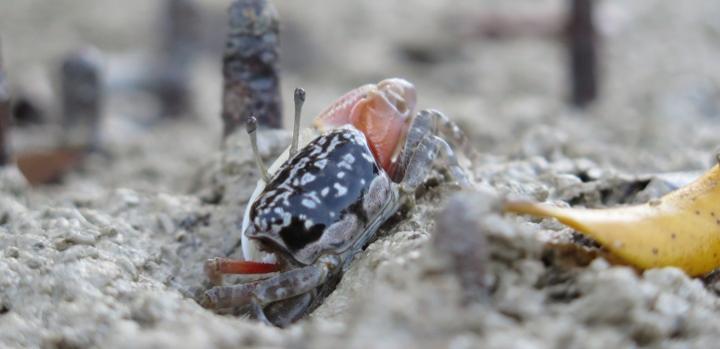
The types of bacteria present in and around mangrove fiddler crab burrows in three different geographic locations were compared by KAUST researchers. They found that the crabs’ burrowing activity changed the sediment in a way that attracted different types of bacteria across the three locations: however, the bacteria performed similar functions, such as aerobic respiration, and potential ecological services, such as turnover of organic matter.

“Mangrove crabs act like ecosystem engineers: Their burrows create radial, halo-like microbiological and geochemical modifications to the surrounding sediment compared with soil that has been left undisturbed,” says Jenny Booth, the first author of the study. “This effect was similar in all three locations, with the burrow-dwelling bacteria being taxonomically different but functionally similar,” she adds.

Microorganisms play important roles in driving global biochemical cycles, such as the nitrogen cycle, in which nitrogen–a building block of proteins and nucleic acids– circulates among the earth, the atmosphere and marine ecosystems.

Microbial ecologist Daniele Daffonchio and his team at KAUST’s Red Sea Research Center hypothesized that bacteria present within the same model system had similar functions, rather than similar taxonomy, even when these systems existed in very different local environmental conditions.

To test this, they sampled the sediment in and around the burrows created by mangrove-dwelling fiddler crabs in two locations on the Saudi Red Sea and a third in South Africa.

The researchers say their findings could be explained by the fact that burrowing leads to similar changes in the sediment regardless of location. Crabs typically bring sediment up from deeper layers onto the surface and vice versa. This sediment mixing changes the biochemical composition of the surrounding sediment, creating a hotspot of oxidative reactions and changing the types of bacteria living there. Burrow sediment, for example, has more bacteria that use oxygen for respiration, while the surrounding bulk soils have more bacteria that employ anaerobic respiration mechanisms. Sediment mixing also increases nutrient availability, and thus bacterial activity, within the burrow soils.

The researchers estimate that the halo-like ring of biochemical and microbial changes that extend a small distance around the fiddler crab burrows can influence up to 35 percent of mangrove sediment. In Kenyan mangroves, where burrow density is very high, this effect can influence almost 80 percent of the sediment.

“We predict that the bioturbation effect of crabs and similar burrowing species has a large overall impact on mangrove ecosystems by altering the nature of the sediment’s microbiome. These changes ultimately govern environmental processes, like carbon and nutrient fluxes, in this coastal ecosystem,” says Daffonchio.

###

Media Contact
Carmen Denman
[email protected]

Original Source

https://discovery.kaust.edu.sa/en/article/812/the-fiddlers-influencing-mangrove-ecosystems

Related Journal Article

http://dx.doi.org/10.1038/s41598-019-40315-0

Tags: BiodiversityBiologyClimate ChangeEcology/EnvironmentMarine/Freshwater BiologyMicrobiologyNutrition/NutrientsPlant Sciences
Share13Tweet8Share2ShareShareShare2

Related Posts

Transforming Jellyfish Bycatch into a Valuable Collagen Source for Cosmetics and Biotechnology — Biology

Transforming Jellyfish Bycatch into a Valuable Collagen Source for Cosmetics and Biotechnology

May 11, 2026
Ancient Plant Populations Reveal Fresh Insights into Climate Resilience — Biology

Ancient Plant Populations Reveal Fresh Insights into Climate Resilience

May 8, 2026

Rare Brain Disorders in Children Linked to Mutations in Lesser-Known Protein Complex

May 8, 2026

From Odd Insect to Underwater Predator: The Remarkable Evolution of a Bloodthirsty Fruit Fly

May 8, 2026
Please login to join discussion

POPULAR NEWS

  • Research Indicates Potential Connection Between Prenatal Medication Exposure and Elevated Autism Risk

    840 shares
    Share 336 Tweet 210
  • New Study Reveals Plants Can Detect the Sound of Rain

    728 shares
    Share 290 Tweet 182
  • Salmonella Haem Blocks Macrophages, Boosts Infection

    62 shares
    Share 25 Tweet 16
  • Breastmilk Balances E. coli and Beneficial Bacteria in Infant Gut Microbiomes

    57 shares
    Share 23 Tweet 14

About

We bring you the latest biotechnology news from best research centers and universities around the world. Check our website.

Follow us

Recent News

NELA, P-POSSUM, Muscle Index Predict Elderly Surgery Risk

PeroCycle Partners with Jindal Steel (Oman) to Pioneer Low-Carbon Steel Innovation

Widely Used Cholesterol Medication Could Disrupt Ovarian Cancer’s Stealth Defense

Subscribe to Blog via Email

Enter your email address to subscribe to this blog and receive notifications of new posts by email.

Join 82 other subscribers
  • Contact Us

Bioengineer.org © Copyright 2023 All Rights Reserved.

Welcome Back!

Login to your account below

Forgotten Password?

Retrieve your password

Please enter your username or email address to reset your password.

Log In
No Result
View All Result
  • Homepages
    • Home Page 1
    • Home Page 2
  • News
  • National
  • Business
  • Health
  • Lifestyle
  • Science

Bioengineer.org © Copyright 2023 All Rights Reserved.