• HOME
  • NEWS
  • EXPLORE
    • CAREER
      • Companies
      • Jobs
    • EVENTS
    • iGEM
      • News
      • Team
    • PHOTOS
    • VIDEO
    • WIKI
  • BLOG
  • COMMUNITY
    • FACEBOOK
    • INSTAGRAM
    • TWITTER
Saturday, February 7, 2026
BIOENGINEER.ORG
No Result
View All Result
  • Login
  • HOME
  • NEWS
  • EXPLORE
    • CAREER
      • Companies
      • Jobs
        • Lecturer
        • PhD Studentship
        • Postdoc
        • Research Assistant
    • EVENTS
    • iGEM
      • News
      • Team
    • PHOTOS
    • VIDEO
    • WIKI
  • BLOG
  • COMMUNITY
    • FACEBOOK
    • INSTAGRAM
    • TWITTER
  • HOME
  • NEWS
  • EXPLORE
    • CAREER
      • Companies
      • Jobs
        • Lecturer
        • PhD Studentship
        • Postdoc
        • Research Assistant
    • EVENTS
    • iGEM
      • News
      • Team
    • PHOTOS
    • VIDEO
    • WIKI
  • BLOG
  • COMMUNITY
    • FACEBOOK
    • INSTAGRAM
    • TWITTER
No Result
View All Result
Bioengineer.org
No Result
View All Result
Home NEWS Science News Health

Dental fillings could last twice as long

Bioengineer by Bioengineer
March 4, 2019
in Health
Reading Time: 2 mins read
0
IMAGE
Share on FacebookShare on TwitterShare on LinkedinShare on RedditShare on Telegram

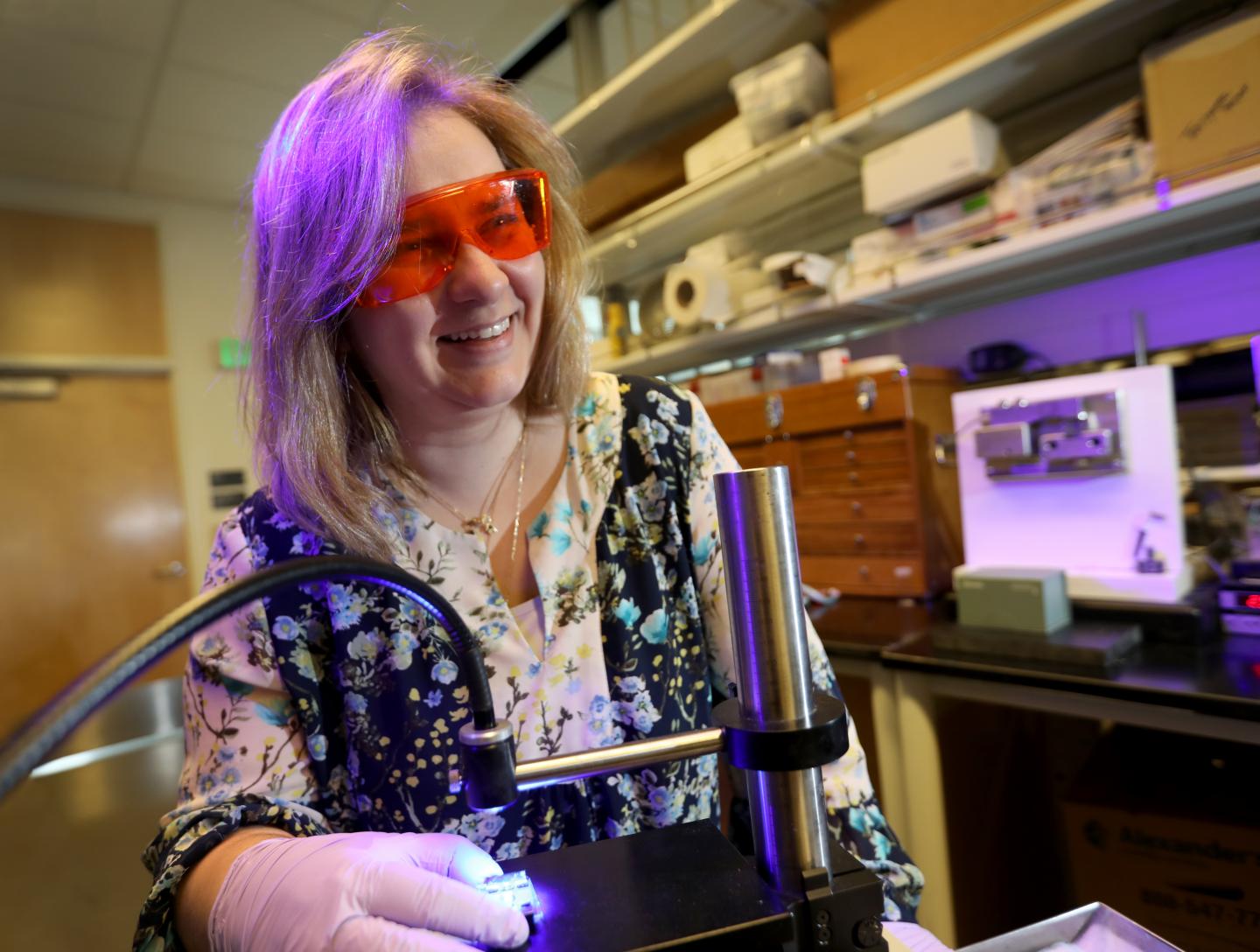
New material could mean fewer trips to the dentist’s office, OHSU scientist report
IMAGE

Credit: OHSU/Kristyna Wentz-Graff

A compound used to make car bumpers strong and protect wood decks could prevent return visits to the dentist’s office.

A team of researchers with the OHSU School of Dentistry in Portland, Oregon, have created a filling material that’s two times more resistant to breakage than standard fillings, according to a study published by the journal Scientific Reports. The new filling uses the additive thiourethane, which is also in protective coatings for cars and decks.

The team also has developed an adhesive that’s 30 percent stronger after six months in use than adhesives that are currently used to keep fillings in place. This new adhesive was described in a recent study published in the journal Dental Materials.

Combined, the new adhesive and the composite are designed to make longer-lasting dental restorations.

“Today’s dental restorations typically only last seven to 10 years before they fail,” said Carmem Pfeifer, D.D.S., Ph.D., corresponding author of the studies published in Scientific Reports and Dental Materials. Pfeifer is an associate professor of restorative dentistry (biomaterials and biomechanics) in the OHSU School of Dentistry.

“They crack under the pressure of chewing, or have gaps form between the filling and the tooth, which allow bacteria to seep in and a new cavity to form,” Pfeifer said. “Every time this happens, the tooth under the restorations becomes weaker and weaker, and what starts as a small cavity may end up with root canal damage, a lost tooth or even life-threatening infections.

“Stronger dental materials mean patients won’t have to get fillings repaired or replaced nearly as often,” she said. “This not only saves them money and hassle, but also prevents more serious problems and more extensive treatment.”

The adhesive described in the Dental Materials study uses a specific kind of polymer – known as (meth)acrylamides – that is much more resistant to damage in water, bacteria and enzymes in the mouth than standard adhesives currently used in dentistry. The composite material described in Scientific Reports uses thiourethane, which holds up much better to chewing.

###

Pfeifer and Jack Ferracane, Ph.D., chair and professor of restorative dentistry, led the materials’ development.

The study published in Dental Materials was supported by the National Institute of Dental and Craniofacial Research, grants K02 DE025280, R01 DE026113, and U01 DE023756. The study published in Scientific Reports was supported by NIDCR grants 1R15-DE023211-01A1, 1U01-DE02756-01 and K02 DE025280.

Media Contact
Erik Robinson
[email protected]

Original Source

https://news.ohsu.edu/2019/03/04/dental-fillings-could-last-twice-as-long

Tags: Dentistry/Periodontal DiseaseHealth CareMaterialsMedicine/HealthTechnology/Engineering/Computer Science
Share12Tweet8Share2ShareShareShare2

Related Posts

Inflammasome Protein ASC Drives Pancreatic Cancer Metabolism

February 7, 2026

Phage-Antibiotic Combo Beats Resistant Peritoneal Infection

February 7, 2026

Boosting Remote Healthcare: Stepped-Wedge Trial Insights

February 7, 2026

Barriers and Boosters of Seniors’ Physical Activity in Karachi

February 7, 2026
Please login to join discussion

POPULAR NEWS

  • Robotic Ureteral Reconstruction: A Novel Approach

    Robotic Ureteral Reconstruction: A Novel Approach

    82 shares
    Share 33 Tweet 21
  • Digital Privacy: Health Data Control in Incarceration

    63 shares
    Share 25 Tweet 16
  • Study Reveals Lipid Accumulation in ME/CFS Cells

    57 shares
    Share 23 Tweet 14
  • Breakthrough in RNA Research Accelerates Medical Innovations Timeline

    53 shares
    Share 21 Tweet 13

About

We bring you the latest biotechnology news from best research centers and universities around the world. Check our website.

Follow us

Recent News

Inflammasome Protein ASC Drives Pancreatic Cancer Metabolism

Phage-Antibiotic Combo Beats Resistant Peritoneal Infection

Boosting Remote Healthcare: Stepped-Wedge Trial Insights

Subscribe to Blog via Email

Enter your email address to subscribe to this blog and receive notifications of new posts by email.

Join 73 other subscribers
  • Contact Us

Bioengineer.org © Copyright 2023 All Rights Reserved.

Welcome Back!

Login to your account below

Forgotten Password?

Retrieve your password

Please enter your username or email address to reset your password.

Log In
No Result
View All Result
  • Homepages
    • Home Page 1
    • Home Page 2
  • News
  • National
  • Business
  • Health
  • Lifestyle
  • Science

Bioengineer.org © Copyright 2023 All Rights Reserved.