• HOME
  • NEWS
  • EXPLORE
    • CAREER
      • Companies
      • Jobs
    • EVENTS
    • iGEM
      • News
      • Team
    • PHOTOS
    • VIDEO
    • WIKI
  • BLOG
  • COMMUNITY
    • FACEBOOK
    • INSTAGRAM
    • TWITTER
Saturday, February 7, 2026
BIOENGINEER.ORG
No Result
View All Result
  • Login
  • HOME
  • NEWS
  • EXPLORE
    • CAREER
      • Companies
      • Jobs
        • Lecturer
        • PhD Studentship
        • Postdoc
        • Research Assistant
    • EVENTS
    • iGEM
      • News
      • Team
    • PHOTOS
    • VIDEO
    • WIKI
  • BLOG
  • COMMUNITY
    • FACEBOOK
    • INSTAGRAM
    • TWITTER
  • HOME
  • NEWS
  • EXPLORE
    • CAREER
      • Companies
      • Jobs
        • Lecturer
        • PhD Studentship
        • Postdoc
        • Research Assistant
    • EVENTS
    • iGEM
      • News
      • Team
    • PHOTOS
    • VIDEO
    • WIKI
  • BLOG
  • COMMUNITY
    • FACEBOOK
    • INSTAGRAM
    • TWITTER
No Result
View All Result
Bioengineer.org
No Result
View All Result
Home NEWS Science News Biology

Bristol undergraduate reconstructs the skulls of 2 species of ancient reptile

Bioengineer by Bioengineer
February 25, 2019
in Biology
Reading Time: 3 mins read
0
IMAGE
Share on FacebookShare on TwitterShare on LinkedinShare on RedditShare on Telegram

IMAGE

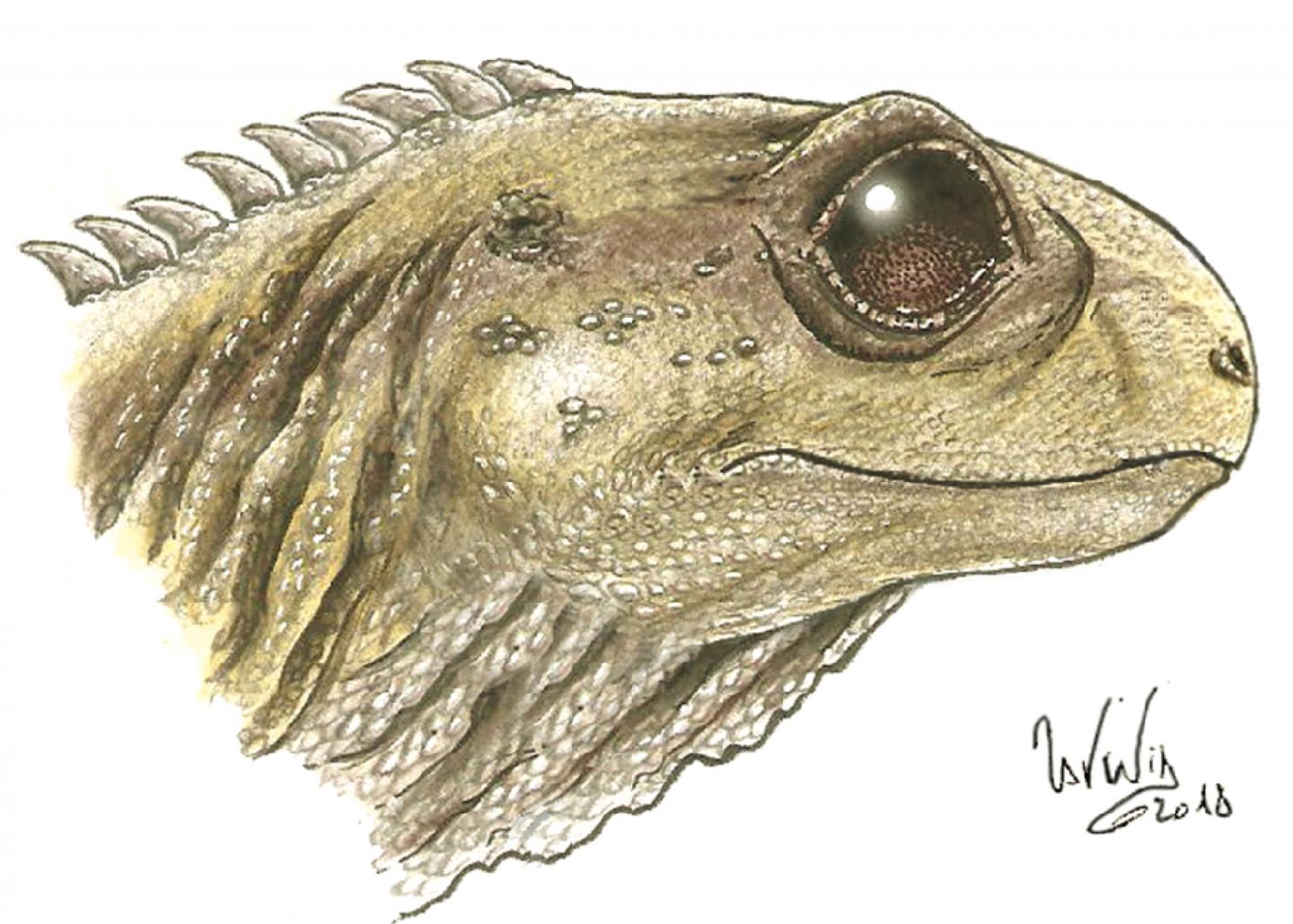
Credit: Image by Sophie Chambi-Trowell.

Using two partially fragmented fossil skulls, a student at the University of Bristol has digitally reconstructed, in three-dimensions, the skulls of two species of ancient reptile that lived in the Late Triassic, one of which had been previously known only from its jaws.

The research was completed by Sofia Chambi-Trowell, an undergraduate in Bristol’s School of Earth Sciences, as part of her final-year project for her degree in Palaeobiology.

Clevosaurus was a lizard-like reptile that was first named back in 1939 from specimens found at Cromhall Quarry, near Bristol.

Since then, similar beasts have been found elsewhere around Bristol and in South Wales, as well as in China and North America. Clevosaurus was an early representative of an ancient group of reptiles called Rhynchocephalia, which today is represent only by the tuatara of New Zealand.

In her project, Sofia worked on new fossils of Clevosaurus hudsoni, the first species to be named, and Clevosaurus cambrica, which was named from a quarry site in South Wales in 2018.

She used CT scans of both skulls to reconstruct their original appearance, and she found evidence that the two species, which lived at the same time in the Late Triassic, some 205 million years ago, showed significant differences.

Sofia said: “I found that Clevosaurus cambrica was smaller overall and had a narrower snout than Clevosaurus hudsoni.

“Other differences include the number, shape and size of the teeth in the jaws, suggesting the two species fed on different food.”

Clevosaurus probably ate insects. Clevosaurus cambrica has corkscrew-shaped teeth which suggests it was able to shred the insect carcass by the natural twist as it drove its teeth through the hard carapace.

Clevosaurus hudsoni had teeth more adapted for simply slicing the prey. This might suggest that Clevosaurus cambrica ate larger or harder-shelled insects like beetles or cockroaches, while Clevosaurus hudsoni ate worms or millipedes which were less tough.

Professor Mike Benton, one of Sofia’s project supervisors, added: “Sofia’s work is a great example of how modern technology like CT scanning can open up information we would not know about.

“It took a lot of work, but Sofia has uncovered a good explanation of how many species of Clevosaurus could live side by side without competing over food.”

Her other supervisor, Dr David Whiteside, said: “Two hundred million years ago, Bristol lay much further south than it does today – about the same latitude as Morocco.

“Also, sea level was higher, so the peaks of limestone hills south of Bristol and in South Wales were islands, like Florida today.

“They were full of dinosaurs, early mammals, and rhynchocephalians feeding on the rich, tropical plants and insects. Sofia’s work helps us understand so much about this extraordinary time when dinosaurs were just taking over the world.”

###

Media Contact
Mike Benton
[email protected]

Related Journal Article

http://dx.doi.org/10.4202/app.00569.2018

Tags: Earth ScienceEvolutionPaleontology
Share12Tweet8Share2ShareShareShare2

Related Posts

Florida Cane Toad: Complex Spread and Selective Evolution

Florida Cane Toad: Complex Spread and Selective Evolution

February 7, 2026
New Study Uncovers Mechanism Behind Burn Pit Particulate Matter–Induced Lung Inflammation

New Study Uncovers Mechanism Behind Burn Pit Particulate Matter–Induced Lung Inflammation

February 6, 2026

DeepBlastoid: Advancing Automated and Efficient Evaluation of Human Blastoids with Deep Learning

February 6, 2026

Navigating the Gut: The Role of Formic Acid in the Microbiome

February 6, 2026
Please login to join discussion

POPULAR NEWS

  • Robotic Ureteral Reconstruction: A Novel Approach

    Robotic Ureteral Reconstruction: A Novel Approach

    82 shares
    Share 33 Tweet 21
  • Digital Privacy: Health Data Control in Incarceration

    63 shares
    Share 25 Tweet 16
  • Study Reveals Lipid Accumulation in ME/CFS Cells

    57 shares
    Share 23 Tweet 14
  • Breakthrough in RNA Research Accelerates Medical Innovations Timeline

    53 shares
    Share 21 Tweet 13

About

We bring you the latest biotechnology news from best research centers and universities around the world. Check our website.

Follow us

Recent News

Evaluating Pediatric Emergency Care Quality in Ethiopia

TPMT Expression Predictions Linked to Azathioprine Side Effects

Improving Dementia Care with Enhanced Activity Kits

Subscribe to Blog via Email

Success! An email was just sent to confirm your subscription. Please find the email now and click 'Confirm' to start subscribing.

Join 73 other subscribers
  • Contact Us

Bioengineer.org © Copyright 2023 All Rights Reserved.

Welcome Back!

Login to your account below

Forgotten Password?

Retrieve your password

Please enter your username or email address to reset your password.

Log In
No Result
View All Result
  • Homepages
    • Home Page 1
    • Home Page 2
  • News
  • National
  • Business
  • Health
  • Lifestyle
  • Science

Bioengineer.org © Copyright 2023 All Rights Reserved.