• HOME
  • NEWS
  • EXPLORE
    • CAREER
      • Companies
      • Jobs
    • EVENTS
    • iGEM
      • News
      • Team
    • PHOTOS
    • VIDEO
    • WIKI
  • BLOG
  • COMMUNITY
    • FACEBOOK
    • INSTAGRAM
    • TWITTER
Monday, June 29, 2026
BIOENGINEER.ORG
No Result
View All Result
  • Login
  • HOME
  • NEWS
  • EXPLORE
    • CAREER
      • Companies
      • Jobs
        • Lecturer
        • PhD Studentship
        • Postdoc
        • Research Assistant
    • EVENTS
    • iGEM
      • News
      • Team
    • PHOTOS
    • VIDEO
    • WIKI
  • BLOG
  • COMMUNITY
    • FACEBOOK
    • INSTAGRAM
    • TWITTER
  • HOME
  • NEWS
  • EXPLORE
    • CAREER
      • Companies
      • Jobs
        • Lecturer
        • PhD Studentship
        • Postdoc
        • Research Assistant
    • EVENTS
    • iGEM
      • News
      • Team
    • PHOTOS
    • VIDEO
    • WIKI
  • BLOG
  • COMMUNITY
    • FACEBOOK
    • INSTAGRAM
    • TWITTER
No Result
View All Result
Bioengineer.org
No Result
View All Result
Home NEWS Science News Chemistry

3D printed stents that treat inflammation

Bioengineer by Bioengineer
November 10, 2020
in Chemistry
Reading Time: 2 mins read
0
IMAGE
Share on FacebookShare on TwitterShare on LinkedinShare on RedditShare on Telegram

IMAGE

Credit: Dong-Woo Cho (POSTECH)

Radiation esophagitis, characterized by the inflammation of the esophagus, is the most common acute adverse effect of radiation therapy that causes swallowing problems. This eventually causes dehydration and leaves the body unfit for further treatment. Unfortunately, no direct cure currently exists for patients suffering from such conditions. To this, a POSTECH research team has developed esophageal stents that biodegrade in the body using 3D printers, opening up the possibility of treating the condition.

A joint research team led by Professor Dong-Woo Cho and Ph.D. candidate Suhun Chae in the Department of Mechanical Engineering at POSTECH and Dr. Dong-Heon Ha of EDmicBio, Inc. has together produced biodegradable stents with esophageal-derived bioink to directly treat radiation esophagitis and verified their therapeutic effects in animal models. These research findings were recently published in Biomaterials, an academic journal with international authority in the biomaterials field.

Various treatment methods are being developed to treat cancer, but radiation therapy is still one of the common treatments along with surgery and chemotherapy. If radiation esophagitis occurs during radiation therapy, treatment is limited to cataclysmic therapy that relieves the pain depending on the symptoms that appear, or inserting a stent to open the swollen esophagus to allow drinking or eating. However, these methods do not treat the damaged tissues directly.

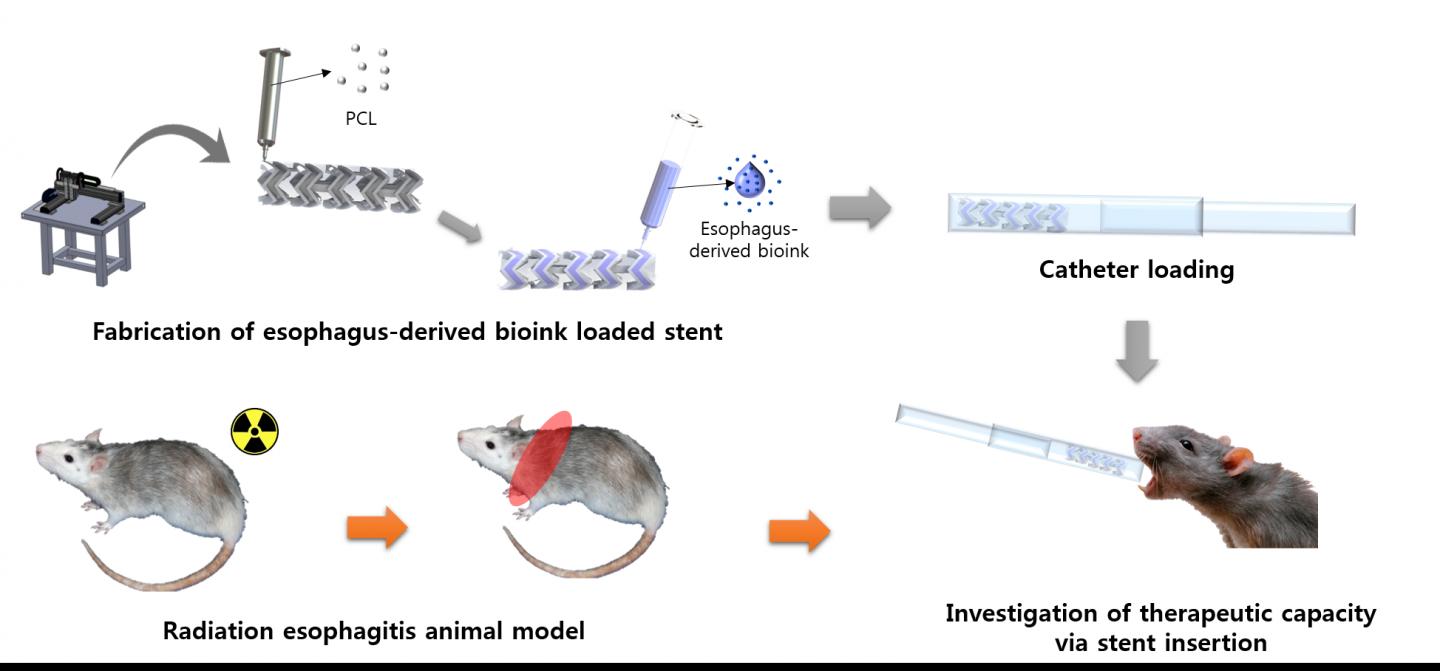
The research team first produced bioink that removed cell components from esophageal tissues and extracted only extracellular matrix through the decellularization process. They produced a dumbbell-type stent that can carry this bioink using a 3D printing system. By inserting this stent into the inflamed esophagus of an animal, they confirmed that it promotes tissue regeneration while mitigating inflammatory reactions.

“The effectiveness of treatment is negated if proper nutrition cannot be delivered due to the pain,” explained Dong-Woo Cho who led the study. He added, “If this esophageal stent implantation is applied clinically, we expect that the patients will have better prognosis and higher quality of life.”

This research was conducted as part of the Research Leader Program the National Research Foundation of Korea and in cooperation with EDmicBio, Inc. which specializes in commercializing 3D organs-on-chips and medical devices.

###

Media Contact
Jinyoung Huh
[email protected]

Original Source

http://www.postech.ac.kr/eng/3d-printed-stents-that-treat-inflammation/?pageds=1&k=&c=

Related Journal Article

http://dx.doi.org/10.1016/j.biomaterials.2020.120477

Tags: BiologyBiomechanics/BiophysicsBiomedical/Environmental/Chemical EngineeringBiotechnologyDevelopmental/Reproductive BiologyMedicine/HealthResearch/DevelopmentTechnology/Engineering/Computer Science
Share12Tweet8Share2ShareShareShare2

Related Posts

AI and Physics Collaborate to Design Advanced Hydrogen Storage Materials

June 25, 2026

International Team Including Dresden Scientists Develops Novel Designer Proteins for Advanced Study of Living Tissue

June 25, 2026

New Study Uncovers Key Factors Driving Water Chemistry in Nanoscale Environments

June 25, 2026

Plasma Technology Extends Catalyst Lifespan in Hydrogen Production

June 24, 2026
Please login to join discussion

POPULAR NEWS

  • Saying Goodbye to PGY-6: Pediatric Fellowship Realities

    103 shares
    Share 41 Tweet 26
  • Multi-Hospital Study Reveals Long Covid Burden Is Twice as High as Current Estimates

    92 shares
    Share 36 Tweet 23
  • Detection of EDCs in Breast Milk and Infant Urine Up to Six Months Highlights Early Exposure Risks

    77 shares
    Share 31 Tweet 19
  • New Drug Candidate Developed at McMaster Shows Potential for Treating Brain Cancer

    58 shares
    Share 23 Tweet 15

About

We bring you the latest biotechnology news from best research centers and universities around the world. Check our website.

Follow us

Recent News

Tracking Lanthanide-Labeled Microplastics in Plants

POSTECH Researchers Slash Cost of Reconstituted Cell-Free Systems by 95%

AI and Physics Collaborate to Design Advanced Hydrogen Storage Materials

Subscribe to Blog via Email

Success! An email was just sent to confirm your subscription. Please find the email now and click 'Confirm' to start subscribing.

Join 82 other subscribers
  • Contact Us

Bioengineer.org © Copyright 2023 All Rights Reserved.

Welcome Back!

Login to your account below

Forgotten Password?

Retrieve your password

Please enter your username or email address to reset your password.

Log In
No Result
View All Result
  • Homepages
    • Home Page 1
    • Home Page 2
  • News
  • National
  • Business
  • Health
  • Lifestyle
  • Science

Bioengineer.org © Copyright 2023 All Rights Reserved.