• HOME
  • NEWS
  • EXPLORE
    • CAREER
      • Companies
      • Jobs
    • EVENTS
    • iGEM
      • News
      • Team
    • PHOTOS
    • VIDEO
    • WIKI
  • BLOG
  • COMMUNITY
    • FACEBOOK
    • INSTAGRAM
    • TWITTER
Friday, June 26, 2026
BIOENGINEER.ORG
No Result
View All Result
  • Login
  • HOME
  • NEWS
  • EXPLORE
    • CAREER
      • Companies
      • Jobs
        • Lecturer
        • PhD Studentship
        • Postdoc
        • Research Assistant
    • EVENTS
    • iGEM
      • News
      • Team
    • PHOTOS
    • VIDEO
    • WIKI
  • BLOG
  • COMMUNITY
    • FACEBOOK
    • INSTAGRAM
    • TWITTER
  • HOME
  • NEWS
  • EXPLORE
    • CAREER
      • Companies
      • Jobs
        • Lecturer
        • PhD Studentship
        • Postdoc
        • Research Assistant
    • EVENTS
    • iGEM
      • News
      • Team
    • PHOTOS
    • VIDEO
    • WIKI
  • BLOG
  • COMMUNITY
    • FACEBOOK
    • INSTAGRAM
    • TWITTER
No Result
View All Result
Bioengineer.org
No Result
View All Result
Home NEWS Science News Chemistry

3D-printed device detects biomarkers of preterm birth

Bioengineer by Bioengineer
May 22, 2019
in Chemistry
Reading Time: 2 mins read
0
IMAGE
Share on FacebookShare on TwitterShare on LinkedinShare on RedditShare on Telegram

IMAGE

Credit: Adapted from Anal. Chem. 2019, DOI: 10.1021/acs.analchem.9b01395

Preterm birth (PTB) — defined as birth before the 37th week of gestation — is the leading complication of pregnancy. If doctors had a simple, accurate and inexpensive way to identify women at risk for the condition, they could develop better prevention strategies. Now researchers have created a 3D-printed microchip electrophoresis device that can sensitively detect three serum biomarkers of PTB. They report their results in ACS’ journal Analytical Chemistry.

According to the World Health Organization, PTB affects about 1 in 10 pregnancies worldwide. Preterm infants can suffer complications such as neurological, respiratory and cardiac problems and, in some cases, even death. Scientists have previously identified biomarker peptides and proteins in maternal serum that can fairly accurately predict PTB at 28 weeks of gestation. However, existing methods for detecting the biomarkers are laborious or not very sensitive. In prior research, Adam Woolley and colleagues used a 2D microfluidic device to separate PTB biomarkers by electrophoresis. But making these devices was slow, error-prone and costly. The process also required a clean room, caustic chemicals and highly trained personnel. Therefore, Woolley’s team wanted to develop a 3D-printed microchip device, which would be much simpler, faster and cheaper to make, for separating and detecting fluorescently labeled PTB biomarkers.

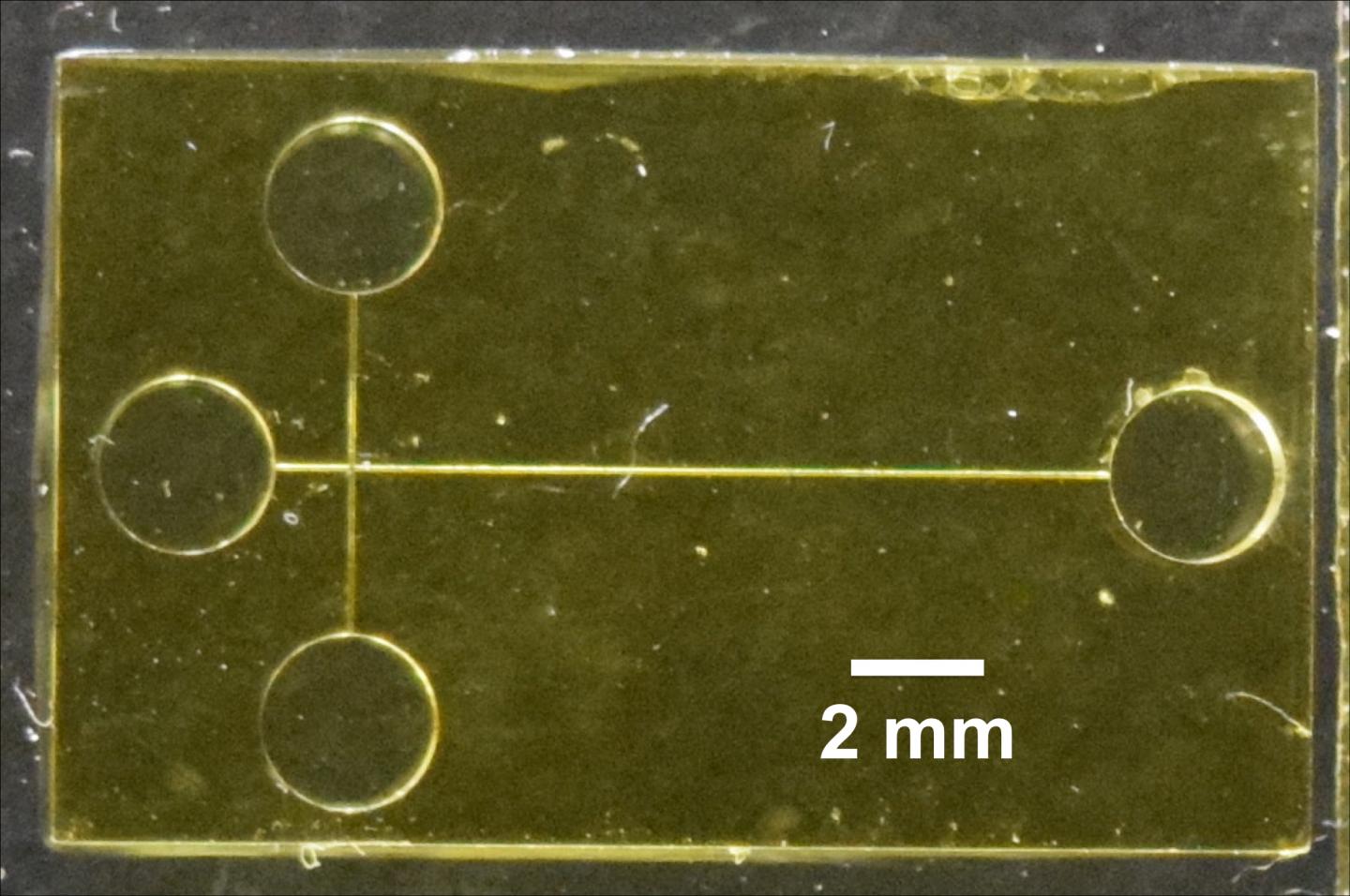
The researchers printed their device onto a glass slide using a 3D printer with a custom resin as the ink. To achieve the best separation of three peptide biomarkers by electrophoresis, they optimized the device design, as well as parameters such as applied voltages and buffer identity and composition. The 3D-printed microchip could detect the three PTB biomarkers in the picomolar to low nanomolar range, similar to their 2D microfluidic device. The researchers note that although these detection limits are still higher than the PTB risk levels for the biomarkers, they could increase the sensitivity by adding a component to the device that concentrates the peptides.

###

The authors acknowledge funding from the National Institutes of Health.

The abstract that accompanies this study is available here.

The American Chemical Society, the world’s largest scientific society, is a not-for-profit organization chartered by the U.S. Congress. ACS is a global leader in providing access to chemistry-related information and research through its multiple databases, peer-reviewed journals and scientific conferences. ACS does not conduct research, but publishes and publicizes peer-reviewed scientific studies. Its main offices are in Washington, D.C., and Columbus, Ohio.

To automatically receive news releases from the American Chemical Society, contact [email protected].

Follow us on Twitter | Facebook

Media Contact
Katie Cottingham
[email protected]

Related Journal Article

http://dx.doi.org/10.1021/acs.analchem.9b01395

Tags: BiologyBiomedical/Environmental/Chemical EngineeringBiotechnologyChemistry/Physics/Materials SciencesDevelopmental/Reproductive BiologyDiagnosticsMaterials
Share12Tweet8Share2ShareShareShare2

Related Posts

AI and Physics Collaborate to Design Advanced Hydrogen Storage Materials

June 25, 2026

International Team Including Dresden Scientists Develops Novel Designer Proteins for Advanced Study of Living Tissue

June 25, 2026

New Study Uncovers Key Factors Driving Water Chemistry in Nanoscale Environments

June 25, 2026

Plasma Technology Extends Catalyst Lifespan in Hydrogen Production

June 24, 2026
Please login to join discussion

POPULAR NEWS

  • Saying Goodbye to PGY-6: Pediatric Fellowship Realities

    103 shares
    Share 41 Tweet 26
  • Multi-Hospital Study Reveals Long Covid Burden Is Twice as High as Current Estimates

    92 shares
    Share 36 Tweet 23
  • Detection of EDCs in Breast Milk and Infant Urine Up to Six Months Highlights Early Exposure Risks

    77 shares
    Share 31 Tweet 19
  • New Drug Candidate Developed at McMaster Shows Potential for Treating Brain Cancer

    58 shares
    Share 23 Tweet 15

About

We bring you the latest biotechnology news from best research centers and universities around the world. Check our website.

Follow us

Recent News

Tracking Lanthanide-Labeled Microplastics in Plants

POSTECH Researchers Slash Cost of Reconstituted Cell-Free Systems by 95%

AI and Physics Collaborate to Design Advanced Hydrogen Storage Materials

Subscribe to Blog via Email

Success! An email was just sent to confirm your subscription. Please find the email now and click 'Confirm' to start subscribing.

Join 82 other subscribers
  • Contact Us

Bioengineer.org © Copyright 2023 All Rights Reserved.

Welcome Back!

Login to your account below

Forgotten Password?

Retrieve your password

Please enter your username or email address to reset your password.

Log In
No Result
View All Result
  • Homepages
    • Home Page 1
    • Home Page 2
  • News
  • National
  • Business
  • Health
  • Lifestyle
  • Science

Bioengineer.org © Copyright 2023 All Rights Reserved.