Oxygen is an essential element for animal survival. Ocean warming, circadian rhythm, eutrophication, high-density aquaculture, power failures and long-distance live animal transportation can all lead to low oxygen levels in water. This reduction in oxygen can affect the health of aquatic animals, potentially leading and consequent ecological damage or economic loss.
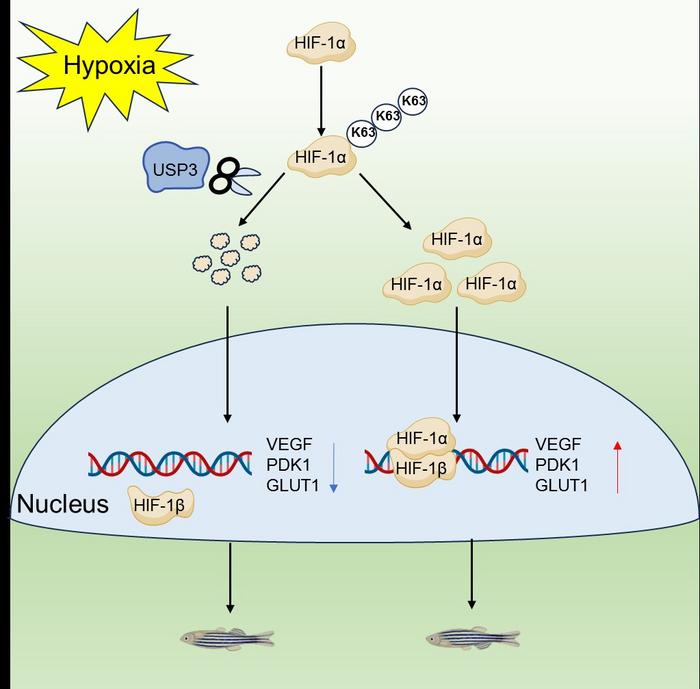
Credit: J. Li, et al.,
Oxygen is an essential element for animal survival. Ocean warming, circadian rhythm, eutrophication, high-density aquaculture, power failures and long-distance live animal transportation can all lead to low oxygen levels in water. This reduction in oxygen can affect the health of aquatic animals, potentially leading and consequent ecological damage or economic loss.
The concentration of dissolved oxygen in water significantly impacts the survival, development, growth and population structure of fish. It is a key environmental factor that determines the success of aquaculture. The hypoxia-inducible factor (HIF)-mediated hypoxia signaling pathway plays a pivotal part in influencing hypoxia (insufficient oxgen) adaptation and tolerance. Under hypoxic conditions, the activity of PHDs decreases, leading to the stabilization and accumulation of HIFα proteins. Stabilized HIFα proteins dimerize with HIF1β proteins, translocate to the nucleus, and induce transcription of genes involved in adaptation or tolerance to hypoxia. The factors that influence the hypoxia signaling pathway mainly affect the stability of the HIFα protein. Hence, identifying and analyzing the regulatory factors of hypoxia signaling pathway will help us understand the mechanism of hypoxia adaptation and hypoxia tolerance in fish.
Recently, a team of researchers in China found that the lack of deubiquitinases usp3 significantly enhanced the hypoxic capacity of zebrafish, and revealed the mechanism of usp3 through inhibiting the hypoxic signaling pathway and hypoxic tolerance in zebrafish.
“We found that the absence of ubiquitin-specific protease 3 (usp3) in zebrafish enhances hypoxia tolerance,” shares Wuhan Xiao, co-corresponding author of the study. “Specifically, zebrafish usp3 binds exclusively to HIF-1αa and triggers its proteasomal degradation, a process contingent upon its deubiquitinase activity. This mechanism results in the attenuation of hypoxia signaling during hypoxic conditions.”
Furthermore, usp3 facilitates the deubiquitination of K63-polyubiquitinated HIF-1αa. Endogenous evidence supports that mammalian USP3 mirrors the regulatory role of zebrafish USP3 in modulating the activity of HIF-1α.
The team’s findings, published in the KeAi journal Water Biology and Security, revealed a novel function for usp3 in influencing hypoxia signaling and showed that tusp3-mediated HIF-1α degradation impairs hypoxia signaling, leading to a decrease in hypoxia tolerance.
###
Contact the author: Jun Li & Jing Wang,Institute of Hydrobiology, Chinese Academy of Sciences, Wuhan, 430072, China, [email protected]; [email protected]
The publisher KeAi was established by Elsevier and China Science Publishing & Media Ltd to unfold quality research globally. In 2013, our focus shifted to open access publishing. We now proudly publish more than 100 world-class, open access, English language journals, spanning all scientific disciplines. Many of these are titles we publish in partnership with prestigious societies and academic institutions, such as the National Natural Science Foundation of China (NSFC).
Journal
Water Biology and Security
DOI
10.1016/j.watbs.2024.100245
Method of Research
Experimental study
Subject of Research
Animals
Article Title
Zebrafish usp3 loss promotes hypoxic tolerance by disrupting deubiquitination of K63-polyubiquitinated hif-1αa
COI Statement
The authors disclose no commercial or financial conflicting interests upon publication of this article. Wuhan Xiao is an editorial board member for Water Biology and Security and was not involved in the editorial review or the decision to publish this article.