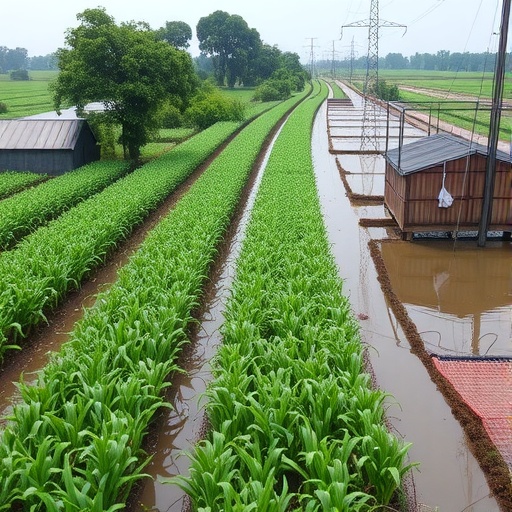
When floodwater swallows a rice paddy or a maize field, the crop does not die of drowning in any ordinary sense. It dies of suffocation. Oxygen dissolved in waterlogged soil can collapse to near zero within hours, and plant roots, starved of the gas they need to respire, begin to run out of energy long before shoots break the surface. A sweeping new review published in Plant Cell Reports by Afsana Praveen and Shilpy Singh of Noida International University in India assembles decades of research on how plants sense, survive and recover from flooding, and distills that knowledge into a blueprint for the flood-resilient crops that a destabilized climate is rapidly making necessary. The timing is pointed. Extreme rainfall and prolonged inundation are expected to intensify across many of the world’s cereal belts, and yield losses from waterlogging are already a prominent concern for rice, wheat, maize and legume farmers. Decoding how certain plants endure days or even weeks underwater, the authors argue, is now central to feeding a growing population on a warming planet.
The root of the problem lies in physics. Oxygen diffuses through water roughly ten thousand times more slowly than through air, so the moment soil pores flood, oxygen supply to buried tissues effectively collapses. Plants therefore experience submergence along a continuum of oxygen status, from normoxia through hypoxia to complete anoxia, and these states can shift across both time and space within a single root system. Deprived of oxygen, mitochondria can no longer oxidize sugars efficiently, ATP production plummets, and cells fall back on fermentation, a far less productive route to energy. Flooding also rewrites soil chemistry. Waterlogged ground turns reduced, accumulating soluble iron, sulfides and organic acids that are toxic in their own right, while carbon dioxide and ethylene build up around submerged organs. The review stresses that this combination of energy starvation, chemical toxicity and oxidative stress upon re-exposure to air explains why even brief floods devastate yields, and why tolerance demands coordinated responses spanning morphology, anatomy, physiology and metabolism rather than any single fix.
Remarkably, plants possess a dedicated first responder for this crisis: the gaseous hormone ethylene. Because ethylene diffuses slowly in water, it becomes trapped inside flooded tissues, accumulating within hours and acting as an internal signal that the plant is underwater. This entrapment converts a passive physical consequence of submergence into an active developmental cue. Ethylene signaling sets in motion nearly every adaptive strategy catalogued in the review: it promotes aerenchyma formation, stimulates adventitious root growth, drives hyponastic leaf movement and shoot elongation, and modulates the translation of hypoxia-response proteins through components such as EIN2 and GCN2. Cited studies show that ethylene can even pre-adapt plants before oxygen actually falls, allowing seedlings to brace for hypoxia before it arrives. Reduced ethylene sensitivity helps tomato maintain photosynthetic capacity during flooding, while in trembling aspen the hormone enhances root water transport through aquaporins. Ethylene, the authors conclude, is less a symptom of stress than the master switch of flooding survival, coordinating when plants should endure and when they should reach for air.
Downstream of ethylene sits one of the most elegant oxygen-sensing systems in biology: the group VII ethylene response factors, or ERF-VIIs. These transcription factors function as hypoxia-triggered switches. In well-aerated cells, a quality-control process known as the N-end rule pathway marks ERF-VIIs for immediate destruction, so they never accumulate. When oxygen drops, degradation stops, the proteins persist, enter the nucleus and switch on a battery of survival genes, among them pyruvate decarboxylase and alcohol dehydrogenase, the enzymatic heart of fermentative metabolism. Rice has co-opted this system spectacularly: SUB1A, a member of the ERF-VII family, underpins the celebrated SUB1 submergence-tolerance trait, restraining elongation growth so that seedlings conserve carbohydrates until floodwater recedes. Recent work highlighted in the review adds further layers of control, including the calcium-dependent protein kinase CPK12, which moves into the nucleus and phosphorylates ERF-VIIs to sharpen hypoxia sensing, and RBOH-type NADPH oxidases that shape reactive oxygen signaling during low-oxygen stress. The authors compile ERF-VII knowledge across major crops, positioning these factors as prime targets for engineering broad-spectrum flood tolerance.
At the very start of the life cycle, flooding poses a distinct threat: a germinating seed submerged in a paddy must sprout with almost no oxygen. Rice, uniquely among cereals, has evolved anaerobic germination, pushing out a coleoptile that stretches toward the water surface powered solely by fermentative energy. The review details the genetic architecture behind this trait, including the AG1 and AG2 quantitative trait loci and the trehalose-6-phosphate phosphatase gene OsTPP7, which boosts tolerance by mobilizing starch reserves to fuel coleoptile elongation. Genome-wide association studies across diverse rice collections continue to uncover fresh loci, and epigenetic pathways have been tied to anaerobic seedling establishment. The payoffs are practical. Varieties that germinate underwater enable direct seeding of rice, a practice that saves labor and irrigation water while suppressing weeds, and interactions between the SUB1 and anaerobic germination loci shape how seedlings fare when established underwater. Carbohydrate management under alternating light and darkness, along with auxin’s contribution to germination tolerance, illustrates how finely tuned this earliest phase of flood resilience has become.
Survival underwater also demands architectural renovation, and the review devotes sustained attention to aerenchyma, the spongy networks of gas-filled space carved into roots and stems through programmed cell death of cortical cells. Formed by lysigenous or schizo-lysigenous mechanisms, aerenchyma lowers the resistance to oxygen diffusion and creates internal conduits that channel air from aerated shoots down to drowned roots. Its construction is orchestrated by ethylene, reactive oxygen species, nitric oxide and RBOH-derived signals, with cell-wall-remodeling enzymes executing the demolition. Complementing these internal channels, many species sprout adventitious roots from stem nodes; in deepwater rice, aquatic adventitious roots can even extract oxygen directly from floodwater, sustaining growth through prolonged submergence. A third anatomical weapon is the barrier to radial oxygen loss: suberized and lignified layers in the outer root cortex act as a fence that keeps precious oxygen from leaking back into the anoxic soil. Experiments show that even low concentrations of organic acids, or sulfides in the rhizosphere, can trigger this barrier in rice roots.
Underneath the morphology lies a metabolic emergency plan. With oxygen scarce, pyruvate is diverted from mitochondrial respiration into fermentation: pyruvate decarboxylase and alcohol dehydrogenase convert sugars to ethanol while regenerating the NAD+ needed to keep glycolysis running, and lactate dehydrogenase helps manage cytosolic acidification. Overexpressing the lactate dehydrogenase gene OsLdh7 in rice improves submergence tolerance by tuning anaerobic glycolysis, ethanolic fermentation and amino acid metabolism, while mutants defective in starch mobilization fail to induce hypoxia genes properly, underlining that carbohydrate supply is non-negotiable. The review also spotlights nitric oxide, whose behavior at low oxygen is paradoxical. Through the phytoglobin–nitric oxide cycle, plant hemoglobins scavenge the gas and help sustain ATP production under anoxia, while nitrite can serve as an alternative electron acceptor in mitochondria. Ethylene-mediated depletion of nitric oxide pre-adapts Arabidopsis to hypoxia, and the alternative oxidase links nitric oxide turnover to redox balance. Selenium seed priming, chemical priming and nanomaterial-delivered nitric oxide donors are emerging as experimental routes to bolster these defenses in the field.
For some plants the winning strategy is not endurance but escape. Submerged rosette plants such as Rumex palustris execute hyponastic growth, curving their leaves upward while petioles elongate rapidly through ethylene- and auxin-driven apoplastic acidification and expansin activity, lifting foliage back toward light and air. Deepwater rice performs the same logic at scale: internodes elongate dramatically in a snorkeling response, and hydrophobic leaf gas films, conferred by wax-synthesis genes such as LGF1, preserve a thin layer of air against the leaf surface that sustains gas exchange under water. Noninvasive imaging has revealed how partial-pressure gradients drive long-distance gas movement through aerenchyma from the leaf blade down to submerged organs. The review frames escape and quiescence as antithetical but complementary strategies: genotype and flood regime determine which is fitter, since quiescence conserves resources during short flash floods while escape suits prolonged, shallow inundation. Misreading the environment carries a cost, because traits tuned for one type of flooding can backfire badly under another.
Those nuances carry weighty consequences for agriculture. The SUB1 gene has been successfully introgressed into popular rice varieties such as Swarna, protecting millions of hectares from flash floods, yet the review highlights evidence that SUB1 introgression can aggravate susceptibility to stagnant, medium-depth flooding in certain genetic backgrounds, a reminder that tolerance traits must be matched to the hydrological reality of a given region. Breeders are responding by pyramiding multiple traits, combining submergence quiescence with the aeration traits needed for stagnant water, favorable root architecture and anaerobic germination to build layered resilience. Beyond marker-assisted selection, the review surveys an expanding toolkit: waterlogging priming that hardens wheat offspring to hypoxia, silicon application that fortifies rice against submergence, beneficial fungi that modulate ethylene metabolism in maize, and nitric oxide donors delivered through nanomaterials. Proteomic and transcriptomic studies across soybean, sweet potato, mulberry, banana, watermelon, grapevine and lotus are mapping conserved and species-specific flood responses, handing breeders a growing catalogue of candidate genes and regulatory networks for crops facing ever more erratic water regimes.
The authors close by charting where the field must go next. They call for integrated multi-omics studies connecting oxygen sensing to metabolism at fine anatomical resolution, better field phenotyping to bridge the gap between controlled hypoxia experiments and the mud and variability of real paddies, and deeper exploration of the crosstalk among ethylene, nitric oxide, reactive oxygen species and calcium signaling. Unresolved questions abound: how ERF-VII networks differ among crops, how phytoglobins and the alternative oxidase can be exploited to maintain energy under anoxia, and how flooding tolerance can be stacked with salinity and heat resilience, since floods rarely arrive alone. What the review makes unmistakably clear is that flooding tolerance is not a single trait but a symphony, an interplay of gas-diffusion physics, oxygen-sensing switches, remodeled anatomy, rerouted metabolism and calibrated growth, all conducted by ethylene. As extreme weather intensifies, translating that symphony into the genomes of staple crops may determine whether agriculture can keep pace with a changing climate and a growing world.
Subject of Research: Flooding stress resilience mechanisms in plants, including oxygen sensing, aerenchyma formation, anaerobic germination, ethylene and nitric oxide signaling, and their application to breeding flood-tolerant crops
Subject of Research: Agriculture
Article Title: Flooding stress resilience and crop improvement
Article References: Praveen, A., & Singh, S. (2026). Flooding stress resilience and crop improvement. Plant Cell Reports, 45(9), Article 264. https://doi.org/10.1007/s00299-026-03941-3
Image Credits: AI Generated
DOI: 10.1007/s00299-026-03941-3
Keywords: Flooding, Anaerobic germination, Aerenchyma, Ethylene, Nitric oxide, Hypoxia, Waterlogging, Submergence tolerance, ERF-VII transcription factors, Resilience, Crop improvement
Cite Scienmag News
APA MLA Chicago
Alan Morgan. (August 30, 2026). Engineering Flood-Resilient Crops to Safeguard Global Food Security. Scienmag. https://scienmag.com/engineering-flood-resilient-crops-to-safeguard-global-food-security/
Alan Morgan. “Engineering Flood-Resilient Crops to Safeguard Global Food Security.” Scienmag, 30 August 2026, https://scienmag.com/engineering-flood-resilient-crops-to-safeguard-global-food-security/. Accessed 30 August 2026.
Alan Morgan. “Engineering Flood-Resilient Crops to Safeguard Global Food Security.” Scienmag. August 30, 2026. https://scienmag.com/engineering-flood-resilient-crops-to-safeguard-global-food-security/
Copy citation Download RIS
Tags: biological mechanisms of plant flood survivalbreeding flood-tolerant cereal cropsbreeding rice and maize for flood resilienceclimate change impact on agricultureclimate-adaptive agriculturecrop resilience to climate changecrop survival under prolonged inundationdevelopment of drought and flood-tolerant cropsFlood-resilient cropsfood security under extreme weathergenetic engineering for flood toleranceplant oxygen deprivation responseplant sensing mechanisms for floodingplant stress response to inundationrice and maize flood survival mechanismsroot respiration in flooded soilsroot respiration in waterlogged soilssoil oxygen diffusion in waterlogged conditionsstrategies for safeguarding global food securitywaterlogging stress tolerance in plantswaterlogging tolerance in plants