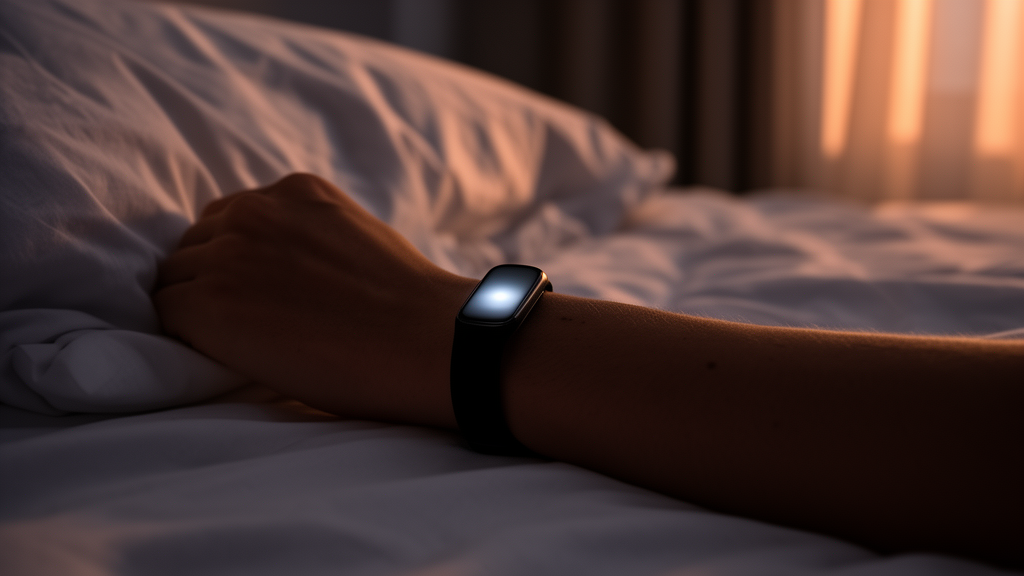
Sleep has long been measured in clinics with electrodes glued to the scalp, a technique that captures a night or two of rest in an artificial laboratory environment. Now, a large-scale study drawing on the UK Biobank has shown that the sleep we actually get at home, tracked quietly by a wrist-worn accelerometer, carries meaningful signals about future health. By applying a deep-learning algorithm to movement data from more than 95,000 middle-aged and older adults, researchers reconstructed real-world sleep architecture—down to individual stages such as rapid eye movement (REM) sleep and deep slow-wave sleep—and linked it to the subsequent onset of more than a thousand health outcomes. The results, published in PLOS Medicine, offer one of the most comprehensive maps yet of how the hidden structure of a night’s sleep relates to disease risk across the human body.
The research team, led by Jingsong Luo and colleagues, analyzed wrist accelerometer recordings from 95,559 UK Biobank participants. Rather than relying on questionnaires, which are notoriously prone to bias, or on polysomnography, which is expensive and impractical at scale, the investigators used an algorithm called SleepNet to infer sleep stages directly from the movement signals. From these data they derived several key metrics: the amount of time spent in REM sleep and in the N1, N2, and N3 non-REM stages; total sleep duration; sleep irregularity, a measure of how inconsistent bedtimes and wake times were from night to night; and wakefulness after sleep onset, or WASO, which quantifies how fragmented a night of sleep was by awakenings after the person first fell asleep.
Participants were followed from the date they wore the accelerometer until the first occurrence of disease, death, or the end of the follow-up period on April 1, 2024, with a median follow-up of 8.9 years. The researchers then performed a phenome-wide association analysis, a systematic sweep across 1,049 distinct health outcomes, using Cox proportional hazard regression models. These models adjusted for demographic characteristics, lifestyle factors, and environmental exposures, allowing the team to estimate whether sleep patterns independently predicted disease incidence. Restricted cubic spline analyses were layered on top to probe whether the relationships between sleep duration and disease were linear or followed more complex curves.
The headline finding is striking in its breadth: variations in real-world sleep patterns were associated with 156 incident diseases. The direction and specificity of these associations varied by sleep feature. Higher amounts of REM sleep were linked to lower risks of 83 diseases, making this dreaming stage the most broadly protective feature measured. Greater amounts of deep sleep, the N3 stage during which the brain and body undergo restorative processes, were associated with lower risks of 7 diseases. On the other side of the ledger, greater sleep irregularity was linked to elevated risks of 3 diseases, and increased wakefulness after sleep onset was tied to higher risks of 6 diseases.
Sleep duration told a more nuanced story. The restricted cubic spline analyses revealed significant non-linear relationships between sleep duration and 86 disease phenotypes, meaning that risk did not simply rise or fall in a straight line as sleep lengthened or shortened. Instead, for 69 of these phenotypes, the point of minimum risk clustered predominantly within a window of 6 to 8 hours of sleep per night. Below or above that window, risks tended to climb, a pattern consistent with the idea that both insufficient and excessive sleep may reflect or contribute to underlying physiological disturbance.
The most alarming signals came from the extreme short sleepers. Individuals who slept fewer than 5 hours per night accounted for 37 of the 41 significant adverse associations identified when compared with the 6-to-8-hour reference group. In other words, extreme short sleep was by far the most widespread clinical vulnerability in the dataset, associated with elevated risk across a broad range of conditions spanning multiple organ systems. This finding suggests that while moderate variation in sleep duration may carry modest consequences, severe sleep restriction stands out as a particularly potent marker of poor future health.
Technically, the study represents a milestone in what wearable devices can achieve. Traditional sleep staging requires polysomnography, in which electroencephalography, electrooculography, and electromyography electrodes record brain waves, eye movements, and muscle tone. SleepNet, by contrast, extracts stage information from a single accelerometer channel, using machine learning trained to recognize the movement signatures that distinguish REM sleep, lighter N1 and N2 stages, and deep N3 sleep. This makes it feasible to characterize sleep architecture in tens of thousands of people over multiple nights in their own homes, capturing habitual sleep rather than the one-off snapshots produced in sleep laboratories, where the unfamiliar setting itself can distort sleep—the so-called first-night effect.
The phenome-wide approach also matters for how the findings should be interpreted. Rather than testing a handful of preselected hypotheses, the researchers scanned the full spectrum of disease categories, which reduces the risk of cherry-picking favorable results and provides an atlas of associations that other scientists can mine for hypotheses. The differential pattern—REM sleep linked to dozens of protective associations, deep sleep to fewer, and fragmentation and irregularity to specific elevated risks—suggests that sleep stages are not interchangeable proxies for sleep quality. Each stage may reflect distinct neurobiological processes, from memory consolidation and emotional regulation during REM to glymphatic clearance and physical restoration during slow-wave sleep, with correspondingly distinct downstream health consequences.
As with any observational cohort, causality remains an open question. The authors note that the study’s main limitation is its observational design, which remains susceptible to residual confounding and precludes causal inference. People who sleep poorly may have undiagnosed illnesses, and reverse causation—disease processes disrupting sleep before diagnosis—cannot be excluded. Accelerometer-based sleep staging, while validated, is also an inference from movement rather than a direct measurement of brain activity, and it cannot capture every nuance of sleep physiology. Even so, the sheer scale of the cohort, the long follow-up, and the systematic adjustment for confounders make these associations difficult to dismiss as statistical noise.
The practical implications are nonetheless compelling. The findings underscore that maintaining 6 to 8 hours of sleep is associated with a more favorable sleep architecture and lower disease risk, offering actionable insight for prevention and health promotion. For clinicians, the study hints that sleep duration and quality could serve as accessible early-warning indicators, measurable with consumer-grade wearables already on millions of wrists. For the public, the message is refreshingly concrete: consistent, adequately long sleep—neither trimmed short by modern schedules nor stretched to extremes—appears to be one of the simplest daily behaviors with measurable ties to long-term health across the cardiovascular, metabolic, neurological, and other body systems. As wearable technology matures, the sleeping wrist may become a routine window into future disease risk, long before symptoms ever appear.
Subject of Research: Associations between accelerometer-derived real-world sleep stages, sleep duration, and incident disease risk in the UK Biobank cohort
Article Title: Accelerometer-derived real-world sleep stages and risk of incident diseases: A UK Biobank cohort study and phenome-wide association analysis
Article References: Luo, J., Liu, R., Yin, J., Cao, W., Sun, S., & Chen, R. (2026). Accelerometer-derived real-world sleep stages and risk of incident diseases: A UK Biobank cohort study and phenome-wide association analysis. PLOS Medicine, 23(9), e1005213. https://doi.org/10.1371/journal.pmed.1005213
Image Credits: AI Generated
DOI: 10.1371/journal.pmed.1005213
Keywords: sleep, UK Biobank, accelerometer, REM sleep, deep sleep, sleep duration, sleep irregularity, phenome-wide association study, disease risk, wearables, PLOS Medicine, cohort study
News Source: Blake Davidson. (October 9, 2026). Your Wrist Knows How You Sleep—and It Predicts Which Diseases You May Face. Scienmag.