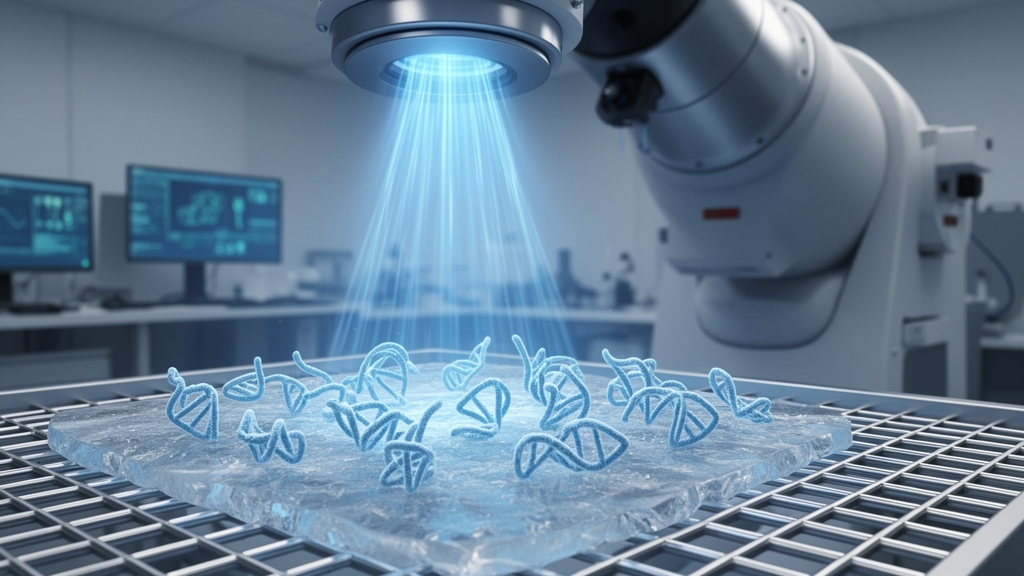
For decades, structural biologists have photographed RNA molecules the way a photographer might capture a dancer in a single frozen pose. X-ray crystallography and conventional cryo-electron microscopy average thousands or millions of particles into one consensus structure, while nuclear magnetic resonance infers motion indirectly through probabilistic models. Now a team at the United States National Cancer Institute has done something that had never been achieved before: they directly visualized, at near-atomic resolution, the full ensemble of shapes that a catalytic RNA adopts in solution, along with the magnesium ions that dance around it. The result, published in Nature, overturns the textbook picture of ribozymes as single static machines and replaces it with something far more dynamic and, arguably, more elegant.
The molecule in question is ribonuclease P, an ancient RNA enzyme found in essentially every living organism. Its job is to trim the precursor forms of transfer RNA, a maturation step so fundamental that life as we know it cannot proceed without it. In bacteria, the RNA component of RNase P carries the catalytic machinery, while a small protein called rnpA assists. The researchers focused on RNase P RNA from the thermophilic bacterium Geobacillus stearothermophilus, a 417-nucleotide molecule with a specificity domain and a catalytic domain. Previous work had shown that more than 80 percent of its residues remain flexible under physiological magnesium concentrations, but nobody had resolved what those motions actually looked like in structural terms.
The technical hurdle was formidable. Cryo-electron microscopy excels at rigid protein assemblies with large structural cores, but small, highly flexible RNA particles produce images with very low signal-to-noise ratios, making it nearly impossible to tell whether differences between particle images arise from different orientations or different conformations. To address this, the team built a simulation framework called EMCrafter, which generates realistic noise matched to experimental data profiles. Their simulations established a practical benchmark: at least 50,000 homogeneous particles are needed to obtain a three-dimensional volume at roughly 3 angstrom resolution for this RNA. That number gave the team a feasibility reference for tackling a conformational landscape containing dozens of coexisting states, many of them sparsely populated.
The analytical workflow they developed departs deliberately from the usual obsession with maximal resolution. Instead of pushing every particle toward a single best map, the protocol prioritizes capturing heterogeneity through four iterative steps: data processing, particle pruning, heterogeneity determination, and final three-dimensional refinement. Expectation-maximization classification with full solvent masks revealed broad variability across the entire particle volume, while focal masking on the rigid core allowed the researchers to sort particles by the poses of their flexible peripheries. Particle stacks that resisted discrete classification, presumably because of continuous motion, were handed to continuous-heterogeneity methods such as 3DFlex and three-dimensional variability analysis. The payoff was extraordinary: 55 distinct conformers of the RNA alone and 21 conformers of the RNA bound to rnpA, each resolved to a global resolution of around 3 angstroms, with the rigid core averaging better than 2.6 angstroms.
Superimposing these 76 volumes revealed a molecule in constant, coordinated motion. The peripheral helices P1, P19 and L15 in the catalytic domain, and P9, P10.1 and P12 in the specificity domain, swung through amplitudes as large as 30 angstroms. Crucially, the motion correlations derived from cryo-EM matched those from an entirely independent technique, atomic force microscopy combined with deep neural networks, with a Pearson correlation of 0.897. The two methods proved complementary: cryo-EM resolved dominant conformers with subtle correlated motions at near-atomic precision, while the AFM approach captured rarer, larger-amplitude states that get averaged out in electron microscopy. This cross-validation is a rare and reassuring example of two orthogonal structural methods converging on the same dynamical picture.
The most consequential finding concerns a transient tertiary interaction between a tetraloop and its receptor, involving helices P10.1 and P12. When this interaction is absent, the RNA adopts an open conformation in which a conserved structural element called the interdigitated T-loop motif folds into a quasi-helical, incorrect shape. When the tetraloop docks into its receptor, the closed state, the motif folds properly. Multivariate cluster analysis showed that only about 13 percent of the RNA-alone ensemble sits in the closed, active configuration. When rnpA binds, that fraction jumps to 43 percent. Mutations that disrupt the tetraloop-receptor contact nearly abolish catalytic activity, confirming that the closed ensemble represents the catalytically competent state. The team even captured a transient intermediate conformer in which the tetraloop contact had formed but the motif had not yet folded, suggesting the docking event precedes and nucleates the folding step.
Here is the twist that elevates the study from impressive structural biology to a conceptual shift: rnpA does not remodel the active site at all. The structurally invariant region encompassing both the catalytic center and the protein-binding site is essentially identical across all 76 conformers, superimposable with root-mean-square fluctuations below 0.6 angstrom, and nearly unchanged by protein binding. The catalytic magnesium ion, M1, chelated by phosphate oxygens of residues A50, A389 and A390, sits preformed and ready in every conformer, with positional fluctuations under 0.2 angstroms. In other words, the enzyme operates by conformational selection and population shift, not induced fit. The protein acts as a thermodynamic controller, tilting the equilibrium toward the active state without touching the chemistry itself. The researchers propose that rnpA, with its high isoelectric point, behaves like a polycation, displacing roughly eight magnesium ions at the binding interface and altering the electrostatic landscape in a way that propagates allosterically through long-range thermodynamic coupling.
Equally striking is the taxonomy of magnesium ions the study establishes. Across the ensembles, the team identified 2,147 ions in the apo state and 648 in the holo state, and sorted them into four behavioral classes. Static ions, present in every conformer with displacements under 1 angstrom, either anchor the catalytic geometry or stabilize pseudoknots, base stacks and kissing-loop motifs. Transient ions appear and disappear with conformer-dependent occupancy, clustering along an open channel that follows the expected transfer RNA substrate path, where they may stabilize intermediate charge distributions during catalysis. Hopping ions, whose existence had been predicted by molecular dynamics simulations but never directly observed, shuttle between adjacent coordination sites along a guanine-rich groove over distances of about 10 angstroms, redistributing charge without perturbing the structure. Companion ions move synchronously with their coordinating nucleotides, maintaining local rigidity within globally flexible regions, such as an ion that anchors a stacking interaction stabilizing the docking of P12 between P9 and P10.1.
The implications ripple outward. The classical dichotomy of inner-sphere versus outer-sphere, structural versus diffusive magnesium, gives way to a semi-quantitative framework in which root-mean-square fluctuation and appearance score become measurable parameters linking ion dynamics to function. Computational modelers may need to abandon fixed ion placements in favor of ensemble or trajectory-based representations. Drug designers gain a practical criterion: static, high-occupancy magnesium sites are potential druggable targets, whereas labile sites are not. More broadly, the study unifies lock-and-key recognition with conformational selection and extends population-shift allostery, a concept first developed for proteins, into the RNA world. Catalysis, in this view, is not a property of a single structure but an emergent property of an entire dynamic ensemble, regulated through multimodal communication between protein, RNA and metal ions. It is a view of molecular machinery that is less like a clockwork mechanism and more like a jazz ensemble, where the music depends on every player moving together.
Subject of Research: Structural dynamics of RNase P ribozyme catalysis and magnesium ion behavior resolved by heterogeneity-focused cryo-electron microscopy
Article Title: RNA catalysis emerges from dynamic structural ensembles
Article References: Degenhardt, M. F. S., Degenhardt, H. F., Bhoge, B. A., Lee, Y.-T., Yu, P., Zhang, J., Deme, J. C., Stagno, J. R., & Wang, Y.-X. (2026). RNA catalysis emerges from dynamic structural ensembles. Nature. https://doi.org/10.1038/s41586-026-11140-z
Image Credits: AI Generated
DOI: 10.1038/s41586-026-11140-z
Keywords: RNA catalysis, ribozyme, RNase P, cryo-electron microscopy, magnesium ions, conformational ensembles, allostery, structural biology, tRNA maturation, rnpA protein, conformational selection, molecular dynamics
News Source: Jason Bradley. (October 9, 2026). Cryo-EM Captures 76 RNA Shapes at Once, Rewriting How Ribozymes Work. Scienmag.