• HOME
  • NEWS
  • EXPLORE
    • CAREER
      • Companies
      • Jobs
    • EVENTS
    • iGEM
      • News
      • Team
    • PHOTOS
    • VIDEO
    • WIKI
  • BLOG
  • COMMUNITY
    • FACEBOOK
    • INSTAGRAM
    • TWITTER
Saturday, January 24, 2026
BIOENGINEER.ORG
No Result
View All Result
  • Login
  • HOME
  • NEWS
  • EXPLORE
    • CAREER
      • Companies
      • Jobs
        • Lecturer
        • PhD Studentship
        • Postdoc
        • Research Assistant
    • EVENTS
    • iGEM
      • News
      • Team
    • PHOTOS
    • VIDEO
    • WIKI
  • BLOG
  • COMMUNITY
    • FACEBOOK
    • INSTAGRAM
    • TWITTER
  • HOME
  • NEWS
  • EXPLORE
    • CAREER
      • Companies
      • Jobs
        • Lecturer
        • PhD Studentship
        • Postdoc
        • Research Assistant
    • EVENTS
    • iGEM
      • News
      • Team
    • PHOTOS
    • VIDEO
    • WIKI
  • BLOG
  • COMMUNITY
    • FACEBOOK
    • INSTAGRAM
    • TWITTER
No Result
View All Result
Bioengineer.org
No Result
View All Result
Home NEWS Science News Biology

You are “what you eat”, but you are not “where you live”

Bioengineer by Bioengineer
November 18, 2022
in Biology
Reading Time: 3 mins read
0
Geographical map of the six populations along the Silk Road investigated in the study
Share on FacebookShare on TwitterShare on LinkedinShare on RedditShare on Telegram

Genetic studies of the past 20 years have extensively shown how, across human populations worldwide, the majority of genetic differences are encountered at the individual rather than at the population level. Two random humans from a single group tend indeed to be more genetically different from each other than two different human populations on average.
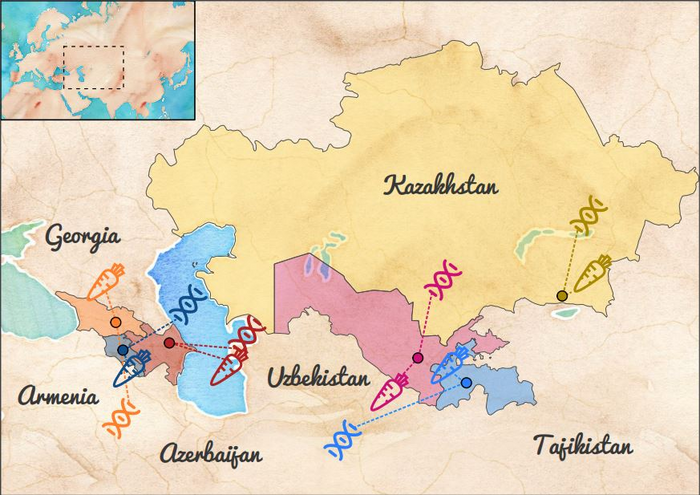
Geographical map of the six populations along the Silk Road investigated in the study

Credit: Serena Aneli

Genetic studies of the past 20 years have extensively shown how, across human populations worldwide, the majority of genetic differences are encountered at the individual rather than at the population level. Two random humans from a single group tend indeed to be more genetically different from each other than two different human populations on average.

Does this hold also when it comes to lifestyle and culture?

In a recently published article on PNAS from the Universities of Tartu, Turin, Trieste and Padova, the authors investigated the matter by taking dietary choices as a proxy for that and by examining food preferences over 79 different foods within six populations along the historical Silk Road route, spanning across the whole of Central Asia.
“We found that preference for certain foods was informative of the preference of other foods, or that, in other words, the food likings could be combined to assemble a discrete number of ‘food signatures’ ” said Prof. Luca Pagani, senior author of the study.

Strikingly, these signatures or profiles were not typical of a given village or country. The food signatures hence identified were instead linked with other features of the queried individuals such as age, biological sex and other cultural choices. Nevertheless, some exceptions were represented by certain foods available only in specific countries. Among them, some typical products from regional cuisines stand out, such as the Georgian brined cheese “sulguni” and “kurut”, dried yogurt balls from Central Asian nomads.

The amount of dietary information that the researchers could link to the country of origin was as little as 20%, which is big if compared with its genetic counterpart (1%) but still not sufficient to explain the observed patterns, despite the thousands of kilometers separating the investigated individuals.

As differences in genetic makeup and food preference between countries could be translated into “genetic” and “food” distances, these were plotted on a geographic map for comparison with the actual geographic distances between sampling locations. The emerging map showed culture to be only slightly more comparable to geography than genetics for the analysed groups (Figure 1), consistently with what emerged from the rest of the results.

“No matter where you live or where you were born, it turns out that your choices (at least as far as food consumption is concerned) are more dependent on your sex and age and on other cultural features” concluded Dr. Serena Aneli, the first author of the study.


Journal

Proceedings of the National Academy of Sciences

DOI

10.1073/pnas.2209311119

Method of Research

Data/statistical analysis

Subject of Research

People

Article Title

Impact of cultural and genetic structure on food choices along the Silk Road

Article Publication Date

14-Nov-2022

COI Statement

No conflict of interest to disclose

Share12Tweet8Share2ShareShareShare2

Related Posts

Comparative Study of Mandarin Fish: Brain, Gut, Microbes

Comparative Study of Mandarin Fish: Brain, Gut, Microbes

January 24, 2026
Plankton: Essential Pillars of Marine Ecosystem Biodiversity

Plankton: Essential Pillars of Marine Ecosystem Biodiversity

January 23, 2026

Diverse Calls Reveal Jackdaw Individuality and Variability

January 23, 2026

Sex-Specific Molecular Insights into Bladder Cancer Revealed

January 23, 2026

POPULAR NEWS

  • Enhancing Spiritual Care Education in Nursing Programs

    156 shares
    Share 62 Tweet 39
  • PTSD, Depression, Anxiety in Childhood Cancer Survivors, Parents

    148 shares
    Share 59 Tweet 37
  • Robotic Ureteral Reconstruction: A Novel Approach

    80 shares
    Share 32 Tweet 20
  • Digital Privacy: Health Data Control in Incarceration

    62 shares
    Share 25 Tweet 16

About

We bring you the latest biotechnology news from best research centers and universities around the world. Check our website.

Follow us

Recent News

Cyber Metasurfaces Enable Closed-Loop Electromagnetic Control

Eco-Friendly Agrochemicals: Embracing Green Nanotechnology

Coumarin-1,3,4-Oxadiazole Conjugates Target Alzheimer’s Disease

Subscribe to Blog via Email

Enter your email address to subscribe to this blog and receive notifications of new posts by email.

Join 71 other subscribers
  • Contact Us

Bioengineer.org © Copyright 2023 All Rights Reserved.

Welcome Back!

Login to your account below

Forgotten Password?

Retrieve your password

Please enter your username or email address to reset your password.

Log In
No Result
View All Result
  • Homepages
    • Home Page 1
    • Home Page 2
  • News
  • National
  • Business
  • Health
  • Lifestyle
  • Science

Bioengineer.org © Copyright 2023 All Rights Reserved.