Different types of barley recruit distinct communities of soil microbes to grow around their roots by releasing a custom mix of sugars and other compounds, according to a new study led by Jacob Malone of the John Innes Center, UK, publishing April 25th in the open-access journal PLOS Biology.
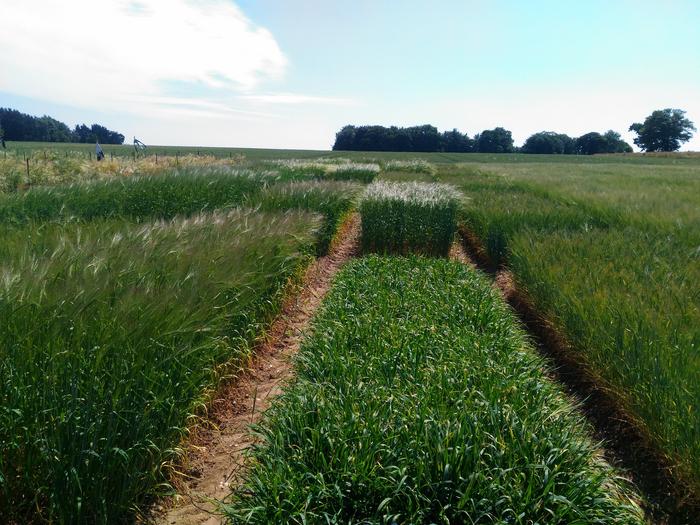
Credit: Alba Pacheco-Moreno (CC-BY 4.0, https://creativecommons.org/licenses/by/4.0/)
Different types of barley recruit distinct communities of soil microbes to grow around their roots by releasing a custom mix of sugars and other compounds, according to a new study led by Jacob Malone of the John Innes Center, UK, publishing April 25th in the open-access journal PLOS Biology.
Beneficial soil microbes that live on or around plant roots can provide nutrition, help the plant withstand stress and protect it from pathogenic microbes. In return, the plant secretes a portion of the sugars it makes through photosynthesis, along with amino acids and other metabolites, into the surrounding environment. The composition of soil microbes that a plant attracts can vary widely, depending on what kinds of compounds the plant provides.
In the new study, researchers took a closer look at the relationship between a plant’s genetics and its root microbes. They analyzed the microbiomes from two types of barley plants – a modern type named Tipple, and a traditional one, named Chevallier. The two barley types each had an overlapping core group of microbes associated with their roots, but with some distinct differences in the overall communities.
One common group of root microbes – the Pseudomonas genus – was especially abundant around Tipple roots. The researchers discovered that this is because Tipple plants secrete large amounts of sugars called hexoses (such as glucose or fructose), which Pseudomonas especially like to eat. They also observed differences in gene activity between the two barley types that helped explain the variation in their root communities. When researchers tried to swap the microbial communities between the two plant types, each barley variety grew better when exposed to its original community.
The new findings suggest that plants can fine-tune the population of microbes colonizing its root zone, which can have important outcomes for plant health. While these findings came from plants grown in greenhouses, researchers said that determining the extent to which these differences occur in barley growing in farm fields will be a key challenge for future research.
The authors add, “Our research shows that different barley varieties recruit distinct microbial communities from the soil, based on the sugars and other nutrients they secrete from their roots. These microbes help some varieties to grow but not others, suggesting that breeding cereals to recruit beneficial, growth promoting microbes may be possible in the future.”
#####
In your coverage, please use this URL to provide access to the freely available paper in PLOS Biology: http://journals.plos.org/plosbiology/article?id=10.1371/journal.pbio.3002232
Citation: Pacheco-Moreno A, Bollmann-Giolai A, Chandra G, Brett P, Davies J, Thornton O, et al. (2024) The genotype of barley cultivars influences multiple aspects of their associated microbiota via differential root exudate secretion. PLoS Biol 22(4): e3002232. https://doi.org/10.1371/journal.pbio.3002232
Author Countries: United Kingdom
Funding: APM was funded by UKRI-BBSRC DTP Studentship Award (BB/M011216/1) to the Norwich Research Park. ABG was supported by a John Innes Foundation Rotation PhD Studentship. GC, PB, JD, OT, JKMB, PN, CR and JGM were supported by BBSRC Institute Strategic Programme Grant BBS/E/J/000PR9797 to the John Innes Centre. PP and VR were supported by UKRI-BBSRC Responsive mode Grant BB/T001801/1 to PP. CR and SD were supported by UKRI-BBSRC Responsive mode Grant BB/K02003X/1 to CR. The funders played no role in the study design, data collection and analysis, decision to publish, or preparation of the manuscript.
Journal
PLoS Biology
DOI
10.1371/journal.pbio.3002232
Method of Research
Observational study
Subject of Research
Not applicable
COI Statement
Competing interests: The authors have declared that no competing interests exist.