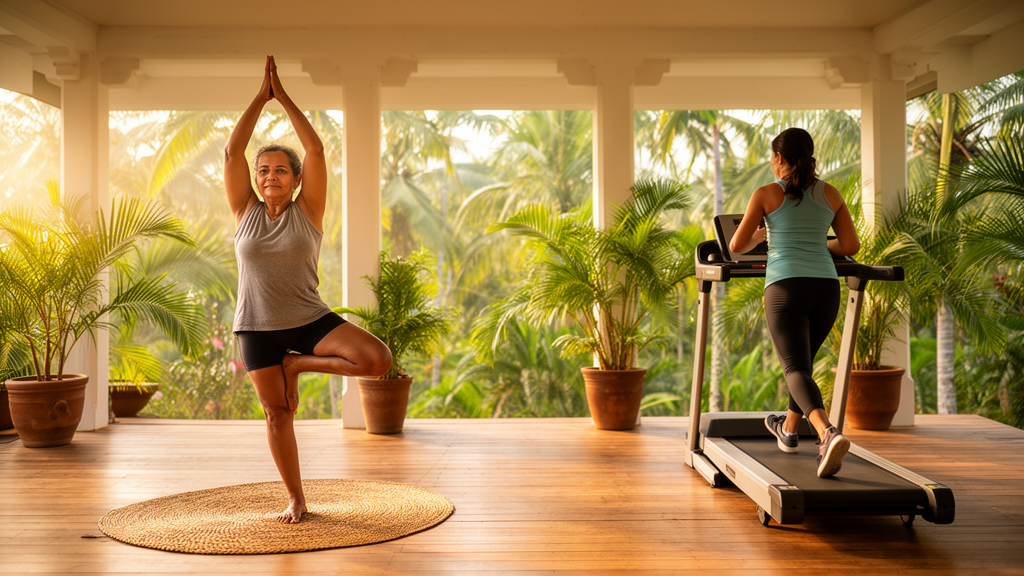
When it comes to exercise, the question of whether yoga or aerobic training delivers better physical fitness has long been argued in gyms, studios, and increasingly in the scientific literature. A new cross-sectional study from Sri Lanka, published in BMC Complementary Medicine and Therapies, offers a direct head-to-head comparison of two of the world’s most popular exercise modalities, measuring three foundational components of physical fitness: lower limb muscle strength, flexibility, and balance. The results suggest that neither discipline is universally superior. Instead, each appears to sculpt a distinct fitness profile, with yoga practitioners excelling in strength and flexibility of the lower body, while aerobic exercisers demonstrated markedly better balance.
The research, led by Lakmi C. Subasinghe of the Faculty of Medicine at the University of Colombo, together with Bhawani Yasassri Alvitigala and Ahalyaa Sivashangar of the Department of Pathology, recruited 126 participants aged 20 years and older. The cohort was evenly split between 63 yoga practitioners training at the Bhudeva Yoga and Fitness Lounge center and 63 aerobic exercisers using the University of Colombo gymnasium. To ensure a meaningful comparison, the researchers imposed strict participation criteria: every participant had to have practiced their respective exercise modality for more than two months, with a minimum commitment of six hours per week during the preceding month. This threshold was designed to exclude casual dabblers and capture the physiological effects of sustained, regular training rather than short-term adaptation.
The choice of outcome measures reflects the central role these three fitness components play in everyday function. Lower limb muscle strength underpins walking, climbing stairs, rising from a chair, and virtually every locomotor task; its decline with age is a major driver of disability and loss of independence. Flexibility of the hamstrings, lower back, and hip complex determines range of motion and injury resilience. Balance, meanwhile, is the silent guardian against falls, which the World Health Organization identifies as a leading cause of injury-related death and morbidity in older adults. As noncommunicable diseases rise across South Asia and globally, public health interest in accessible exercise modalities that preserve these capacities has intensified, providing the motivation for the study.
The researchers used three simple, widely validated field tests. Lower limb strength was assessed with the wall sit test, an isometric endurance challenge in which participants hold a seated position against a wall with knees bent at right angles, loading the quadriceps, hamstrings, and gluteal muscles without movement. Flexibility was measured with the classic sit-and-reach test, which quantifies the ability to flex forward at the hips and reach toward or beyond the toes, primarily probing hamstring and lumbar extensibility. Balance was evaluated with the single-leg stance test, requiring participants to stand motionless on one leg, a task that integrates visual, vestibular, and proprioceptive inputs with the rapid corrective muscle activity known as postural control. Group differences were then analyzed using mean comparisons between the two cohorts.
The findings were striking. Yoga practitioners outperformed aerobic exercisers on the wall sit test, holding the isometric position for a mean of 0.46 plus or minus 0.41 units compared with 0.34 plus or minus 0.23 in the aerobic group, a difference that reached statistical significance at p equal to 0.047. The flexibility gap was even more dramatic: on the sit-and-reach test, yoga practitioners averaged 44.81 plus or minus 10.88 centimeters, while aerobic exercisers managed 30.97 plus or minus 8.91 centimeters, a difference of nearly 14 centimeters that was highly significant at p less than 0.001. For anyone who has watched a seasoned yogi fold effortlessly into a forward bend while a runner grimaces at the same task, the result will come as little surprise, but quantifying the gap so starkly gives the observation real scientific weight.
Balance told the opposite story. On the single-leg stance test, aerobic exercisers held their position for a mean of 2.53 plus or minus 1.53 units, roughly double the 1.40 plus or minus 0.46 achieved by the yoga group, and this difference was also highly significant at p less than 0.001. The finding is intriguing because yoga is often assumed to be the balance-building exercise par excellence, given its repertoire of one-legged postures such as tree pose and warrior III. Yet in this Sri Lankan cohort, the aerobic exercisers were the steadier group on one leg, suggesting that the dynamic, repetitive weight-shifting demands of sustained aerobic activity may train the postural control system in ways that static yoga holds do not, at least as measured by this particular test.
The study also probed how training dose related to performance. Lower limb strength was positively correlated with the number of hours of daily practice in both the yoga and aerobic groups, indicating that more time under training translated into greater isometric leg strength regardless of modality. In the aerobic group specifically, balance and flexibility showed a strong correlation with each other, a relationship the authors report at a significance level of p less than 0.05. This coupling hints that in aerobic exercisers, the same underlying factor, perhaps overall training volume or general neuromuscular conditioning, drives both capacities, whereas in yoga practitioners the components appear to develop along more independent trajectories shaped by the specific demands of asana practice.
The authors conclude that both yoga and aerobic exercise offer distinct and complementary benefits for physical fitness. Yoga, in their analysis, appears more effective for improving lower limb strength and flexibility, while aerobic exercise may be the better choice for improving balance. For the general public, the practical implication is that the optimal exercise prescription may not be a choice between the two but a combination of both. A weekly routine that blends yoga sessions with aerobic activity could, in principle, capture the strength and flexibility gains of the former alongside the balance advantages of the latter, addressing a broader spectrum of the fitness components that sustain functional ability and quality of life across the lifespan.
Several caveats are worth keeping in mind when interpreting the results. As a cross-sectional study, the design captures a snapshot in time and cannot establish that yoga causes superior strength and flexibility or that aerobic training causes better balance; it is possible that people with certain physical attributes gravitate toward one modality over the other, a classic self-selection problem in exercise research. The participants were drawn from a single yoga center and a single university gymnasium in Colombo, which may limit how far the findings generalize to other populations, training styles, and intensity levels. The reported standard deviations, particularly the wide spread in the wall sit results, indicate considerable individual variability within each group. Nonetheless, the study, which received ethical approval from the Ethical Review Committee of the Faculty of Medicine, University of Colombo, and was conducted in accordance with the Declaration of Helsinki, adds valuable evidence from a South Asian context where such comparative fitness data remain scarce. As interest in yoga and aerobic exercise continues to grow as tools against the global tide of noncommunicable disease, studies like this one help move the conversation beyond enthusiasm and toward evidence-based exercise prescription.
Subject of Research: Comparative physical fitness outcomes of yoga versus aerobic exercise in Sri Lankan adults
Article Title: A comparative study of lower limb muscle strength, flexibility, and balance in yoga practitioners and aerobic exercise participants in Sri Lanka
Article References: A comparative study of lower limb muscle strength, flexibility, and balance in yoga practitioners and aerobic exercise participants in Sri Lanka. (n.d.). https://doi.org/10.1186/s12906-026-05644-4
Image Credits: AI Generated
DOI: 10.1186/s12906-026-05644-4
Keywords: yoga, aerobic exercise, physical fitness, lower limb strength, flexibility, balance, Sri Lanka, cross-sectional study, wall sit test, sit-and-reach test, single-leg stance, noncommunicable diseases
News Source: Ophelia Keating. (October 15, 2026). Yoga Builds Strength and Flexibility, but Aerobic Exercise Wins on Balance, Sri Lankan Study Finds. Scienmag.