


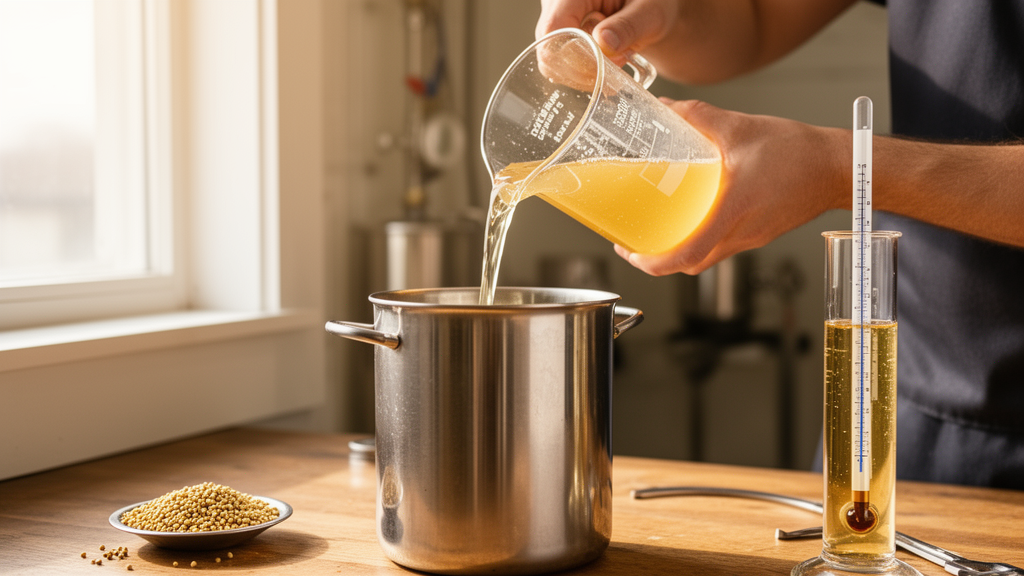
Researchers have mapped how two everyday brewing levers, the density of red sorghum wort and the amount of yeast added at pitching, shape ethanol output during fermentation with Saccharomyces cerevisiae. The study, published in AMB Express, applied a 3 × 3 factorial design combining three wort densities (14, 16, and 18°P) with three inoculum levels (105, 106, and 107 CFU/mL), and used response surface methodology to model alcohol production and identify optimal conditions.
Across the nine treatment combinations, alcohol production ranged from 5.2 to 7.7% (v/v). The highest experimental value was obtained at 16°P with an inoculum of 106 CFU/mL, a combination that outperformed both leaner and richer worts pitched at the same yeast rate.
Analysis of variance revealed significant linear, quadratic, and interaction effects of wort density and inoculum size on ethanol production, with p values below 0.01. The fitted quadratic model explained 87.9% of the total variability in the data, indicating that the two factors and their interplay account for most of the observed differences in alcohol yield.
Desirability analysis based on the model predicted a maximum alcohol content of 8.0% (v/v) at 18°P and 106 CFU/mL. This predicted optimum sits above the best measured value and points to a denser wort than the one that performed best experimentally, a distinction the authors draw explicitly between model prediction and observed result.
Yeast performance itself followed a different pattern. Viability and cell concentration increased with both wort density and inoculum size, reaching their highest values at 18°P and 107 CFU/mL, the densest wort and the largest yeast dose tested.
Yet the treatment that produced the most yeast biomass was not the one that produced the most alcohol. The highest experimental alcohol concentration was obtained at 16°P and 106 CFU/mL, and the authors conclude that final yeast abundance and viability alone did not account for the differences in alcohol production among treatments.
The work is framed as relevant to improving ethanol production and process efficiency in sorghum-based brewing systems, where fermentation conditions are a key optimization target.
The study is a controlled fermentation experiment with a defined factorial design and statistical modeling; its findings apply to the tested red sorghum wort system and the yeast strain and conditions described, and the predicted 8.0% optimum remains a model estimate rather than a measured value.
Subject of Research: Optimizing wort density and yeast inoculum size for ethanol production during red sorghum wort fermentation with Saccharomyces cerevisiae
Article Title: Optimization of yeast inoculum and wort density for alcohol production from red sorghum wort
Article References: Amisi, A. K., Omeonga, M. K., Kizungu, R. V., Masimango, T. N., & Bwanganga, J.-C. T. (2026). Optimization of yeast inoculum and wort density for alcohol production from red sorghum wort. AMB Express. https://doi.org/10.1186/s13568-026-02125-2
Image Credits: AI Generated
DOI: 10.1186/s13568-026-02125-2
Keywords: red sorghum, wort density, yeast inoculum, Saccharomyces cerevisiae, ethanol, fermentation, response surface methodology, desirability analysis, yeast viability, brewing, Optimization, yeast
News Source: Gregory Coleman. (October 28, 2026). Yeast dose and wort density tuned to boost alcohol from red sorghum. Scienmag.



