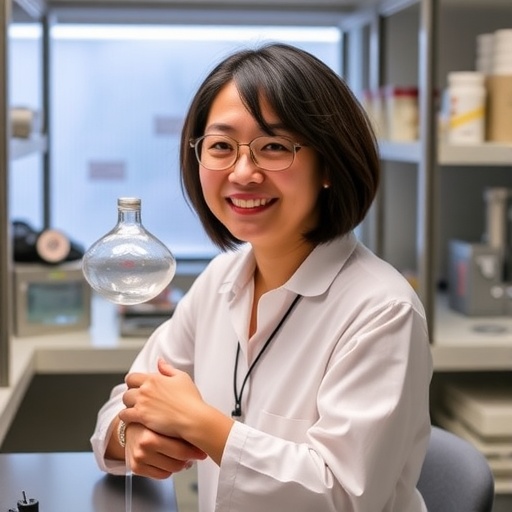
In the quest to unlock new frontiers in chemical synthesis, researchers are persistently searching for innovative methods that allow the formation and manipulation of molecular bonds in unprecedented ways. A remarkable breakthrough has emerged from the laboratory of Professor Yang Yang at the University of California, Santa Barbara, where his team has pioneered a novel class of biocatalytic reactions that blend the power of enzymatic catalysis with advances in photochemistry. This groundbreaking research, recently published in the prestigious journal Nature Catalysis, reveals a previously unknown mechanism for carbon-carbon bond formation via metal-carbene chemistry, fundamentally expanding the toolkit available to chemists for building complex molecules.
Transition metal carbene chemistry has been a vibrant area of study for decades, owing to the unique reactivity of metal-carbene intermediates—transient species in which a metal center is bound to a divalent carbon atom. These metal-carbenes act as powerful but fleeting intermediates, able to forge key carbon-carbon bonds essential for constructing the diverse frameworks found in pharmaceuticals, agrochemicals, and advanced materials. Despite their importance, the mechanistic landscape of metal-carbene chemistry remained relatively constrained, with well-established pathways that have been refined but seldom revolutionized—until now.
Professor Yang’s innovative approach combines two distinct catalytic cycles working in synergy: a light-driven photoredox cycle and an enzymatic metalloenzyme catalytic cycle. This integration ushers in a new paradigm where photochemically generated radical intermediates are directly coupled with enzymatically created iron-carbenoid intermediates. This union facilitates an intermolecular carbon-carbon bond-forming reaction that exploits radical intermediates in a controlled enzymatic environment—an achievement that not only challenges existing dogmas but also heralds unprecedented control over reaction selectivity and efficiency.
Central to this discovery is the use of directed evolution to engineer a metalloprotein catalyst capable of hosting iron ions within its active site. This finely tuned protein environment not only produces the iron-carbenoid intermediate but also exercises exquisite control over the highly reactive iron-radical intermediates generated during the photochemical step. The enzyme facilitates the crucial proton transfer step, a fundamental transformation in organic synthesis, with a precision that synthetic catalysts have struggled to match. Without this engineered metalloenzyme, the researchers believe this distinctive chemistry would have likely remained undisclosed.
The cooperation between photoredox catalysis and metalloenzyme activity effectively pushes the boundaries of transition metal carbene chemistry, offering a synthetic strategy with considerable generality. The dual catalytic system provides a versatile platform for carbon-carbon bond formation, accommodating a broad range of substrates and enabling the construction of molecules featuring multiple stereogenic centers. Such stereochemical complexity is vital for function in biologically active compounds, underscoring the potential impact on drug discovery and the design of agrochemical agents.
Photoredox catalysis has garnered significant attention in recent years for its ability to harness visible light energy to access radical intermediates under mild conditions. By integrating this with a metalloenzyme cycle, Yang’s team has pioneered a cooperative catalytic process that allows controlled radical coupling in a biological setting, effectively marrying the finesse of enzymatic catalysis with the versatility of photochemistry. This represents a new frontier in synthetic methodology, where light-powered biocatalysts can orchestrate complex chemical transformations with enhanced selectivity and sustainability.
The intricate mechanistic interplay revealed through this work demonstrates how radicals—often regarded as indiscriminate and challenging to control—can be tamed within an enzymatic pocket. The iron center in the metalloenzyme acts as a conductor, directing the radical pathway toward selective bond formation, while the protein scaffold stabilizes ephemeral intermediates. This fine balance of reactivity and control is unprecedented in the realm of metallocarbene chemistry and exemplifies the power of directed evolution in tailoring enzyme function for synthetic purposes.
Beyond method development, the researchers anticipate a wide spectrum of applications that could flow from this approach. The ability to generate complex, chiral molecules with high precision opens doors for the synthesis of fine chemicals and bioactive compounds that were previously difficult or impractical to obtain. Moreover, the modularity of this dual catalytic platform suggests that it could be expanded to include other metal centers and reaction types, fostering a versatile toolkit adaptable to diverse chemical challenges.
The collaborative nature of this research, involving experts from UCSB, the University of Pittsburgh, and Florida State University, highlights the interdisciplinary effort required to unravel such complex chemistry. Combining expertise in enzymology, photoredox catalysis, organometallic chemistry, and computational modeling was crucial in elucidating the mechanism and optimizing the catalytic system. This synergy underlines the importance of collaborative approaches in pushing the boundaries of contemporary chemical science.
Moving forward, the team plans to generalize this transformative methodology to broaden its applicability. By exploring additional substrates and refining the biocatalyst through further rounds of directed evolution, they aim to generate a diverse array of synthetically valuable molecules. This work not only deepens fundamental mechanistic understanding but also provides a roadmap for integrating photochemical activation with biocatalysis, opening avenues for green and sustainable synthesis.
In summary, the discovery of this new metal-carbene chemistry mechanism represents a significant leap in transition metal catalysis. It leverages the specificity and tunability of metalloenzymes engineered by directed evolution, combined with the power of photochemistry, to orchestrate complex carbon-carbon bond-forming reactions with unprecedented control. This advancement is poised to transform the synthesis of stereochemically rich molecules critical to pharmaceuticals and agrochemicals, catalyzing further innovation in both academic and industrial chemistry.
Subject of Research: Novel metal-carbene biocatalytic reactions enabling carbon-carbon bond formation through integrated photoredox and metalloenzyme catalysis.
Article Title: (Information not provided)
News Publication Date: (Information not provided)
Web References:
Nature Catalysis Article
Yang Yang UCSB Faculty Page
References: Research by Yang’s lab including Huanan Wang, Chongtao Li, Xiao-Wang Chen at UCSB; Peng Liu and Binh Khanh Mai at the University of Pittsburgh; Rachel Weiss and Bryan Kudisch at Florida State University.
Image Credits: (Information not provided)
Keywords
Physical sciences, Chemistry, Chemical reactions, Organic chemistry, Organometallic chemistry, Stereochemistry
Tags: advances in chemical synthesis methodsbiocatalysis and photochemistry integrationbiocatalytic carbon-carbon bond formationcarbon-carbon bond formation techniquescomplex molecule construction strategiesenzymatic catalysis in organic synthesismetal carbene radical cross-couplingmetal-carbene radical reaction pathwaysnovel mechanisms in metal carbene chemistryphotochemistry-driven catalysissynergistic catalytic cyclestransition metal carbene intermediates