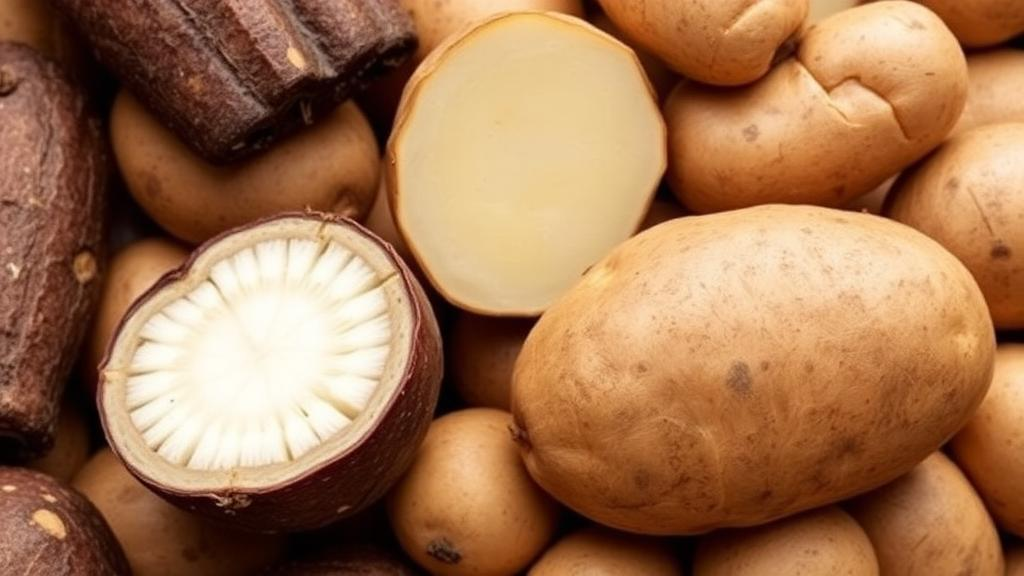
In the bustling markets of Lafia, the capital of Nigeria’s Nasarawa State, two humble tubers sit side by side on vendor stalls, feeding millions and anchoring the nation’s food security. White yam, known locally as doya, isu, or ji depending on the language spoken, and Irish potato, called dankalin turawa in Hausa, have long been treated as interchangeable staples in many households. But a new open-access study published in Discover Chemistry suggests that these two crops are far from nutritional twins, and the differences between them could shape dietary advice, food processing strategies, and even industrial applications across West Africa and beyond.
A team of researchers led by Stephen Olaide Aremu and corresponding author Caleb Zando, working with colleagues at the Federal University of Lafia and partner institutions, purchased edible tubers of both species from multiple vendors at the Lafia Modern Market to ensure representative sampling. The varietal identities were confirmed with the university’s Department of Agronomy before the tubers were peeled, sliced, and carefully oven-dried at temperatures gradually raised from 60 to 110 degrees Celsius over eighteen hours to avoid hardening. The dried samples were ground into fine powder and subjected to a battery of standardized analytical methods drawn from the Association of Official Analytical Chemists, including micro-Kjeldahl nitrogen determination, permanganate titration for oxalates, ferric chloride titration for phytates, and alkaline titration for cyanogenic glycosides.
The proximate analysis delivered a clear first verdict: the potato wins on protein. Solanum tuberosum registered 14.27 percent crude protein against 11.76 percent for Dioscorea rotundata, a figure the authors note is substantially higher than most previously published values for both crops. Potato proteins, dominated by the glycoprotein patatin and various protease inhibitors, have been reported in earlier literature to rival or exceed those of legumes, and the Lafia samples appear to bear that out. The yam, however, fought back on two fronts: it contained more crude fiber, at 9.99 percent versus 8.53 percent, and more ash, at 6.29 percent versus 5.31 percent, indicating superior mineral density and dietary fiber content.
Fat was the lowest-ranking component in both tubers, at 2.99 percent for yam and 3.22 percent for potato, consistent with the general reputation of root and tuber crops as low-fat foods, though the authors note that frying can change that picture dramatically. Carbohydrate dominated everything else, with the two crops nearly tied at 63.60 percent for yam and 63.74 percent for potato. Both samples showed remarkably low moisture contents of around 5.3 to 5.5 percent, far below the 54 to 75 percent range typical of fresh tubers, a consequence of the dehydration protocol. Low moisture translates to high dry matter, which the researchers point out is a hallmark of good eating and textural quality, and it also means the flours resist microbial spoilage and store well, an important consideration for food industries.
The phytochemical results are where the story gets genuinely nuanced, because the compounds measured are double agents: some harm nutrition, others protect health. Yam contained more than twice the oxalate of potato, 6.52 percent against 2.73 percent, a difference with real consequences, since oxalates bind minerals such as calcium and iron and, at high intakes, can contribute to kidney stone formation. Yam also carried more phytate, at 333.63 milligrams per 100 grams versus 300.10 for potato. Phytate is a notorious chelator of minerals, yet the same molecule exhibits antioxidant and anticancer potential and even binds toxic heavy metals like cadmium and lead, illustrating how context determines whether a compound is villain or guardian.
Potato, meanwhile, led on several other fronts. It contained more alkaloids, 9.47 percent versus 7.37 percent, a notable finding given that alkaloid derivatives display analgesic, antitussive, and antibacterial pharmacological activities, though potato alkaloids are also the class of compounds behind greening-related toxicity when tubers are mishandled. Potato also showed higher tannins, at 3.04 milligrams per 100 grams against 2.14, and a strikingly higher cyanide content of 1.52 milligrams per 100 grams compared with just 0.42 in yam. The authors are careful to note that these cyanide levels remain well below acute toxicity thresholds, but they emphasize that neither tuber should ever be eaten raw and that adequate cooking is critical for degrading residual cyanogenic glycosides. Yam, for its part, dominated the antioxidant ledger, with flavonoids at 9.13 percent against potato’s 3.25 percent, suggesting stronger protection against oxidative stress and inflammation.
The amino acid analysis added another layer of sophistication. Glutamic acid was the most abundant amino acid in both tubers, at 12.65 grams per 100 grams of protein in potato and 9.01 in yam, followed by aspartic acid, which reached 9.87 grams in potato versus 7.60 in yam. Potato outperformed yam on most essential amino acids, including leucine, lysine, isoleucine, tryptophan, valine, methionine, and threonine, while yam held the edge in phenylalanine, proline, arginine, glycine, cystine, and alanine. Arginine is particularly interesting, as the authors note its value as a supplement during pregnancy, trauma, and illness such as cancer. Tryptophan, the sole precursor of the neurotransmitter serotonin, which regulates appetite, sleep, and mood, was also higher in potato, as was the case for the branched-chain amino acids that support muscle repair and blood sugar control.
When the researchers computed composite quality metrics, potato again came out ahead on protein. Its predicted protein efficiency ratio, calculated from leucine and tyrosine content using a classic regression equation, was 2.09 versus 1.92 for yam, and its leucine-to-isoleucine ratio of 3.08 dwarfed yam’s 1.79. Potato also scored higher on total amino acids, total non-essential amino acids, total acidic and basic amino acids, and amino acid scores for most essential residues, leading the authors to conclude that potato delivers the higher overall protein quality. Yam, by contrast, led on total essential amino acid fractions when histidine was included and on sulfur-containing amino acid parameters, underscoring just how complementary the two crops are rather than how one simply beats the other.
The authors are refreshingly candid about the limitations of their work. All measurements were performed only in duplicate, which they acknowledge was insufficient for meaningful inferential statistical comparison, meaning the compositional differences reported here cannot yet be formally tested for significance. They commit to larger replicate numbers in future studies to strengthen reproducibility. This honesty matters in a field where single-sample analyses are sometimes overinterpreted, and it frames the study as a strong, variety-specific baseline for Lafia-grown tubers rather than a definitive word on all Nigerian yams and potatoes.
The bigger picture is one of agricultural and nutritional strategy. Nigeria is the world’s leading yam producer, contributing 65.5 percent of global output, while it ranks fourth in sub-Saharan Africa for potato production with more than 1.28 million metric tonnes annually. As climate pressure and population growth strain food systems, understanding exactly what these staples deliver, and what processing can unlock, becomes a matter of public health. The researchers conclude that all antinutrient levels observed fall within ranges that standard techniques such as boiling, fermentation, soaking, and roasting can effectively minimize, and that cooking yams in particular reduces phytate while water-soluble tannins largely leach away. Their bottom line is pragmatic and encouraging: potato offers the better protein package, yam the better fiber, minerals, and antioxidants, and eaten together, properly cooked, the two tubers form a genuinely balanced dietary partnership for the hundreds of millions who depend on them.
Subject of Research: Comparative nutritional and antinutritional composition of white yam and Irish potato tubers cultivated in Lafia, Nigeria
Article Title: Comparative study of nutritive and antinutritive values of Dioscorea rotundata and Solanum tuberosum cultivated in Lafia, Nigeria
Article References: Aremu, S. O., Zando, C., Aremu, M. O., Ezekiel, E., Aliyu, Z. E., Omosebi, M. O., & Aremu, D. O. (2026). Comparative study of nutritive and antinutritive values of Dioscorea rotundata and Solanum tuberosum cultivated in Lafia, Nigeria. Discover Chemistry, 3(1), Article 473. https://doi.org/10.1007/s44371-026-00917-w
Image Credits: AI Generated
DOI: 10.1007/s44371-026-00917-w
Keywords: Dioscorea rotundata, Solanum tuberosum, white yam, Irish potato, proximate analysis, antinutritional factors, amino acid profile, phytochemicals, food security, Nigeria, protein quality, oxalate
News Source: Daisy Hatcher. (October 11, 2026). Yam Versus Potato: Head-to-Head Nutritional Showdown in Nigeria Reveals Surprising Winner. Scienmag.