


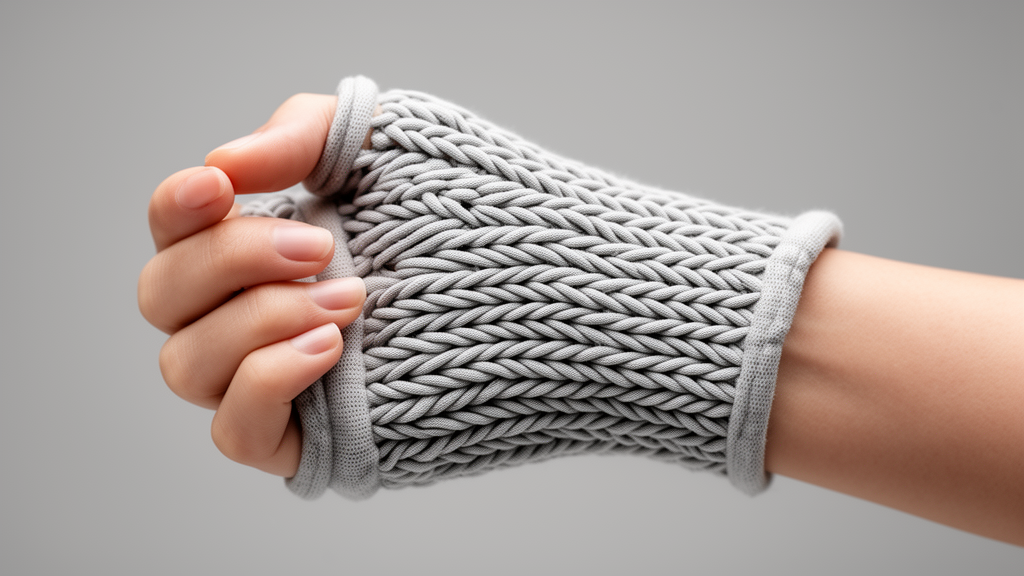
Researchers have built a hand assistive glove whose actuator is not bolted on top of the fabric but woven into it, and their user tests suggest the textile-first approach can reduce the muscular effort of gripping while keeping the glove light and visually unobtrusive. The work, published in the journal Fashion and Textiles, describes a twisted string actuator (TSA) module in which the tendon strings themselves are structural yarns of a woven fabric, eliminating the bulky, externally mounted actuation hardware that has long limited the wearability of robotic gloves.
The motivation comes from the logistics industry, where repetitive manual handling places sustained strain on hands and forearms. The authors note that lifting objects heavier than 4.5 kilograms with one hand for more than two hours a day is classified as a musculoskeletal stress-inducing task, and that continuous strain on grip force is considered a major risk factor. An aging workforce sharpens the problem: a survey by the International Road Transport Union found that an average of 31.6 percent of truck drivers across 36 countries were aged 55 or older, with Spain, Australia and Italy each reporting figures near half. Older workers also fatigue faster. In one cited study, participants over 65 showed an average grip strength reduction of 30.42 percent after continuously gripping an object for 20 seconds, compared with 7.08 percent for subjects in their twenties.
Conventional assistive gloves have traded strength for dexterity. Early systems relied on rigid exoskeletons with hard joints, linkages and electric motors that could generate high torque but were heavy and could raise the risk of secondary injury during prolonged use. Soft pneumatic gloves improved comfort, yet their pumps and inflatable chambers can interfere with natural finger motion. Glove thickness itself matters, since prior work has shown that thickness significantly affects hand dexterity and force generation. Logistics workers in particular need fine as well as gross manipulation: according to the Bureau of Labor Statistics’ Occupational Requirements Survey, 99.5 percent of cargo handling workers reported occasionally requiring gross manipulation and 81.3 percent reported occasionally requiring fine manipulation.
The twisted string actuator offers a compact alternative. A TSA converts rotational motion into linear contraction by twisting two or more parallel strings around a common axis. When a small rotary motor spins the strings, they twist and shorten, generating a linear pull along the load direction. Because the strings are slim and lightweight, they suit tendon-driven glove designs in which actuation lines run along the flexion direction of each finger, keeping the motor away from the joints. In this study the team went further than previous TSA gloves, which had generally treated the actuator as an added mechanical component. Here the tendon strings were structurally integrated into the woven textile itself, with the fabric designed to withstand the unidirectional contraction that TSA actuation imposes.
Choosing the right weave was a quantitative exercise. The researchers compared a 1/1 plain weave with a 3/1 twill weave, measuring tensile strength, elongation at break and crease recovery. The plain weave reached 650 newtons of tensile strength in the warp direction and 290 newtons in the weft, while the twill showed 590 and 430 newtons respectively. Elongation at break was 53.8 percent warp and 43.9 percent weft for the plain weave against 48.9 and 50.5 percent for the twill. Because TSA-driven actuation loads the fabric along the warp direction, the plain weave’s superior warp-direction tensile strength and crease recovery made it the preferred structure. Density was the next variable: samples woven at 6, 10 and 12 ends per inch resisted string slippage up to 0.67, 1.58 and 2.05 newtons respectively, and at 24 ends per inch no slippage occurred even above 30 newtons. Higher density, however, increases frictional resistance during rotational actuation, so the team adopted 6 ends per inch to balance force transmission against friction while staying below the slip threshold in normal operation.
The tendon yarns were wax-coated SK75 Dyneema blended with 67 percent Dyneema and 33 percent Vectran, paired with an acrylic-polyester weft yarn of comparable thickness. Two module shapes were fabricated on this identical base: a flat type, a two-dimensional rectangular patch attached to the palmar fingertip, and a round type, a tapered thimble form enclosing the fingertip. The glove itself combined a non-stretch, high-tensile fabric on the palmar finger region where actuation force is transmitted with breathable stretch fabric elsewhere, and used a double-layer construction that concealed the internal components. The TSA strings, distributed equally to four fingers excluding the thumb, were routed through side-seam openings to a rigid dorsal component carrying the actuation unit, which was fixed with screw-type rivets and an adjustable hook-and-loop wrist strap. Using a Maxon DCX16L motor with a 5.3:1 gear ratio and a 150-millimeter string length, the team’s model estimated a TSA tensile force of roughly 90 newtons at 15 motor turns, achievable within about one second.
Triggering the glove also demanded a textile solution. The researchers designed a fabric-based pressure sensor with a stacked conductive fabric-mesh-conductive fabric configuration, joined by fusible web so that pressure-induced changes in electrode contact register as resistance changes. Calibrated on a universal testing machine, the sensor’s pressure-resistance relationship fit a nonlinear regression with a coefficient of determination of 0.95. Across a 0 to 1000 kilopascal range the root-mean-square error was 60.6 kilopascals, about 6 percent of the range, improving to 46.7 kilopascals within 0 to 800 kilopascals. After an initial break-in of 50 cycles, 1000 repeated loading cycles produced a mean hysteresis of 17.9 percent of full-scale output, a baseline drift of minus 12.3 percent, and highly stable peak resistance averaging 61.4 plus or minus 0.6 ohms with a coefficient of variation of 0.98 percent.
Ten adult male participants who fit a standard medium glove evaluated four conditions: the flat-type glove, the round-type glove, a commercial pneumatic glove, and bare hands. Assistance was measured with surface electromyography over the flexor digitorum profundus, the primary muscle for strong gripping, during a 12-kilogram static holding task lasting 20 seconds. Signals were normalized to each participant’s bare-hand reference, called the reference voluntary contraction. The round-type glove reduced muscle activation to 74.14 percent of the bare-hand level, a 25.86 percent reduction, while the flat type reached 85.26 percent, a 14.74 percent reduction. The pneumatic glove, by contrast, showed a slight increase to 105.92 percent, which the authors attribute to the actuator behaving like a variable-stiffness spring whose restoring force resists firm gripping beyond its equilibrium point. A repeated-measures ANOVA on the three glove conditions confirmed a significant main effect of glove condition on muscle activation, with F(2, 18) = 7.002, p < 0.01 and a partial eta-squared of 0.438, though standard deviations were relatively large across participants.
Wearability told a subtler story. During repetitive box-lifting tasks with a 5-kilogram box, electroencephalography showed no statistically significant differences across conditions in any spectral index, suggesting the gloves did not meaningfully increase cognitive load or stress. Clothing pressure, however, differed sharply: the pneumatic glove produced the highest mean pressure, followed by the round type, the flat type, and bare hands, with a significant main effect of condition, F(3, 27) = 26.057, p < 0.001, and a large effect size of 0.743. Post-hoc comparisons showed the pneumatic glove significantly exceeded all other conditions, and the round type exceeded bare hands, but the round-versus-flat difference was not statistically significant. In the questionnaires, the round-type glove scored highest for aesthetic appeal and functional perception and received significantly higher ratings than the pneumatic glove in design perception, comfort, usefulness and purchase intention, and higher ratings than the flat type in comfort and purchase intention. Notably, despite generating more physical pressure than the flat type, the round type won on perceived functionality and purchase or use intention, indicating that wearability reflects perceived functional effectiveness, not pressure alone.
The authors conclude that module shape is a decisive design variable balancing mechanical assistance and user acceptance, and that structural choices can modulate assistance, wearing stability and perception rather than optimizing a single dimension. They also state the limitations plainly: the study involved only ten adult male participants, which may restrict generalizability to female users and people with different hand anthropometry or age-related characteristics, and the mechanical performance of the TSA within the woven structure should be further verified under controlled actuation conditions. Future work with larger, more diverse participant groups in real logistics environments is needed to validate long-term assistive efficacy. Even so, the demonstration that a tendon actuator can live inside the weave itself marks a concrete step toward assistive gloves that workers might actually choose to wear.
Subject of Research: A textile-integrated twisted string actuator glove for reducing grip effort in manual handling
Article Title: Development of woven TSA fabric module for hand assistive gloves
Article References: Park, S., Kim, J., Oh, J. H., Choi, S., Shin, D., & Koo, S. (2026). Development of woven TSA fabric module for hand assistive gloves. Fashion and Textiles, 13(1), Article 34. https://doi.org/10.1186/s40691-026-00486-7
Image Credits: AI Generated
DOI: 10.1186/s40691-026-00486-7
Keywords: twisted string actuator, assistive glove, woven fabric, wearable robotics, surface electromyography, clothing pressure, logistics workers, textile sensor, plain weave, muscle activation, soft exoskeleton, user evaluation
News Source: Denise Maddox. (October 29, 2026). Woven Twisted String Fabric Module Slims Down Hand Assistive Gloves. Scienmag.



