• HOME
  • NEWS
  • EXPLORE
    • CAREER
      • Companies
      • Jobs
    • EVENTS
    • iGEM
      • News
      • Team
    • PHOTOS
    • VIDEO
    • WIKI
  • BLOG
  • COMMUNITY
    • FACEBOOK
    • INSTAGRAM
    • TWITTER
Saturday, February 7, 2026
BIOENGINEER.ORG
No Result
View All Result
  • Login
  • HOME
  • NEWS
  • EXPLORE
    • CAREER
      • Companies
      • Jobs
        • Lecturer
        • PhD Studentship
        • Postdoc
        • Research Assistant
    • EVENTS
    • iGEM
      • News
      • Team
    • PHOTOS
    • VIDEO
    • WIKI
  • BLOG
  • COMMUNITY
    • FACEBOOK
    • INSTAGRAM
    • TWITTER
  • HOME
  • NEWS
  • EXPLORE
    • CAREER
      • Companies
      • Jobs
        • Lecturer
        • PhD Studentship
        • Postdoc
        • Research Assistant
    • EVENTS
    • iGEM
      • News
      • Team
    • PHOTOS
    • VIDEO
    • WIKI
  • BLOG
  • COMMUNITY
    • FACEBOOK
    • INSTAGRAM
    • TWITTER
No Result
View All Result
Bioengineer.org
No Result
View All Result
Home NEWS Science News Biology

Worm nerve responses for good and bad

Bioengineer by Bioengineer
March 13, 2020
in Biology
Reading Time: 2 mins read
0
IMAGE
Share on FacebookShare on TwitterShare on LinkedinShare on RedditShare on Telegram

IMAGE

Credit: Shunji Nakano & Ikue Mori


Nagoya University researchers and colleagues have revealed the nerve circuitry regulating the response of a tiny soil worm to changing temperatures. The findings, published in the journal Proceedings of the National Academy of Sciences, help clarify one way the nervous system translates external signals into behaviours.

One of the fundamental questions of neurobiology is: how does the brain determine if an external stimulus is good or bad? Animal behaviour depends on this ability. For example, the scent of a predator elicits a fear response, while the scent of a potential mate elicits mating behaviour.

The nematode Caenorhabditis elegans is about one millimetre long and lives in the soil, feeding on microbes. It is often used as a model organism for biological studies in diverse fields, such as development, neurobiology and aging.

Generally, a lab C. elegans will migrate towards a cooler temperature when placed in a warmer environment than the one it was cultivated in, and vice versa. Molecular neurobiologists Shunji Nakano and Ikue Mori of Nagoya University and colleagues wanted to understand the molecular and neurological underpinnings behind this behaviour.

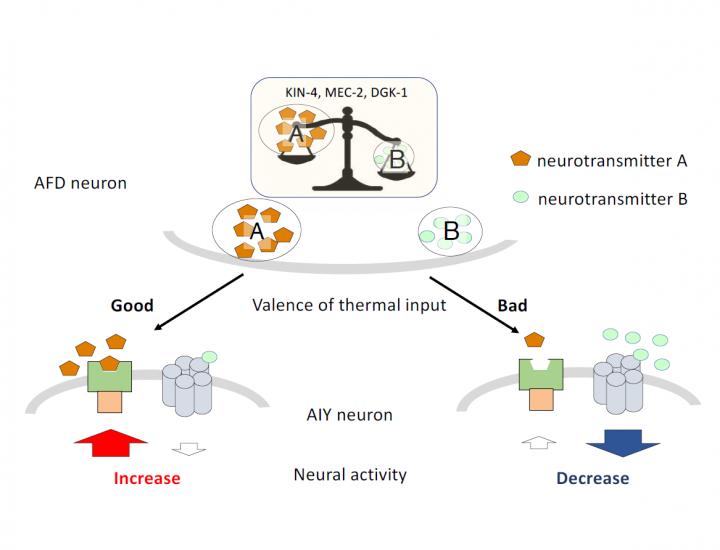
Using genetic and imaging tools, the scientists found that a temperature-sensing nerve cell in the worms, called AFD, transmits signals that activate or inhibit its receiving nerve cell, called AIY.

The scientists exposed freely moving worms to either a good or bad external temperature stimulus. The first ‘good’ signal started below the worms’ cultivation temperature and gradually warmed towards it. The other ‘bad’ signal started at the cultivation temperature and gradually warmed above it.

AFD was activated by both warming signals. But it then sent stimulating molecules to AIY in the case of the good signal, and inhibiting ones during the bad one. The result shows how the same nerve cell can send signals that convey opposite messages.

Genetic studies further revealed three specific genes, and the enzymes and proteins they encode, that are involved in this response: kin-4, mec-2, and dgk-1. “These three genes are evolutionarily conserved in mammals, including humans,” says Nakano. “A similar mechanism thus might be present in the nervous systems of higher organisms.”

The team next plans to identify other stimuli that elicit similar neuronal responses in C. elegans.

###

Media Contact
Shunji Nakano
[email protected]

Original Source

http://en.nagoya-u.ac.jp/research/activities/news/2020/03/worm-nerve-responses-for-good-and-bad.html

Related Journal Article

http://dx.doi.org/10.1073/pnas.1909240117

Tags: BiologyGenesMolecular BiologyPhysiology
Share12Tweet8Share2ShareShareShare2

Related Posts

Florida Cane Toad: Complex Spread and Selective Evolution

Florida Cane Toad: Complex Spread and Selective Evolution

February 7, 2026
New Study Uncovers Mechanism Behind Burn Pit Particulate Matter–Induced Lung Inflammation

New Study Uncovers Mechanism Behind Burn Pit Particulate Matter–Induced Lung Inflammation

February 6, 2026

DeepBlastoid: Advancing Automated and Efficient Evaluation of Human Blastoids with Deep Learning

February 6, 2026

Navigating the Gut: The Role of Formic Acid in the Microbiome

February 6, 2026
Please login to join discussion

POPULAR NEWS

  • Robotic Ureteral Reconstruction: A Novel Approach

    Robotic Ureteral Reconstruction: A Novel Approach

    82 shares
    Share 33 Tweet 21
  • Digital Privacy: Health Data Control in Incarceration

    63 shares
    Share 25 Tweet 16
  • Study Reveals Lipid Accumulation in ME/CFS Cells

    57 shares
    Share 23 Tweet 14
  • Breakthrough in RNA Research Accelerates Medical Innovations Timeline

    53 shares
    Share 21 Tweet 13

About

We bring you the latest biotechnology news from best research centers and universities around the world. Check our website.

Follow us

Recent News

Decoding Prostate Cancer Origins via snFLARE-seq, mxFRIZNGRND

Digital Health Perspectives from Baltic Sea Experts

Florida Cane Toad: Complex Spread and Selective Evolution

Subscribe to Blog via Email

Enter your email address to subscribe to this blog and receive notifications of new posts by email.

Join 73 other subscribers
  • Contact Us

Bioengineer.org © Copyright 2023 All Rights Reserved.

Welcome Back!

Login to your account below

Forgotten Password?

Retrieve your password

Please enter your username or email address to reset your password.

Log In
No Result
View All Result
  • Homepages
    • Home Page 1
    • Home Page 2
  • News
  • National
  • Business
  • Health
  • Lifestyle
  • Science

Bioengineer.org © Copyright 2023 All Rights Reserved.