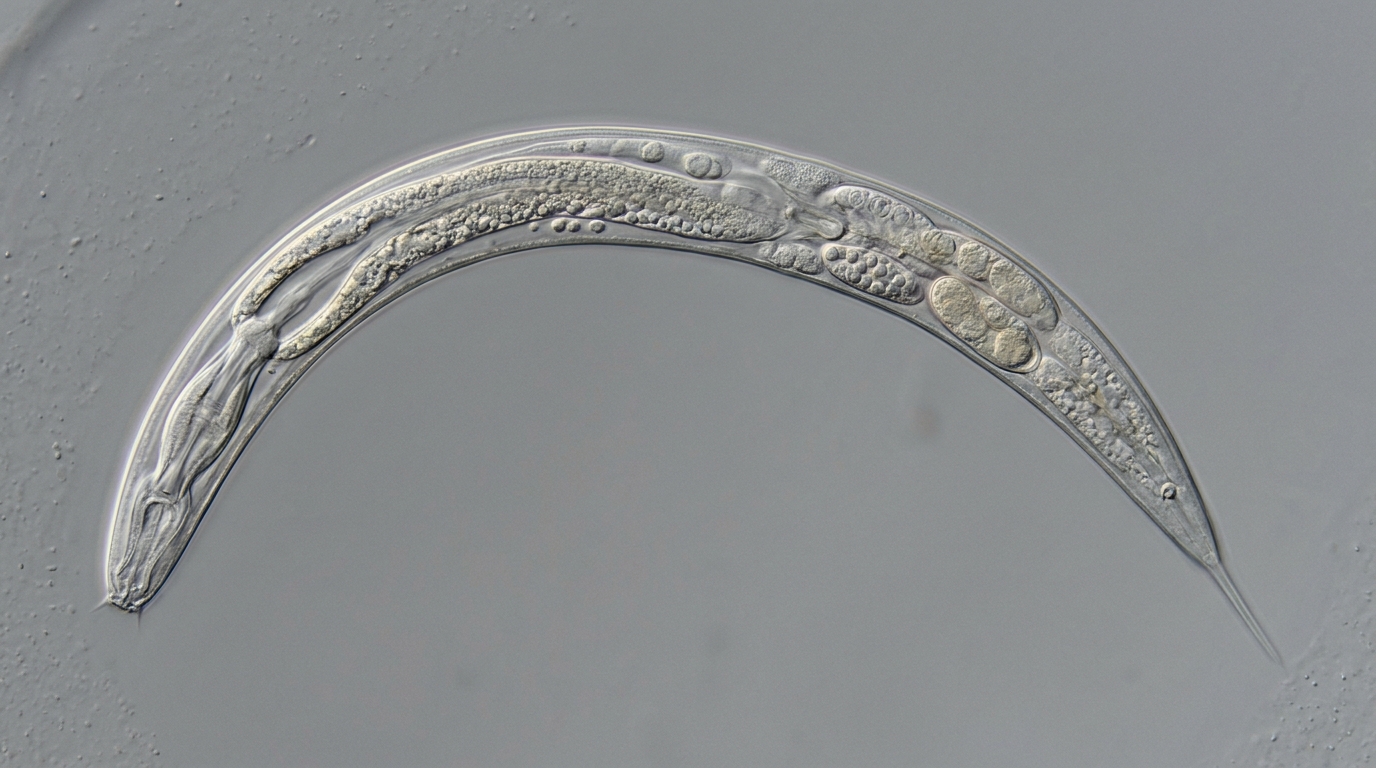
The nematode C. elegans carries a gene called kri-1, the counterpart of the human KRIT1 gene, whose mutations cause cerebral cavernous malformations, a disease marked by defects in vascular integrity. A new study reports that this conserved gene does far more than previously appreciated: it helps the worm intestine maintain its epithelial barrier, mount innate immune responses, and manage lipid stores during aging.
Researchers found kri-1/KRIT1 in a forward genetic screen designed to uncover novel regulators of innate immune gene transcription. Follow-up work showed that, like its role in human blood vessels, the worm gene is required for the integrity of the intestinal epithelial cell barrier, the tissue layer that must stay sealed to keep the animal functioning normally.
The team also found that kri-1/KRIT1 is needed for host tolerance to bacterial infection, for normal fecundity, and for normal development. Animals without proper gene function therefore face problems on several fronts at once: a weakened gut lining, reduced ability to withstand pathogens, and impaired reproduction.
A key mechanistic finding concerns skn-1/NRF2, a cytoprotective transcription factor. According to the study, kri-1/KRIT1 restrains the activity of skn-1/NRF2 to control immune gene transcription and likely intestinal lipid mobilization during aging, a process the authors describe as necessary for healthy reproduction. In other words, the gene appears to help decide how adult animals partition energy between immune defense, fat allocation to the germline, and other demands.
Notably, that regulatory relationship does not explain everything the gene does. The researchers report that kri-1/KRIT1 functions independently of skn-1/NRF2 to promote epithelial integrity and pathogen tolerance, indicating that the gene acts through at least two separable pathways in the same organ.
The work began from a basic biological puzzle. Animals must differentially allocate essential metabolic resources in response to changing environmental conditions to ensure reproductive success. Adult C. elegans coordinate innate immune defenses during infection and also allocate fat stores to the germline, each of which is required for evolutionary fitness. Yet the genetic mechanisms that integrate resource allocation and host defenses in this context were not fully understood.
By identifying kri-1/KRIT1 as a node in that integration, the study suggests a single conserved regulator can simultaneously influence immune transcription, lipid handling, and tissue barrier maintenance in the intestine. Because KRIT1 is strongly conserved between worms and humans, the authors argue the findings reveal a broad role for this protein in essential physiological processes required for reproductive fidelity and evolutionary success.
The study was published in PLOS Genetics by Akshay Alaghatta and colleagues, including Read Pukkila-Worley. The findings are limited to the worm model and the specific experimental conditions tested, but they establish kri-1/KRIT1 as a candidate link between vascular disease genetics, gut barrier biology, and the physiology of aging and reproduction.
Subject of Research: The role of the kri-1/KRIT1 gene in innate immunity, lipid homeostasis and epithelial integrity in the C. elegans intestine
Article Title: kri-1/KRIT1 promotes innate immune and lipid homeostasis in the C. elegans intestine
Article References: Alaghatta, A., Tse-Kang, S. Y., Bollen, D., Wani, K. A., Peterson, N. D., & Pukkila-Worley, R. (2026). kri-1/KRIT1 promotes innate immune and lipid homeostasis in the C. elegans intestine. PLOS Genetics, 22(10), e1012166. https://doi.org/10.1371/journal.pgen.1012166
Image Credits: AI Generated
DOI: 10.1371/journal.pgen.1012166
Keywords: C. elegans, kri-1, KRIT1, innate immunity, lipid homeostasis, intestinal barrier, skn-1/NRF2, cerebral cavernous malformations, host tolerance, aging, fecundity, PLOS Genetics
News Source: Juliet Wilcox. (November 6, 2026). Worm gene kri-1 ties gut barrier, immunity and fat control together. Scienmag.