• HOME
  • NEWS
  • EXPLORE
    • CAREER
      • Companies
      • Jobs
    • EVENTS
    • iGEM
      • News
      • Team
    • PHOTOS
    • VIDEO
    • WIKI
  • BLOG
  • COMMUNITY
    • FACEBOOK
    • INSTAGRAM
    • TWITTER
Monday, July 6, 2026
BIOENGINEER.ORG
No Result
View All Result
  • Login
  • HOME
  • NEWS
  • EXPLORE
    • CAREER
      • Companies
      • Jobs
        • Lecturer
        • PhD Studentship
        • Postdoc
        • Research Assistant
    • EVENTS
    • iGEM
      • News
      • Team
    • PHOTOS
    • VIDEO
    • WIKI
  • BLOG
  • COMMUNITY
    • FACEBOOK
    • INSTAGRAM
    • TWITTER
  • HOME
  • NEWS
  • EXPLORE
    • CAREER
      • Companies
      • Jobs
        • Lecturer
        • PhD Studentship
        • Postdoc
        • Research Assistant
    • EVENTS
    • iGEM
      • News
      • Team
    • PHOTOS
    • VIDEO
    • WIKI
  • BLOG
  • COMMUNITY
    • FACEBOOK
    • INSTAGRAM
    • TWITTER
No Result
View All Result
Bioengineer.org
No Result
View All Result
Home NEWS Science News Chemistry

Working on the frontier of nanoparticle research

Bioengineer by Bioengineer
July 21, 2020
in Chemistry
Reading Time: 2 mins read
0
IMAGE
Share on FacebookShare on TwitterShare on LinkedinShare on RedditShare on Telegram

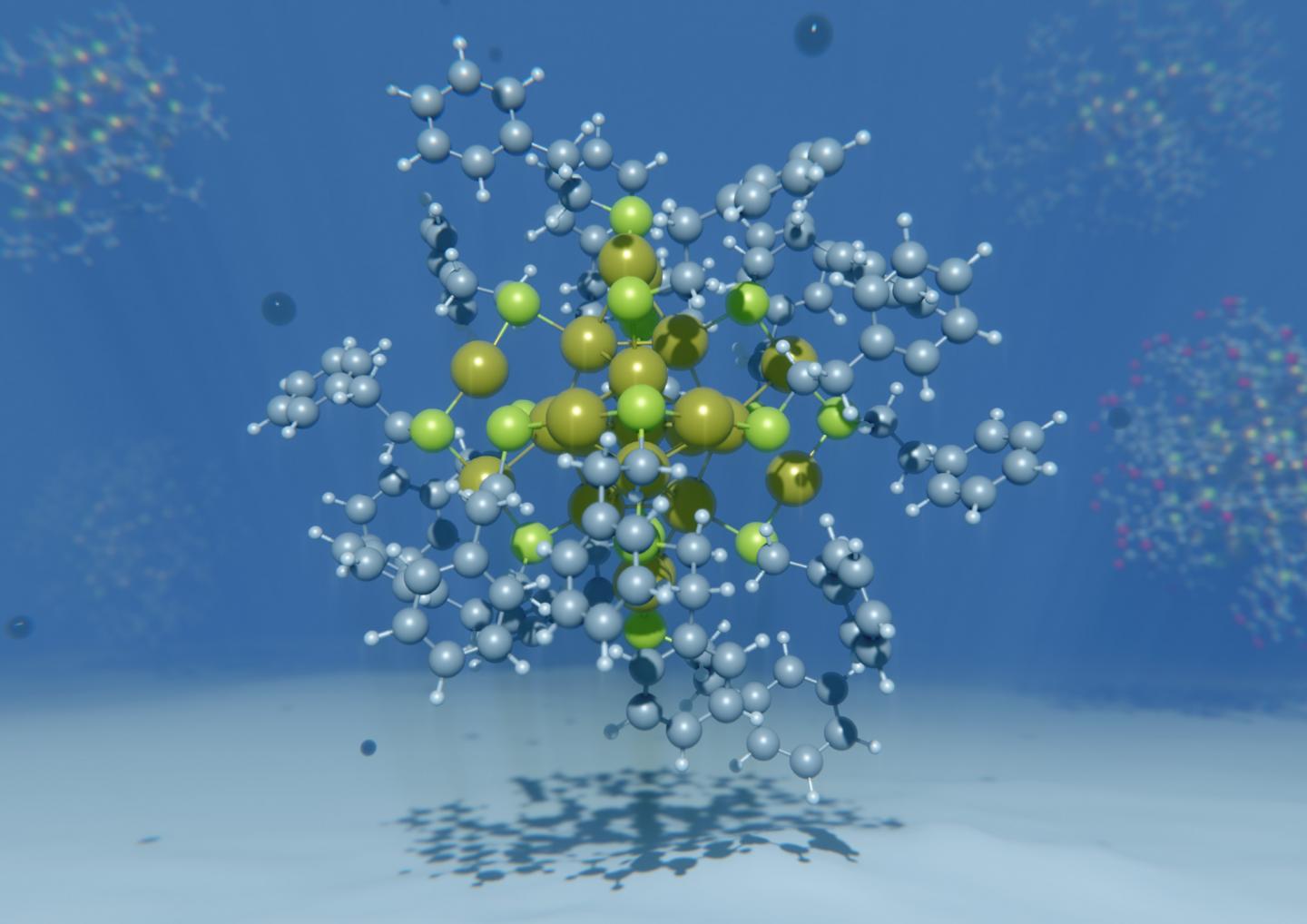
Mpourmpakis’s CANELa lab work featured on cover of the Journal Dalton Transactions and selected as hot article
IMAGE

Credit: Mpourmpakis and Cowan

A field studying something very small is becoming very big: In the last decade, the field of nanoparticle research has exploded. At about one nanometer in size, nanoparticles are 100,000 times smaller than the width a strand of human hair and cannot be seen with the naked eye, but researchers are discovering broad uses for them in fields ranging from bioimaging to energy and the environment.

Working at this scale, it is difficult to be precise; however, the Computer-Aided Nano and Energy Lab (CANELa) at the University of Pittsburgh’s Swanson School of Engineering is advancing the field, modeling metal nanoclusters that are atomically precise in structure. An article highlighting their work and its influence on the field of nanoparticles is featured on the cover of the latest issue of Dalton Transactions.

“One major benefit of these very small systems is that by knowing their exact structure, we can apply very accurate theory,” said Giannis “Yanni” Mpourmpakis, Bicentennial Alumni Faculty Fellow and associate professor of chemical engineering, who leads the CANELa. “With theory we can then investigate how properties of nanoclusters depend on their structure.”

Ligand-protected metal nanoclusters are a unique class of nanomaterials that are sometimes referred to as “magic size” nanoclusters because of their high stability when they have specific compositions. One of the key advances their lab has made to the field, with funding from the National Science Foundation, is in modeling the specific number of gold atoms stabilized by a specific number of ligands, on the surface.

“With larger nanoparticles, researchers may have an estimate of how many atoms exist on each structure, but our modelling of these nanoclusters is exact. We can write out the precise molecular formula,” explained Michael Cowan, graduate student in the CANELa and lead author on the article. “If you know the exact structure of small systems you can tailor them to create active sites for catalysis, which is what our lab focuses on most.”

Predicting new alloys and previously undiscovered magic sizes is the next step that the field–and the lab–will need to tackle. The lab uses computational chemistry methods to model known nanoclusters, but creating a complete database of nanocluster structure, property and synthesis parameters will be the next step to apply machine learning and create a prediction framework.

###

The Frontier article, titled “Toward elucidating structure of ligand-protected nanoclusters,” (DOI: 10.1039/D0DT01418D) was published in the journal Dalton Transactions by the Royal Society of Chemistry and was authored by Cowan and Mpourmpakis.

Media Contact
Maggie Pavlick
[email protected]

Original Source

https://www.engineering.pitt.edu/News/2020/CANELA-Featured-Dalton-Transactions/

Related Journal Article

http://dx.doi.org/10.1039/D0DT01418D

Tags: Atomic/Molecular/Particle PhysicsBiomedical/Environmental/Chemical EngineeringChemistry/Physics/Materials SciencesNanotechnology/Micromachines
Share12Tweet8Share2ShareShareShare2

Related Posts

Salt adaptation linked to higher disease risk, Mizzou study finds

Salt adaptation linked to higher disease risk, Mizzou study finds

July 6, 2026
Intelligent Microgrid Management Promises Lower Household Energy Bills and Reduced Diesel Emissions — Chemistry

Intelligent Microgrid Management Promises Lower Household Energy Bills and Reduced Diesel Emissions

July 4, 2026

Graz University of Technology Deciphers the Structural Secrets of MOF Thin Films

July 2, 2026

Breaking Thermodynamic Limits: Wavelength-Driven Catalysis Advances Ammonia Synthesis

July 2, 2026
Please login to join discussion

POPULAR NEWS

  • Detection of EDCs in Breast Milk and Infant Urine Up to Six Months Highlights Early Exposure Risks

    77 shares
    Share 31 Tweet 19
  • New Drug Candidate Developed at McMaster Shows Potential for Treating Brain Cancer

    58 shares
    Share 23 Tweet 15
  • Saying Goodbye to PGY-6: Pediatric Fellowship Realities

    103 shares
    Share 41 Tweet 26
  • KTU Researchers Explore Ultrasound’s Role in Enhancing Blood Flow Beyond Diagnostics

    53 shares
    Share 21 Tweet 13

About

We bring you the latest biotechnology news from best research centers and universities around the world. Check our website.

Follow us

Recent News

Flame retardant BDE-209 targets molecularly linked to ulcerative colitis

Ultra-high frequency particle impacts mimic rockbursts to shatter hard rock

Kidney transplant outcomes in older adults studied by German researchers

Subscribe to Blog via Email

Enter your email address to subscribe to this blog and receive notifications of new posts by email.

Join 83 other subscribers
  • Contact Us

Bioengineer.org © Copyright 2023 All Rights Reserved.

Welcome Back!

Login to your account below

Forgotten Password?

Retrieve your password

Please enter your username or email address to reset your password.

Log In
No Result
View All Result
  • Homepages
    • Home Page 1
    • Home Page 2
  • News
  • National
  • Business
  • Health
  • Lifestyle
  • Science

Bioengineer.org © Copyright 2023 All Rights Reserved.