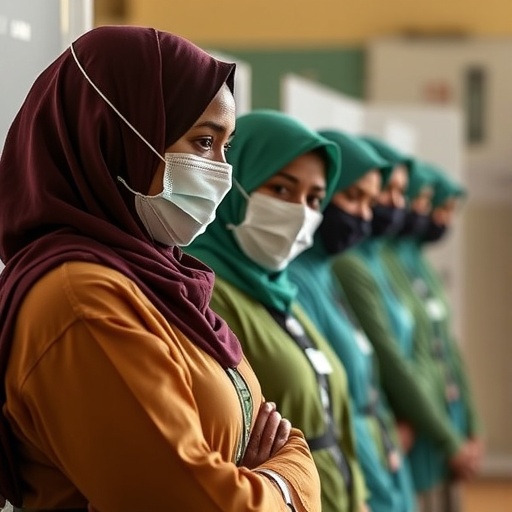
Women now make up nearly 70% of the global health workforce, yet the world still faces a shortage of 34.4 million doctors, nurses, midwives, dentists, and pharmacists, according to a new study published in The Lancet Public Health. The analysis, based on estimates from the Global Burden of Disease Study 2023, provides the first global, sex-disaggregated assessment of 20 health worker cadres across 204 countries and territories from 1990 through 2023. Its central finding is both striking and paradoxical: women have driven most of the dramatic expansion in health care labor, but millions of people remain without reliable access to essential services because health systems lack enough trained personnel.
The global health workforce nearly tripled during the period studied, rising from 40.9 million workers in 1990 to 122.1 million in 2023. Women accounted for 71.4% of that increase, adding tens of millions of workers to hospitals, clinics, pharmacies, community programs, and other health services. The growth included an increase of 18.9 million nurses and 8.7 million doctors, although the pace varied widely between countries and professional categories. Researchers describe the expansion as one of the most significant transformations in the structure of global health systems over the past three decades, while emphasizing that numerical growth alone has not eliminated geographic inequality, professional hierarchies, or persistent shortages.
In 2023, women represented 68.9% of all health workers worldwide. Their presence was particularly strong in professions traditionally associated with caregiving and community-based health delivery. Women made up 80.7% of nurses, 96.0% of midwives, and 89.5% of community health workers. By contrast, women accounted for less than half of doctors globally. Similar patterns appeared in dentistry and pharmacy, where women were more likely to work as dental or pharmaceutical assistants than as dentists or pharmacists themselves. These differences are important because professional roles are linked to income, autonomy, access to advanced training, and the likelihood of reaching senior management or policy-making positions.
“Women have transformed the global health workforce over the past three decades, but they continue to be concentrated in professions that generally offer lower pay and fewer opportunities for leadership,” said Megan Knight, the study’s lead author and a researcher at the Institute for Health Metrics and Evaluation. The pattern reflects a long-standing division of labor in health care, in which women perform a large share of direct patient care and essential support work while remaining underrepresented in the most highly paid and influential positions. The researchers argue that expanding opportunity will require more than recruiting additional workers. Health systems will also need leadership pathways, protection from harassment and discrimination, paid parental leave, flexible work arrangements, and safe working conditions that allow women to remain and advance in the profession.
The study estimates that an additional 34.4 million health workers would be needed to achieve a score of 80 out of 100 on the GBD universal health coverage effective coverage index. This benchmark represents a moderate level of universal health coverage, defined as access to essential health services without financial hardship. The projected gap includes 23.9 million nurses and midwives, 7.1 million doctors, 1.8 million dentists, and 1.6 million pharmacists. These figures do not simply represent vacancies in existing facilities. They estimate the workforce required for countries to deliver a defined level of effective coverage, taking into account population needs, service availability, and the relationship between worker density and health outcomes.
The shortages are concentrated in regions where populations are growing rapidly and health systems often operate with limited financial and educational resources. South Asia would require an additional 2.6 million doctors and 10 million nurses and midwives to reach the moderate universal health coverage threshold used in the analysis. Sub-Saharan Africa also faces severe deficits across major health professions. Nursing density in the region was estimated at 14.5 workers per 10,000 people, compared with 121.8 per 10,000 in high-income countries. At the country level, the contrast was even more pronounced: Chad had an estimated nursing density of 3.2 per 10,000 people and Madagascar 3.3, while Belgium reached 171.7 and the United States 161.4.
To translate workforce numbers into planning targets, the researchers identified minimum densities associated with moderate universal health coverage. The thresholds were 23.8 doctors and 64.5 nurses and midwives per 10,000 people, along with 5.2 dentists and 5.6 pharmacists per 10,000. Such benchmarks are not intended to function as universal staffing formulas for every hospital or community. Instead, they provide a population-level measure that governments can use to compare current capacity with projected needs. The authors say the estimates can help identify where investments in medical schools, nursing education, recruitment, retention, and distribution are most urgent, particularly in places where the workforce is clustered in major cities while rural and remote communities remain underserved.
The analysis also offers a new way to examine progress toward two United Nations Sustainable Development Goals: target 3.c.1, which calls for increased recruitment, development, training, and retention of health workers, and target 3.8, which aims to achieve universal health coverage. By separating estimates by sex and professional category, the study reveals that a country can appear to be expanding its workforce while still failing to address inequalities within it. A growing number of women may improve access to care, especially in nursing, midwifery, and community health, but unequal pay, limited promotion, and inadequate workplace support can weaken retention. At the same time, a high national worker density may conceal major shortages among rural populations or low-income communities.
“Health workers are the foundation of every health system,” said Dr. Annie Haakenstad, senior author of the study and assistant professor of health metrics sciences at the Institute for Health Metrics and Evaluation. She said the findings establish minimum thresholds that countries can use when planning how many doctors, nurses, midwives, dentists, and pharmacists will be needed to strengthen health systems and move toward universal coverage. Meeting those thresholds will require sustained investment rather than short-term emergency recruitment. Governments will need to expand training capacity, finance salaries and equipment, improve working conditions, and create policies that encourage trained professionals to stay in areas with the greatest need.
The study’s message is ultimately larger than a global head count. The world has added more than 81 million health workers since 1990, but workforce growth has not kept pace with the distribution of disease, population change, and demand for care. Women have supplied most of the expansion, yet their concentration in lower-paid roles exposes a structural weakness in the way health systems value labor. Closing the projected gap of 34.4 million workers will depend on educating and retaining far more professionals, while also ensuring that women can enter every health occupation, reach leadership positions, and work in environments where they are protected and supported. Without those changes, the global health workforce may continue to grow on paper while millions of people remain unable to obtain essential care.
Subject of Research: People
Article Title: Measuring the composition and availability of human resources for health by sex in 204 countries and territories, 1990–2023, and workforce gaps for universal health coverage: a systematic analysis for the Global Burden of Disease Study 2023
News Publication Date: 18-Aug-2026
Web References: The Lancet Public Health: https://www.thelancet.com/journals/lanpub/article/PIIS2468-2667(26)00145-3/fulltext; Institute for Health Metrics and Evaluation: https://healthdata.org/
References: DOI: 10.1016/S2468-2667(26)00145-3
Keywords: Global health workforce, women in science, nursing, midwifery, doctors, pharmacists, dentists, community health workers, universal health coverage, health equity, health disparities, public health, health care delivery, scientific workforce, health systems
Tags: doctor and nurse workforce growthfemale healthcare professionalsglobal health labor trendsglobal health workforce shortagehealth system workforce expansionhealth workforce demographic analysishealthcare access and staffing shortageshealthcare worker gender disparitiesimpact of women in healthcare sectorinternational health workforce studiessex-disaggregated health dataWomen in global health workforce