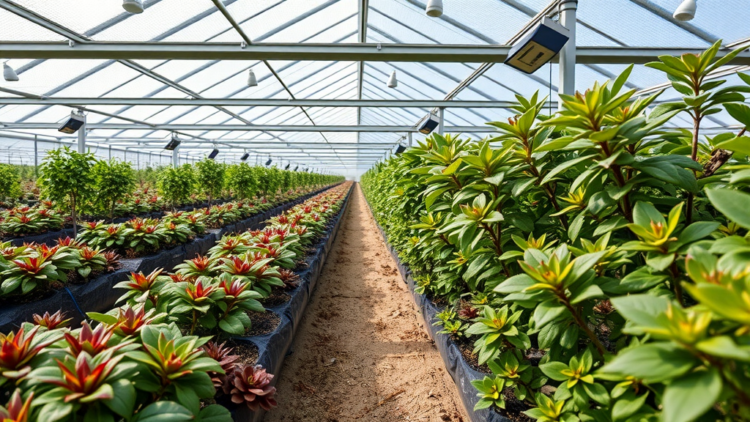
Inside a modern commercial greenhouse, the difference between a thriving crop and a struggling one often comes down to data. Temperature, humidity, light intensity, and soil moisture must be tracked continuously and reliably, because the automated systems that regulate them are only as good as the environmental readings they receive. Yet greenhouses are notoriously hostile territory for wireless networks. Cultivation racks, support columns, equipment rooms, and irrigation pipelines all block sensor signals and restrict where devices can physically be placed, creating blind spots that can silently undermine even the most sophisticated climate-control software. A new study published in Smart Agricultural Technology tackles this foundational problem head-on, presenting an enhanced artificial-intelligence optimization method that decides exactly where LoRa wireless nodes should be placed to maximize both sensing coverage and communication reliability.
The research, led by Yibo Shang and Hongling Li, introduces a refined version of the Grey Wolf Optimizer, a nature-inspired search algorithm that mimics the cooperative hunting behavior of wolf packs. The standard optimizer is popular because of its simple structure and strong global search ability, but the authors found that it tends to converge prematurely when applied to greenhouse deployment, where obstacles fragment the feasible solution space. Their improved variant, called IGWO-AS, weaves three complementary mechanisms into the original framework: an adaptive phase adjustment mechanism that controls the transition from broad exploration to fine-tuned refinement, a stochastic disturbance mechanism that maintains diversity among candidate layouts, and a communication-aware simulated annealing acceptance criterion that helps the algorithm escape local optima while favoring layouts with stronger wireless links.
Each mechanism addresses a distinct failure mode of the standard algorithm. The adaptive phase adjustment replaces the usual linearly decreasing convergence factor with a Gaussian-shaped nonlinear schedule. In early iterations, the convergence factor remains relatively high, encouraging the virtual wolf pack to roam widely across the greenhouse floor plan and identify broad regions where nodes could plausibly operate. As iterations progress, the factor decays more sharply than in the linear version, pulling candidate solutions toward promising deployment structures, and in the final stage it suppresses abrupt position changes so that node coordinates settle stably rather than oscillating around coverage holes. The phase coefficient was set to a value of five after preliminary trials, and dedicated sensitivity experiments confirmed that values that were too small left the algorithm exploring too late, while values that were too large caused premature contraction of the search.
The second mechanism injects controlled randomness into the position updates. In the standard optimizer, candidate solutions gravitate steadily toward the pack leaders, which risks clustering every node near obstacle boundaries or around the fixed gateway position, leaving distant corners of the greenhouse uncovered. The stochastic disturbance mechanism perturbs a small fraction of decision variables each iteration, with a disturbance probability of 0.1 and an amplitude coefficient of 0.6, chosen through systematic sensitivity testing. Boundary correction keeps perturbed coordinates within legal ranges, and any node that lands inside an obstacle region is repaired before evaluation. The result is a population of candidate layouts that stays diverse enough to discover balanced spatial arrangements without descending into the noisy, unstable convergence that excessive randomness would cause.
The third and perhaps most distinctive innovation is the communication-aware acceptance criterion, which borrows from simulated annealing. Instead of greedily rejecting any new layout with slightly worse coverage fitness, the algorithm occasionally accepts such solutions with a probability that depends on both an annealing temperature and a relative link-quality ratio between the old and new deployments. When a marginally worse coverage layout promises measurably better LoRa communication quality, it has a heightened chance of being retained. This design embeds communication reliability directly into the search process without complicating the primary coverage objective, allowing the optimizer to favor placements that will hold up in real radio environments rather than merely looking good on a coverage map.
The deployment problem itself was formulated rigorously. The greenhouse monitoring region is discretized into a 100 by 100 grid of sampling points, obstacles are excluded from the valid set, and a sampling point counts as covered only when it lies within the sensing radius of at least one node and the straight line between them does not intersect any obstacle. The objective, expressed as a minimization fitness function, is to maximize the fraction of valid points covered. Importantly, the researchers showed that their added mechanisms do not change the asymptotic computational complexity of the standard optimizer, which remains linear in iterations, population size, and decision dimensions, meaning the improvements come from smarter search rather than heavier computation.
The algorithm was paired with a complete three-layer Internet of Things system architecture. The perception layer combines environmental sensors for air temperature, humidity, and light with soil sensors measuring soil temperature and volumetric water content, all integrated around STM32F407 microcontrollers with SX1276-based LoRa modules, RS-485 and I²C interfaces, relay drivers, and PWM circuits for actuating irrigation pumps, ventilation, and lighting. The network layer centers on a LoRa gateway in a star topology that relays data to the cloud, while the application layer runs on an IoT cloud platform supporting device virtualization, data visualization, threshold configuration, and remote command execution. Standby power consumption of the nodes stays below half a watt, an important consideration for long-term battery-powered deployment.
Field validation took place in a 50-meter by 50-meter commercial multi-span greenhouse in the dryland farming region of northwestern China, where obstacles covered roughly 15 percent of the area. Three deployment schemes were compared under identical hardware and conditions: the proposed IGWO-AS layout, a standard Grey Wolf Optimizer layout, and a traditional equidistant empirical layout, each using 40 LoRa sensing nodes with a fixed gateway. IGWO-AS achieved a measured effective coverage rate of 93.5 percent on a 2-meter by 2-meter physical grid, beating 87.2 percent for standard GWO and 84.1 percent for empirical placement. Perhaps more striking was the communication result: average packet loss at 100 meters was just 0.2 percent for IGWO-AS, compared with 0.5 percent for GWO and 0.9 percent for empirical deployment, indicating that more uniform node spacing also produces more stable wireless links and fewer energy-wasting retransmissions.
Simulation experiments reinforced the field findings across six scenarios spanning 50, 60, and 70-meter regions under both obstacle-free and obstacle-constrained conditions. In ablation tests, each of the three mechanisms contributed measurable gains on its own, but the full integration delivered the most uniform layouts, faster convergence, and the highest final coverage. Benchmark comparisons against Particle Swarm Optimization, the Whale Optimization Algorithm, Harris Hawks Optimization, the Dung Beetle Optimizer, the Crested Porcupine Optimizer, and an established improved GWO variant showed IGWO-AS reaching high-coverage states earlier and sustaining smoother convergence trends, with the advantage growing most pronounced in larger, heavily obstructed spaces. Statistical analysis over 30 independent runs per scenario, including Wilcoxon rank-sum testing, confirmed that IGWO-AS not only achieved higher median coverage but also produced markedly narrower dispersion, a crucial property for engineers who cannot rely on lucky random initializations.
The authors are candid about the limits of the current work. Field validation was conducted in a single representative greenhouse, and future testing should span different structural layouts, crop distributions, obstacle densities, and seasonal conditions. The deployment model also does not yet incorporate long-term energy consumption, battery state, sensor drift, or maintenance costs, and the theoretical convergence properties of the multi-mechanism framework remain to be characterized formally. Still, the practical implications are considerable: with reliable coverage and low packet loss established as the sensing backbone, the same architecture can now integrate advanced closed-loop strategies such as model predictive control and LSTM-based microclimate forecasting. In an era when protected cultivation must deliver more food with fewer resources, ensuring that every corner of a greenhouse can see, speak, and be heard may prove just as important as the control algorithms that listen.
Subject of Research: Optimization of relay-node deployment for LoRa-based wireless sensor networks in smart greenhouse systems
Article Title: IGWO-AS: An enhanced grey wolf optimizer for relay-node deployment in LoRa-based smart greenhouse systems
Article References: Shang, Y., & Li, H. (2026). IGWO-AS: An enhanced grey wolf optimizer for relay-node deployment in LoRa-based smart greenhouse systems. Smart Agricultural Technology, 15, Article 102538. https://doi.org/10.1016/j.atech.2026.102538
Image Credits: AI Generated
DOI: 10.1016/j.atech.2026.102538
Keywords: smart greenhouse, LoRa, grey wolf optimizer, wireless sensor network, node deployment, Internet of Things, precision agriculture, coverage optimization, simulated annealing, metaheuristics, environmental monitoring, IoT architecture
Cite Scienmag News
APA MLA Chicago
Alan Morgan. (September 12, 2026). Wolf-Inspired Algorithm Boosts Sensor Coverage in Smart Greenhouses. Scienmag. https://scienmag.com/wolf-inspired-algorithm-boosts-sensor-coverage-in-smart-greenhouses/
Alan Morgan. “Wolf-Inspired Algorithm Boosts Sensor Coverage in Smart Greenhouses.” Scienmag, 12 September 2026, https://scienmag.com/wolf-inspired-algorithm-boosts-sensor-coverage-in-smart-greenhouses/. Accessed 12 September 2026.
Alan Morgan. “Wolf-Inspired Algorithm Boosts Sensor Coverage in Smart Greenhouses.” Scienmag. September 12, 2026. https://scienmag.com/wolf-inspired-algorithm-boosts-sensor-coverage-in-smart-greenhouses/
Copy citation Download RIS
Tags: AI-driven greenhouse climate controlautonomous sensor node placementcoverage optimizationEnvironmental Monitoringgreenhouse data collection challengesGreenhouse sensor network optimizationgrey wolf optimizerGrey Wolf Optimizer for agricultureInternet of ThingsIoT architectureLoRaLoRa sensor deploymentmetaheuristicsnature-inspired algorithms for agriculturenode deploymentoptimizing sensor coverage in obstructed environmentsprecision agriculturesensor placement in hostile environmentssimulated annealingsmart greenhousesmart greenhouse environmental monitoringwireless communication in greenhouseswireless sensor networkwireless signal coverage in greenhouses