Credit: (c) MPI-P
The fungal disease "Esca" infects grapevines and causes great financial damage to winegrowers every year. The fungus infects the vine trunks and decomposes the wood from inside – so spraying cannot reach the fungus. Dr. Frederik R. Wurm and colleagues have developed a nanotechnology-based carrier to protect and heal the vine from the infestation. Here, "nanocarriers" – i.e. small nanoparticles smaller than a millionth of a meter – made by chemical processes are filled with a commercially available fungicide. These nanospheres are inserted directly into the trunk of the plants.
The shell of these balls is made of lignin – a substance that is the main component of wood besides cellulose. Therefore, this shell can also be decomposed by the fungus, thus releasing the agent inside the nanoparticle. "It is almost like a Trojan Horse: the fungus decomposes the shell of our nanocarriers and releases the fungicide that fights it", says Wurm. One of the main advantages of the method of the scientists is that the agent is delivered slowly and over a long period of time.
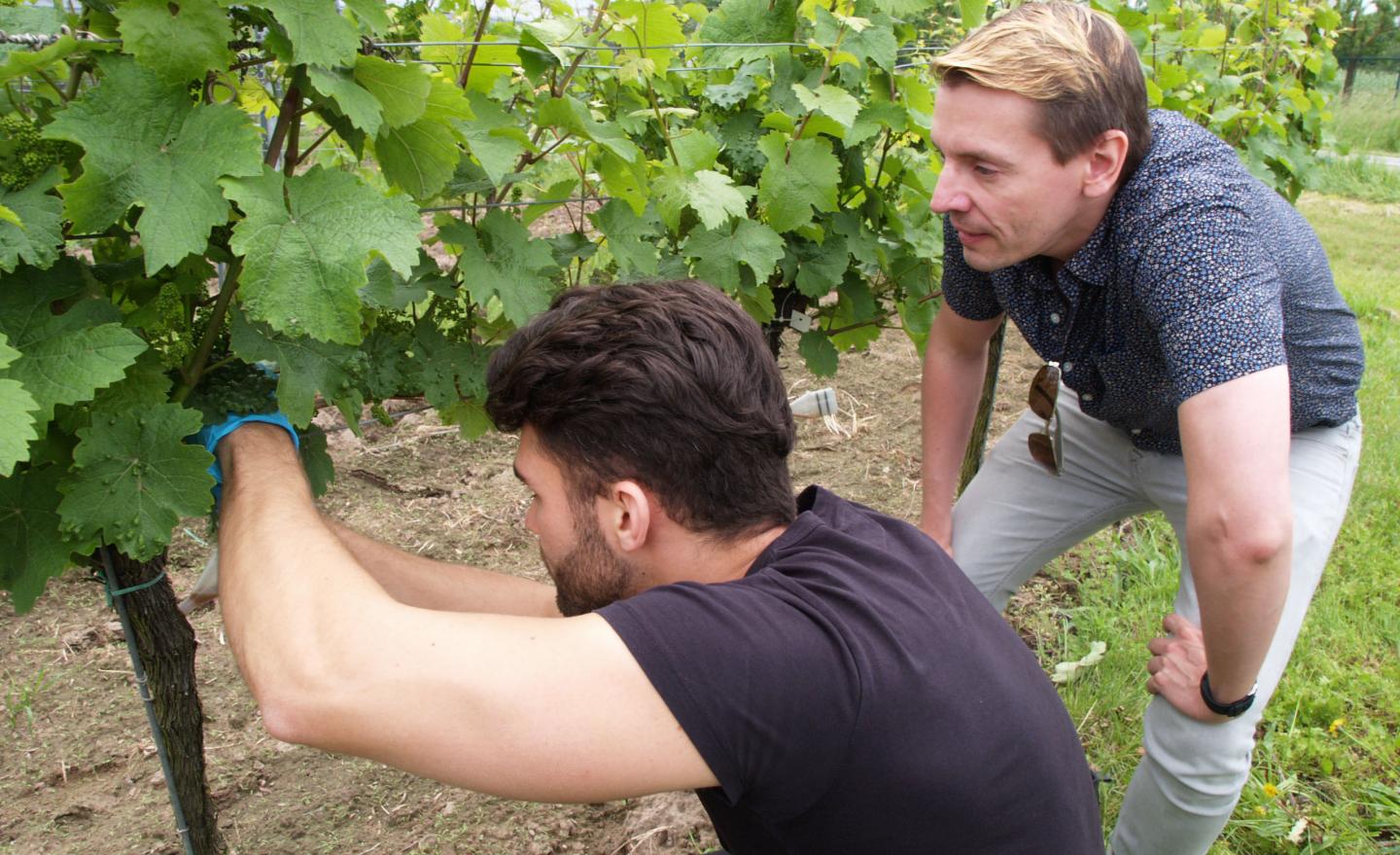
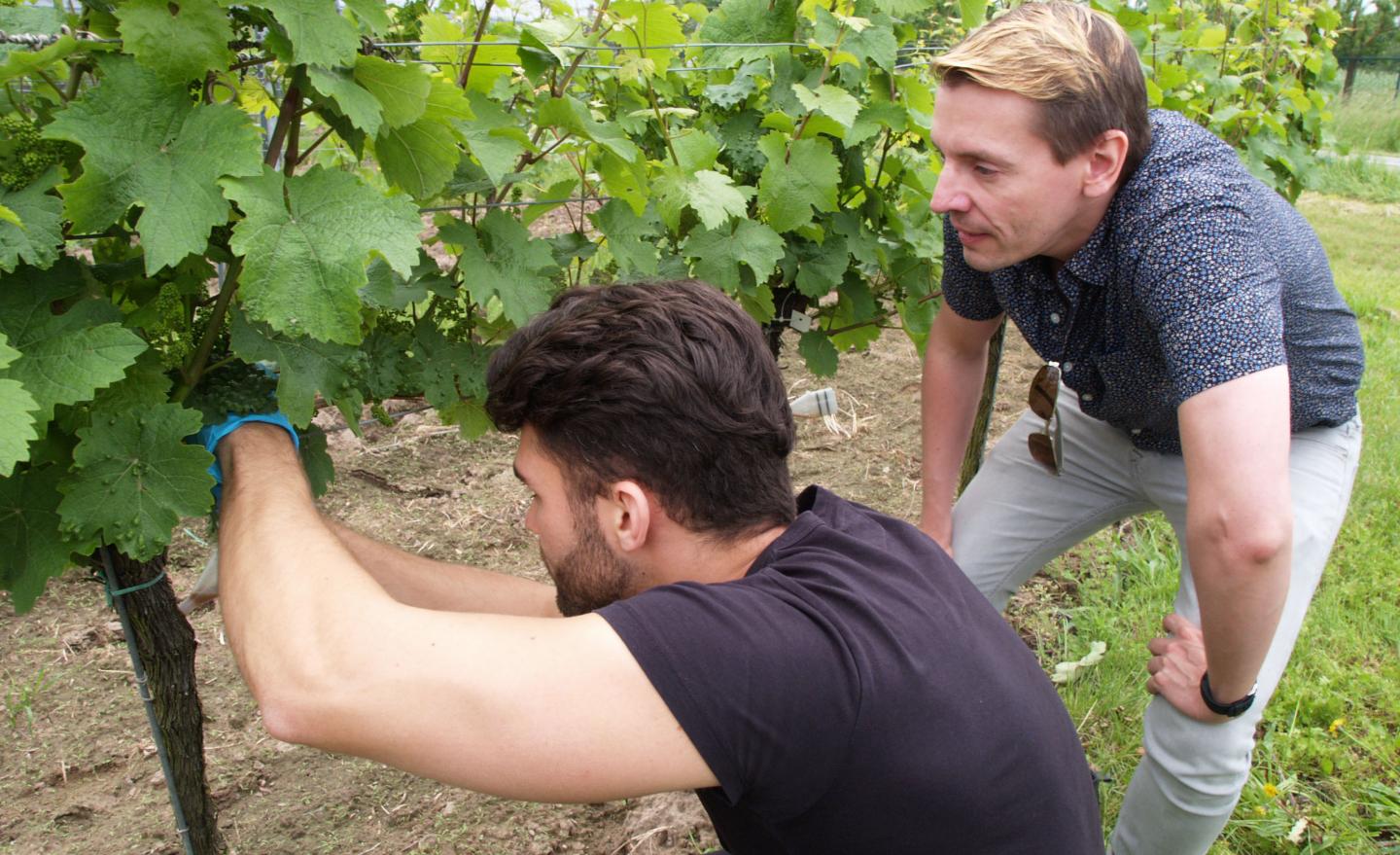
After successful initial trials, more than 100 grapevines have now been treated by the interdisciplinary research team on a vineyard of the DLR in Neustadt a.d. Weinstrasse, Germany. Within several hours, they drilled holes into the trunks and inserted small tanks containing the agent. Scientists can expect initial results within a few weeks, but the plants will be observed for several years.
The project is carried out together with the "Institute for Biotechnology and Drug Research" (Kaiserslautern, Germany), and the "Dienstleistungszentrum Ländlicher Raum Rheinpfalz, Institut für Pflanzenschutz" (Neustadt a.d. Weinstrasse).
The technology has already been patented by Wurm and colleagues.
###
About Frederik Wurm
Frederik Wurm was born in Wiesbaden and studied chemistry at the Johannes Gutenberg University Mainz and the University of Toronto. After completing his PhD in 2009 and postdoctoral studies as a Feodor-Lynen Fellow at the École Polytechnique Fédérale in Lausanne, he became group leader in the department of Katharina Landfester at the Max Planck Institute for Polymer Research in Mainz in November 2011. His research includes the production of biodegradable polymers and nanocarriers. He was recently awarded the Lecturer's Prize of the German Chemical Industry Fund.
Max Planck Institute for Polymer Research
The Max Planck Institute for Polymer Research (MPI-P) ranks among the globally leading research centers in the field of polymer research since its foundation in 1984. The focus on soft materials and macromolecular materials has resulted in the worldwide unique position of the MPI-P and its research focus. Fundamental polymers research on both production and characterization as well as analysis of physical and chemical properties are conducted by scientific collaborators from all over the world. Presently over 500 people are working at the MPI-P, the vast majority of whom are engaged in scientific research.
Additional information:
Pictures and audio files: http://www.mpip-mainz.mpg.de/5341147/PM2018-14
Group page of Dr. Frederik Wurm: http://www.mpip-mainz.mpg.de/3479149/Welcome
Max Planck Institute for Polymer Research: http://www.mpip-mainz.mpg.de/home/en
Patent Application: https://patents.google.com/patent/WO2017134308A1/en
Publication about nanomaterials: https://pubs.acs.org/doi/abs/10.1021/acsbiomaterials.7b00278
Institute for Biotechnology and Drug Research: http://www.ibwf.de
Dienstleistungszentrum Ländlicher Raum Rheinpfalz: http://www.dlr-rheinpfalz.rlp.de
Media Contact
Dr. Frederik Wurm
[email protected]
49-613-137-9581
http://www.mpip-mainz.mpg.de/
Original Source
http://www.mpip-mainz.mpg.de/5341847/PM2018-14