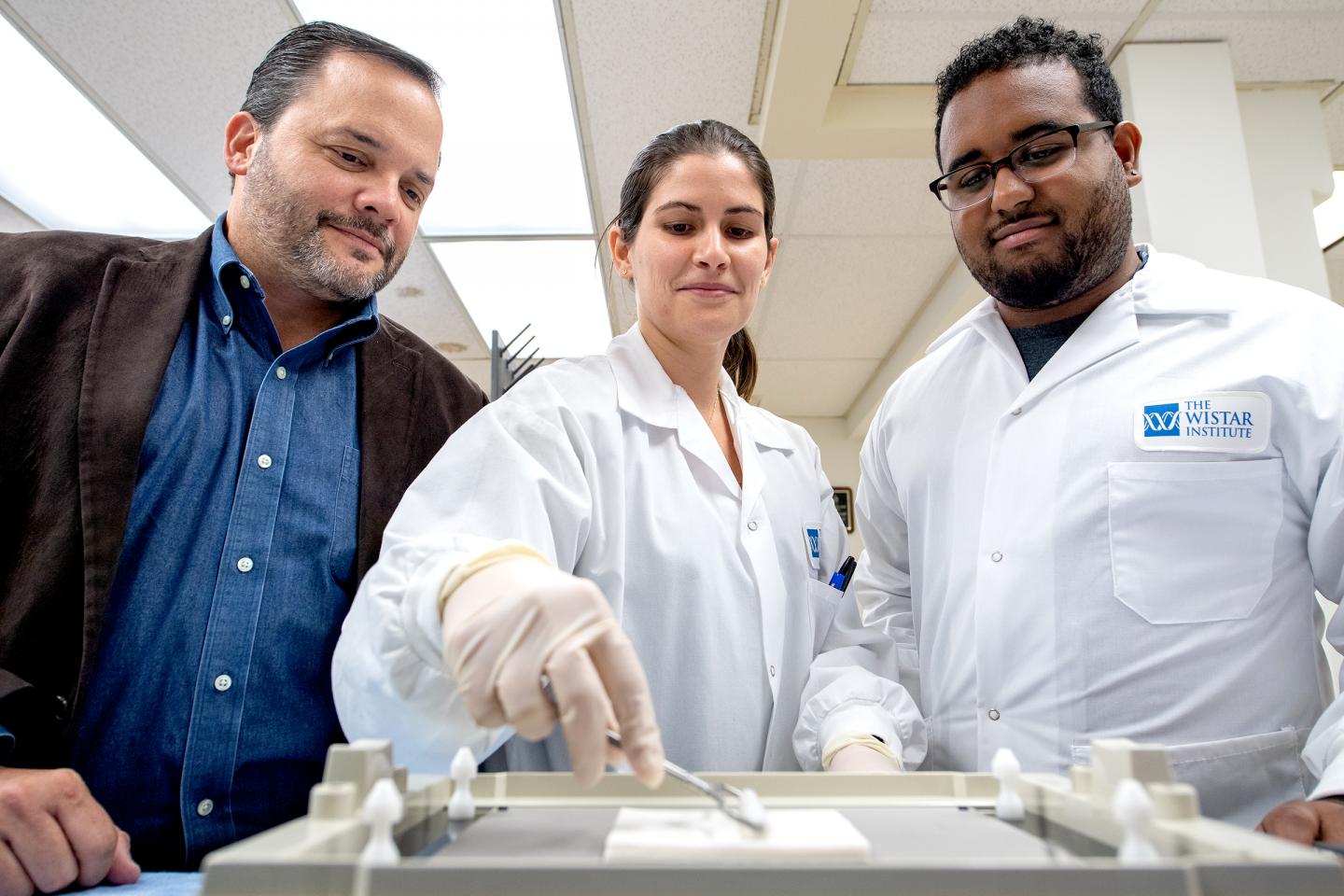
Credit: The Wistar Institute
PHILADELPHIA — (September 24, 2019) — The Wistar Institute was awarded two major grants totaling more than $12 million from the National Institute on Drug Abuse (NIDA), part of the National Institutes of Health, to fund an international multidisciplinary clinical research consortium spearheaded by Wistar’s HIV Research Program. The consortium, including several partner institutions in the U.S. and abroad, will investigate the impact of opioid use disorder (OUD) and medications for opioid use disorder (MOUDs) on immune recovery in response to antiretroviral therapy (ART) in HIV-infected people.
“We have uncovered a potential link between substance abuse, HIV infection and MOUDs that may determine health outcomes only if the right medication is chosen,” said study leader Luis J. Montaner, D.V.M., D.Phil., the Herbert Kean, M.D., Family Professor and director of the HIV-1 Immunopathogenesis Laboratory at Wistar’s Vaccine & Immunotherapy Center.
Both HIV infection and chronic opioid exposure are associated with immune activation, which leads to T-cell depletion and progression to acquired immunodeficiency syndrome (AIDS).
OUD is commonly treated with drugs that either activate (agonists) or block (antagonists) the opioid receptor. “Yet, we have a very limited understanding of how the medications we use to treat OUD impact disease progression and the response to ART in people living with HIV,” commented Montaner.
The overarching goal of this research is to investigate the role of opioid receptor involvement in modulating the levels of immune activation, and the effects of different classes of MOUDs, in people living with HIV. Effectively controlling immune activation after ART in persons taking MOUDS can directly impact health and mortality.
The NIDA support of this initiative will fund two clinical studies:
- The first grant provides $8,373,891 over five years for an international trial conducted among the U.S., Vietnam and France, in collaboration with the Vietnam Ministry of Health, the Perelman School of Medicine at the University of Pennsylvania, the Institute of Applied Medicine and Epidemiology (a French-led initiative to expand access to HIV/hepatitis prevention and treatment services), and the Pasteur Institute.
The goal of this three-arm randomized trial, conducted in Vietnam and co-led by Montaner and David Metzger, Ph.D., a research professor and director of the HIV Prevention Research Division at the Perelman School of Medicine at the University of Pennsylvania, is to evaluate the impact of long-term opioid receptor stimulation or blockage with MOUDs on immune reconstitution in HIV-infected people who inject drugs and are initiating ART. Early preliminary data suggest that chronic opioid receptor engagement by an opioid receptor agonist while on ART may result in increased immune activation and inflammation associated with increased levels of persistent HIV, when compared to a full opioid receptor antagonist. To verify this hypothesis, the study will assess recovery outcomes and adherence to therapy 48 weeks after initiation of ART in 225 participants with OUD who receive either methadone (opioid receptor agonist), extended-release naltrexone (antagonist) or buprenorphine (partial agonist).
- A second, complementary grant will provide $3,889,138 over five years for mechanistic studies on local persons living with HIV on ART and taking MOUDs. Collaborators on this research are the Perelman School of Medicine at the University of Pennsylvania, Jonathan Lax Treatment Center, and the Icahn School of Medicine at Mount Sinai. The study will assess the preliminary observation that greater myeloid activation and HIV persistence are present in people receiving opioid receptor agonists when compared to people treated with opioid receptor antagonist naltrexone.
Blood and tissue samples from individuals living with HIV who are receiving ART and treatment with different MOUDs will be used to study the mechanisms that regulate persistent immune activation and residual HIV expression.
“We expect the results of this major collaborative effort, which has its hub in Philadelphia, to have broad clinical implications in informing the best pharmacologic strategy for the management of opioid use disease in HIV-infected people starting ART,” said Montaner. “This is directly relevant in light of the opioid epidemic ongoing in our nation and will help ensure that the right medications are used for both HIV and OUD, with the ultimate objective of saving lives in the future.”
###
The Wistar Institute is an international leader in biomedical research with special cancer, immunology, infectious disease research, and vaccine development. Founded in 1892 as the first independent nonprofit biomedical research institute in the United States, Wistar has held the prestigious Cancer Center designation from the National Cancer Institute since 1972. The Institute works actively to ensure that research advances move from the laboratory to the clinic as quickly as possible. wistar.org.
Media Contact
Ms. Darien Sutton
[email protected]
Original Source
https:/