


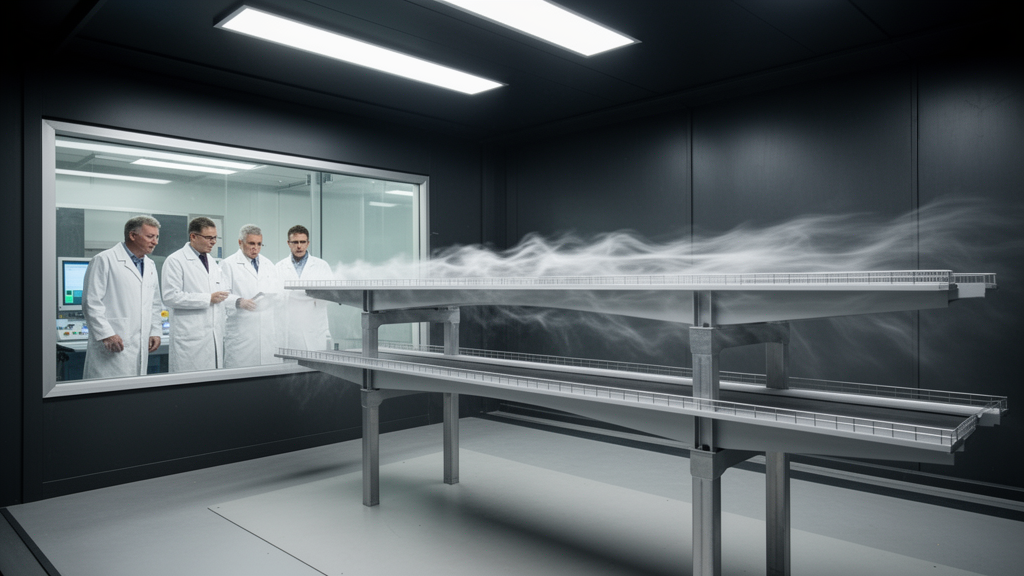
Double-deck bridges are becoming an increasingly common answer to crowded transport corridors, but the bluff, truss-braced girders that carry their two traffic levels behave in aerodynamically complicated ways. A new study published in Advances in Aerodynamics has combined wind tunnel testing with computational fluid dynamics to measure, for the first time in a systematic comparison, how three distinct double-deck girder configurations divide wind loads among their structural subcomponents. The work, led by Bo Wu and colleagues, goes beyond the usual whole-structure analysis and shows that the way drag, lift and pitching moment are partitioned between upper decks, lower decks, windward trusses and leeward trusses depends strongly on the girder’s cross-sectional shape.
The researchers classified double-deck girders into three representative configurations defined by the relative widths of their upper and lower decks. Model A has equal-width upper and lower decks of 0.35 metres at model scale. Model B takes an inverted-trapezoidal form, with the upper deck at 0.35 metres but the lower deck narrowed to 0.18 metres. Model C keeps the 0.35-metre upper deck but extends the lower deck to 0.45 metres through cantilever slabs on each side. Each sectional model was built at a geometric scale of 1:80 from epoxy resin boards and engineering plastic, with a total length of 2.1 metres and a height of 0.165 metres. The truss system consisted of 19 bays along the span, each bay 110 millimetres wide with diagonal and vertical members forming triangular bracing, giving a calculated solidity ratio of 0.38. The bare girder, without ancillary structures such as railings or fairings, was the test subject.
The static force measurements were carried out in the XNJD-1 wind tunnel at Southwest Jiaotong University, in a test section 2.4 metres wide and 2.0 metres high. The incoming flow was set to 10 metres per second and measured with a TFI Cobra Probe, while a computer-driven mechanism varied the angle of attack from −6 degrees to +6 degrees in 2-degree increments. Each model was mounted on a side-wall support system with a dedicated setup measuring lift, drag and pitching moment, from which the corresponding force coefficients were calculated using the model dimensions and the upper deck width as the reference length.
The global force results revealed clear differences among the three shapes. Model B, the inverted trapezoid, produced the lowest drag coefficient across most angles of attack, an exception occurring at plus or minus 2 degrees, and also the smallest absolute lift coefficients under most conditions. The authors attribute its low drag to the significantly shortened lower deck, which reduces the frontal projected area exposed to airflow impingement. Model A showed peak drag coefficients in the angle-of-attack range from −6 degrees to +2 degrees, with intermediate lift and moment values. Model C’s drag coefficients were comparable to Model A’s at large angles of attack and to Model B’s at small ones, but this configuration displayed the most pronounced dependence on angle of attack. For lift, the magnitude of the absolute coefficients increased in the order of Model B, Model A and Model C, with Model C’s cantilever slab generating the largest pressure differential between upper and lower surfaces. Model B exhibited the largest moment coefficients, a consequence of its strongly asymmetric cross-section, while Model A, being aerodynamically symmetric, kept its moment coefficient closest to zero with minimal variation across the tested angles.
The central novelty of the study lies in its subcomponent-level force partitioning. Using numerical simulations, the team decomposed each girder into four parts—the upper deck, the lower deck, the windward truss and the leeward truss—and integrated pressure and shear stresses over each surface independently, verifying that the sum matched the total force on the main girder. For mean drag, the windward and leeward trusses together carried over 50 percent of the total in every configuration, with the combined share decreasing as the lower deck became narrower: largest for Model C, intermediate for Model A and smallest for Model B. In Model A, the windward truss alone accounted for roughly half the drag, the leeward truss 22 percent, and the two decks 13 percent each; in Model C the windward truss took about 55 percent, the leeward truss 25 percent, the upper deck 15 percent and the lower deck only 5 percent.
The distribution of mean lift and moment separated the models into two behavioural groups. In Models A and C, the upper deck generated positive lift and moment while the lower deck produced nearly equal negative values, so the net loads were close to zero and the two decks shared the loading in a balanced way. In Model B, by contrast, the mean lift was carried almost entirely by the upper deck, which accounted for nearly 100 percent of the total, and the upper deck’s moment contribution reached 1.15 times the total moment, partially offset by a counteracting moment of about 10 percent from the lower deck. The fluctuating, time-varying components told a complementary story: fluctuating drag was dominated by the trusses in all three models, while fluctuating lift and moment were governed mainly by the decks, exceeding a combined 70 percent contribution in Models A and C, with Model B’s fluctuating loads concentrated on the windward truss and upper deck. Notably, some subcomponent shares summed to more than 100 percent because opposing forces in the upper and lower decks, or in the two trusses, acted with phase differences in their time histories.
To ensure the numerical results were trustworthy, the team ran both two-dimensional unsteady Reynolds-averaged Navier–Stokes simulations and three-dimensional large eddy simulations, the latter using meshes of 7.2 to 9.4 million cells depending on the model. Against the wind tunnel measurements, the drag coefficient deviated by less than 5 percent at zero angle of attack and within 8 percent over the full range; lift coefficient errors peaked at about 9 percent near −6 degrees but stayed within 4 percent at small angles; and the moment coefficient agreed with a maximum absolute error of roughly 0.002, below 2 percent in relative terms. This level of consistency supported the use of the simulations for the detailed partitioning analysis and for the flow field investigations that followed.
The flow mechanisms behind these differences were probed with Dynamic Mode Decomposition applied to 500 vorticity field snapshots for each model. Three dominant vortex modes emerged across all configurations. The first captured large-scale vortex shedding from the trailing edge of the lower deck, with shedding frequency increasing as the lower deck grew longer. The second characterised vortex evolution in the gap between the windward and leeward trusses: Models A and C showed strong, periodic, energy-concentrated vortices there, reflecting significant interference between the decks and directly contributing to drag, whereas Model B’s dense but porous truss produced no distinct interlayer vortices, with high vorticity instead concentrated in the wake of the leeward truss and upper deck. The third mode captured smaller-scale shedding from the upper deck and leeward truss trailing edges. Excluding the steady zeroth-order mode, the first three modes accounted for 14, 12.2 and 9.6 percent of the total modal energy in Model A, confirming that a small set of coherent structures governs the primary flow dynamics.
The authors translate these findings into design guidance. Model B, with its lowest drag, is recommended for high-wind regions, but the concentration of aerodynamic loads on its upper deck means that deck requires structural reinforcement. Model A’s balanced load sharing between decks lends itself to standardised design, while Model C’s relatively high drag and strong sensitivity to angle of attack suggest that careful aerodynamic mitigation would be needed in practice. Because the study examined bare sectional models at a single wind speed and a fixed range of angles of attack, the results characterise these idealised configurations rather than full bridges in turbulent atmospheric boundary layers; nevertheless, the quantified partitioning data and identified vortex modes offer a direct physical basis for wind-resistant design of the growing generation of double-deck crossings.
Subject of Research: Aerodynamic force partitioning among subcomponents of double-deck bridge girders with three cross-sectional configurations
Article Title: Measurement of aerodynamic force partitioning among subcomponents in double-deck girders with varied configurations
Article References: Wu, B., Li, J., Yu, Z., Wei, L., Wu, D., Wu, F., & Yang, Y. (2026). Measurement of aerodynamic force partitioning among subcomponents in double-deck girders with varied configurations. Advances in Aerodynamics, 8(1), Article 18. https://doi.org/10.1186/s42774-026-00259-2
Image Credits: AI Generated
DOI: 10.1186/s42774-026-00259-2
Keywords: double-deck bridges, aerodynamics, wind tunnel testing, force partitioning, computational fluid dynamics, Dynamic Mode Decomposition, vortex shedding, bridge engineering, drag coefficient, wind-resistant design, large eddy simulation, truss girders
News Source: Denise Maddox. (October 29, 2026). Wind tunnel study reveals how double-deck bridge girder shapes split aerodynamic loads. Scienmag.



