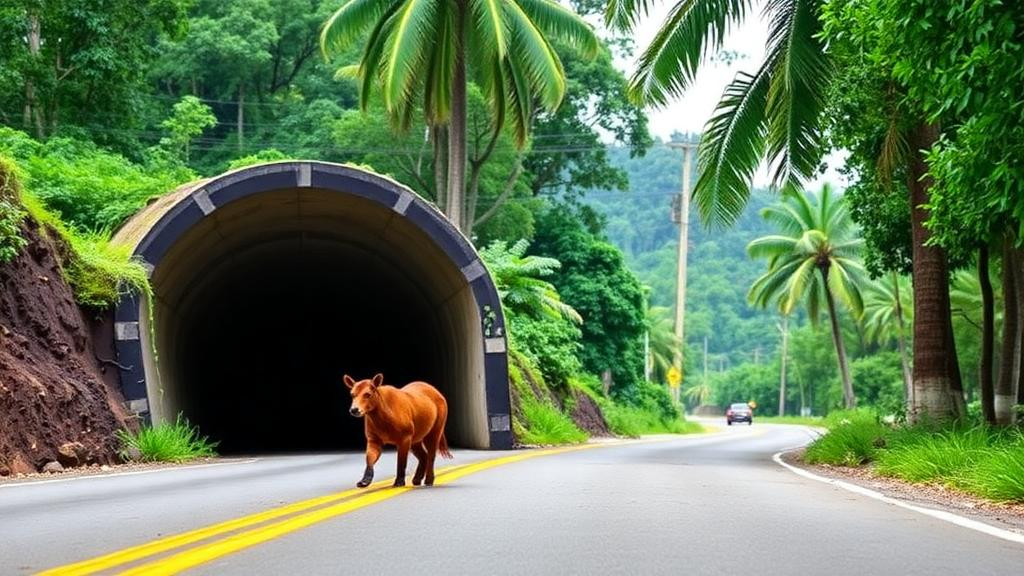
When a wild animal must cross a busy road, every second of exposure can be dangerous. A vehicle may pass at the wrong moment, while traffic noise, roadside vegetation and barriers can push the animal deeper into a hazardous attempt to reach the habitat on the other side. Four underpasses built beneath Route 606 near Guacimal, Costa Rica, appear to offer another option. Camera traps recorded 12 mammal species entering or leaving the structures during a three-week monitoring period, providing a rare field demonstration that tunnels and drainage culverts can connect habitat fragments while keeping animals out of moving traffic.
The observations, made between 14 November and 6 December 2021, included two purpose-built subterranean tunnels and two dry circular culverts. The larger crossings were designed for wildlife, whereas the culverts were created to divert water beneath the road. Nevertheless, both types functioned as animal passages. Across all four structures, cameras documented 108 crossings. The results show that relatively simple infrastructure can be used by animals with very different body sizes and behaviors, from rodents and opossums to armadillos, raccoon-like coatis, wild cats and domestic dogs. The findings also demonstrate that drainage structures, even when not built specifically for wildlife, may provide valuable crossing opportunities where the surrounding land remains connected on both sides.
Route 606 runs between Guacimal and Monteverde through a landscape of pastures, secondary forest and patches of primary growth. The road is especially challenging for wildlife because it carries frequent traffic associated with travel and tourism. Before the tunnels were installed in 2016, local observations had documented both animal crossings and roadkill. The new structures were intended to reduce that mortality and maintain links between habitat fragments, but their actual use by local mammals had not previously been tested with camera traps. Fifteen cameras were deployed around the four crossings, while mud track stations placed at tunnel entrances provided supporting evidence that could be compared with the photographs.
The individual structures produced strikingly different patterns of use. The circular Tunnel 1 recorded 67 crossings involving 10 species, making it both the busiest and the most biologically diverse of the purpose-built passages. The square Tunnel 2, located less than 400 meters away, recorded 24 crossings by four species. Among the smaller culverts, Culvert 2 was used more frequently, with 12 crossings by two species, whereas Culvert 1 produced five crossings but involved three species. These patterns show why traffic volume alone cannot determine which structure will work. Shape, habitat cover, barriers and the species present on either side of the road can all influence whether an animal is willing to enter and use an underpass.
Common opossums were the most frequent native users, appearing in all four passages. Agoutis, nine-banded armadillos and northern tamanduas were also among the most frequently recorded native mammals, while coatis, ocelots, variegated squirrels and Norway rats made repeated use of the tunnels. The smaller culverts accommodated common opossums, domestic cats, rat opossums and Watson’s climbing rats. Some animals in the surrounding fragments were never filmed using a crossing during the survey. These included coyotes, gray foxes, cows, chickens, black iguanas, an olive sparrow, a Swainson’s thrush, a spiny pocket mouse and a rice rat. Cameras confirmed their presence near the road, but not passage through the underpasses.
Timing added another ecological layer. Native species crossed mainly at night, whereas domestic cats and dogs used the structures most often during daylight hours. This temporal separation may reduce direct encounters between people’s animals and wildlife, but it does not eliminate the potential problem. The study counted repeated movements by a small number of individuals, including a pair of dogs responsible for 15 passages through Tunnel 1 and a cat recorded crossing Culvert 2 four times. Domestic cats and dogs hunt wildlife, and repeated underpass traffic could give them access to otherwise separated areas. Local residents may therefore need guidance on managing pets near crossing structures even while the passages benefit wild animals.
Vegetation and structural design may help explain why the tunnels and culverts differed so much in performance. Tunnel 1 had considerably more tree cover around its entrances than Tunnel 2, and the more heavily used Culvert 2 also had denser surrounding vegetation. The northern tamandua crossed only through the circular Tunnel 1, even though it was photographed less than five meters from the entrance of the square Tunnel 2. Its behavior is consistent with a preference for a rounded passage, although other studies have recorded northern tamanduas using square structures elsewhere. No single crossing design accommodates every species: dimensions, internal light, substrate, cover and familiarity can all shape a mammal’s decision to enter. The Route 606 observations also include army ants and leaf-cutting termites moving through the passages in foraging trails, although the study was not designed to quantify insect use.
Human modifications created a conspicuous obstacle. After the wildlife tunnels were built, landowners surrounding them placed barbed-wire fencing across the entrances to keep livestock out. These fences were not designed as wildlife deterrents, yet they likely restricted access, especially for larger animals. Collared peccaries and white-tailed deer had previously been seen crossing the road or dying on it, but neither was observed using the underpasses; both would have had difficulty passing the added barriers. The fence at Tunnel 2 was more degraded and had fewer wire lines than the one at Tunnel 1, which may have influenced usage. Reconfiguring livestock exclusion so that it keeps cattle away without blocking native species could make these crossings more inclusive. Purpose-built roadside guide fences can also funnel animals toward passages, although poorly designed fencing can injure wildlife and create new barriers of its own.
The findings are persuasive evidence of road permeability, but they are not a complete test of conservation success. The survey lasted only three weeks, so seasonal changes, unusual weather and differences in animal abundance could have affected the totals. The researchers also lacked comparable pre-installation camera data, making it impossible to quantify how much roadkill or crossing activity changed after construction. Nevertheless, animals photographed entering and leaving the passages were using them to move beneath Route 606 rather than across its traffic lanes. Species that are frequently killed on Costa Rican roads, including opossums, tamanduas and armadillos, took advantage of the routes, while uncommon and conservation-sensitive mammals such as the ocelot and northern tamandua also crossed safely. Longer studies, comparing different designs and quantifying population-level effects, will be needed to determine which combinations of fencing, vegetation, shape and maintenance deliver the greatest benefits.
Subject of Research: Wildlife underpass use by 12 mammal species crossing Route 606 in Costa Rica
Article Title: Mammal use of underpasses to cross Route 606 in Guacimal, Costa Rica
Article References: Terner, E. R. (2023). Mammal use of underpasses to cross Route 606 in Guacimal, Costa Rica. Neotropical Biology and Conservation, 18(2), 107-117. https://doi.org/10.3897/neotropical.18.e102809
Image Credits: AI Generated
DOI: 10.3897/neotropical.18.e102809
Keywords: wildlife underpasses, habitat fragmentation, Route 606, Costa Rica, mammal movement, road ecology, camera trapping, wildlife-vehicle collisions, conservation infrastructure, animal corridors, Mammal, underpasses
News Source: Margaret Porter. (October 19, 2026). Wildlife Tunnels Give Costa Rica’s Road-Crossing Mammals a Safer Route. Scienmag.