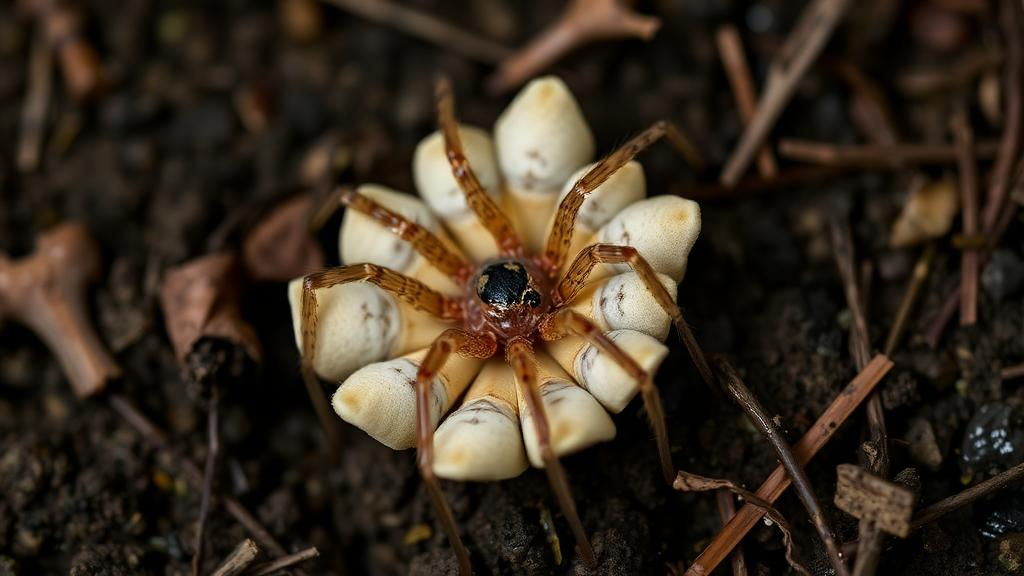
A trapdoor spider hidden beneath the leaf litter of Brazil’s Atlantic Forest carried an unexpected passenger: a previously unknown fungus that killed the arachnid and grew a purple, spore-producing stalk from its body. Researchers examining the specimen found that the pathogen belonged to the Purpureocillium genus and was closely related to P. atypicola, a widespread spider parasite that has remained taxonomically obscure for more than a century. The discovery was published in IMA Fungus as the formal description of Purpureocillium atlanticum, named for the threatened biome where it was found.
The new species was recovered during a six-hour field survey in November 2022 at the RPPN Alto da Figueira private reserve, a cloud forest near Nova Friburgo in Rio de Janeiro state. The researchers were searching for arthropod-associated fungi, including the “zombie-ant” fungi and related pathogens that infect spiders, moths, and other invertebrates. They inspected soil, leaves, trunks, and shrub surfaces, then noticed a narrow fungal structure projecting from a hole in the forest floor. Excavation revealed a trapdoor spider at the bottom of its burrow, covered in white mycelium and connected to a cylindrical, purple fruiting body.
That unusual combination of host, habitat, and fungal form helped place the specimen within the P. atypicola group while also showing that the familiar name concealed a much broader biological diversity. The team combined microscopic measurements with DNA sequences from the small subunit ribosomal RNA, large subunit ribosomal RNA, and translation elongation factor genes. A maximum-likelihood phylogeny showed that the Brazilian material was distinct from specimens of P. atypicola sensu stricto collected in Japan and from other lineages associated with spiders in the United States and Thailand.
Several features support recognition of P. atlanticum as a separate species. Its synnema, the stalk-like aggregation of fungal tissue that produces spores, was only about 2 centimeters long, compared with roughly 6 centimeters for the Japanese type material. It also had larger phialides, the cells that generate conidia, and cylindrical conidia that differed in size and shape from those described for P. atypicola. No sexual structures were observed, and the fungus has so far been found only at the Brazilian site, leading the authors to assign it a Data Deficient conservation status.
The unusual discovery depended on a field-based method the team calls “taxogenomics,” a combination of classical fungal taxonomy, ecological observations, and genome-scale DNA analysis. Rather than transporting samples to a distant sequencing facility, the researchers extracted DNA and prepared libraries in the field before reading them with an Oxford Nanopore Technologies MinION Mk1C. Their PCR-free genome-skimming approach recovered a broad cross-section of the organism’s DNA rather than targeting only a few conventional barcoding markers, allowing endogenous fungal sequences, associated microbes, and incidental organisms to be examined together.
After quality filtering, the analysis retained approximately 208 million DNA bases. Mapping these reads against the genome of the related fungus P. takamizusanense recovered about 10.1 million bases of endogenous fungal DNA and data from 2,115 genes. Separate calculations indicated depths of about 160 times for the TEF region, 234 times for SSU, and 394 times for LSU. Simulations using the error characteristics of the reads indicated that consensus sequences became highly reliable at coverage of 10 times or greater, helping the researchers judge whether the nanopore data were dependable enough for phylogenetic analysis.
Not all of the recovered DNA belonged to the target fungus. The bacterial sequences were dominated by Proteobacteria, including groups represented by Pseudomonas, Variovorax, and Pandoraea, while smaller fractions matched fungi such as Trichoderma and Epichloë. Some reads also resembled the genome of a fungus gnat in the family Mycetophilidae. Because reference genomes for the infected trapdoor spider and other organisms in its surroundings are scarce, the study could not determine whether all of this microbial material was directly associated with the fungus, carried by the host, or simply entered the sample from the surrounding environment.
The findings also indicate that P. atypicola is not one widely distributed species but a complex containing genetically, morphologically, and ecologically distinct fungi. Records linked to the group include infections of orb-weaving spiders, ground-dwelling spiders, trapdoor spiders, and spiders resting beneath leaves. Fungi infecting ground-dwelling hosts produce stalked fruiting bodies that can extend beyond burrows or other concealed locations, whereas the lineages associated with orb-weaving spiders tend to sporulate directly from the host’s body. The Brazilian species adds another ecological and geographic combination to this still incompletely sampled lineage.
The authors argue that recognizing cryptic species within the complex could affect estimates of biodiversity and open new avenues for biotechnology. Different lineages may produce distinct secondary metabolites, including compounds of possible medical or agricultural interest, but their chemistry cannot be assessed reliably without first clarifying which species produced them. The original P. atypicola material, collected in Tokyo in 1910, is too old and degraded for DNA extraction, so the researchers plan to seek modern specimens that could serve as an epitype and provide a firmer reference for the species.
The study also carries implications for conservation. The Atlantic Forest is among the world’s richest biodiversity hotspots, but it is heavily fragmented, and the cool, humid cloud-forest habitats above 1,000 meters occupy only a small fraction of its original extent. P. atlanticum may occur in other old-growth or well-preserved forests, yet its distribution remains unknown. The authors warn that climate change, habitat reduction, and further fragmentation could threaten poorly mapped fungi before their distributions or ecological roles become clear. More broadly, they call for targeted surveys of “dark taxa,” better training in taxogenomic methods, and reliable genomic and morphological references from authenticated specimens. In a field where a single day of fieldwork and portable sequencing technology can reveal a new species and glimpse its microbiome, those efforts could accelerate the long process of documenting life before much of it disappears.
Subject of Research: Discovery and genome characterization of a new spider-parasitizing Purpureocillium fungus in Brazil’s Atlantic Forest
Article Title: A new species of Purpureocillium ( Ophiocordycipitaceae ) fungus parasitizing trapdoor spiders in Brazil’s Atlantic Forest and its associated microbiome revealed through in situ “taxogenomics”
Article References: Araújo, J. P. M., Przelomska, N. A. S., Smith, R. J., Drechsler-Santos, E. R., Alves-Silva, G., Martins-Cunha, K., Hosoya, T., Luangsa-ard, J. J., Perrigo, A., Repullés, M., Matos-Maraví, P., Woods, R., Pérez-Escobar, O. A., & Antonelli, A. (2025). A new species of Purpureocillium (Ophiocordycipitaceae) fungus parasitizing trapdoor spiders in Brazil’s Atlantic Forest and its associated microbiome revealed through in situ “taxogenomics”. IMA Fungus, 16, Article e168534. https://doi.org/10.3897/imafungus.16.168534
Image Credits: AI Generated
DOI: 10.3897/imafungus.16.168534
Keywords: new fungal species, spider parasites, Purpureocillium atlanticum, Atlantic Forest, taxogenomics, Oxford Nanopore sequencing, fungal microbiome, cryptic species, biodiversity discovery, species, Purpureocillium, Ophiocordycipitaceae
News Source: Roger Howard. (October 19, 2026). Field DNA sequencing uncovers a new spider-killing fungus in Brazil. Scienmag.