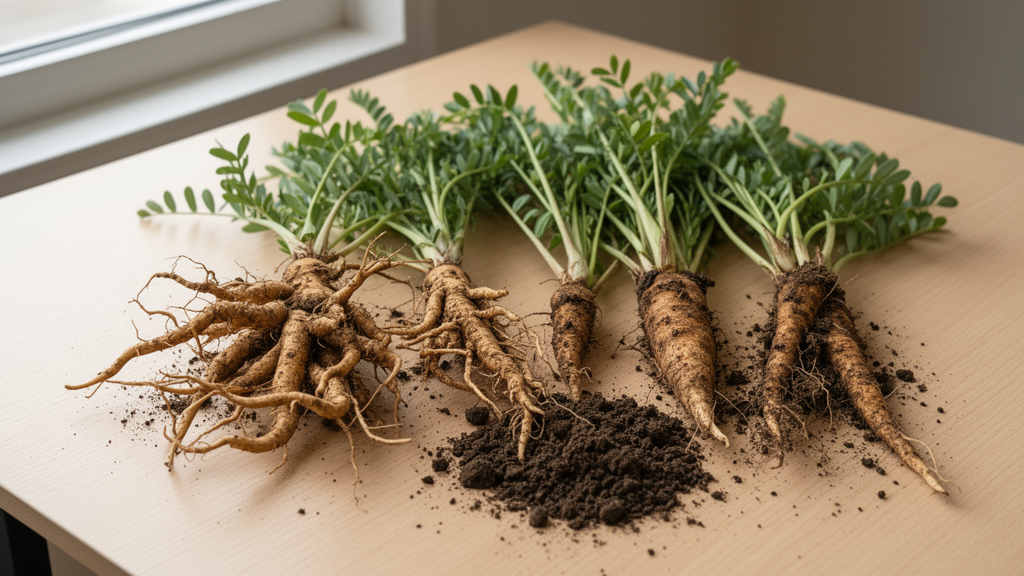
Astragalus membranaceus, a perennial legume prized across Asia as the traditional medicine huangqi, has now received its first head-to-head metabolic comparison between wild and cultivated Mongolian plants. In a study published in Botanical Studies, researchers analyzed the roots of naturally growing plants from Zavkhan province and cultivated material from a farm in Khentii province, and found that although the two root types carry broadly similar levels of their signature polysaccharides, their overall metabolic profiles diverge in ways that reflect the very different environments in which the plants grew.
The motivation for the work is practical as much as scientific. Rising demand for A. membranaceus roots in the pharmaceutical, food, nutrition, and cosmetic industries has pushed wild populations toward endangerment in several countries, and Astragalus species are officially listed as endangered in Mongolia. To relieve pressure on natural stands, cultivation was initiated several years ago in Khentii province in eastern Mongolia, and roots from these fields increasingly supply food and nutrition supplement markets. Yet, until this study, no comparative metabolomic analysis of natural and cultivated Mongolian material had been reported, leaving questions about quality, authenticity, and pharmacological equivalence unanswered.
The team, led by Munkhtsetseg Tsednee and Chao-Yu Hsu with corresponding author Chuan-Ming Yeh, collected natural plants from Zavkhan province during the active growth season in July 2021, air-drying the roots immediately while avoiding direct sunlight. Cultivated roots were purchased as chopped, dried raw tissue from commercial stores in Ulaanbaatar; the source plants had been grown in the cultivation field of Kherlenbayan soum in Khentii province, where cultivation has been maintained stably for eight years. Because natural plants are difficult to obtain, the metabolomic analysis relied on three biological replicates per group, with each replicate pooling chopped roots from three to five individual plants.
The first question the researchers addressed was polysaccharide content, since these compounds dominate the root chemistry of A. membranaceus. Alcohol-soluble polysaccharides were extracted from homogenized root samples through sequential Soxhlet extraction with benzene-methanol and 80% ethanol, followed by hot water extraction, ethanol precipitation, dialysis, and freeze-drying, with content expressed as a yield normalized to the natural roots. Although the cultivated roots showed roughly 1.5-fold higher total alcohol-soluble polysaccharide content than natural roots, the difference did not reach statistical significance, leading the authors to conclude that overall polysaccharide levels are comparable between the two root types.
Monosaccharide composition told a similar story with one notable nuance. Using UPLC-based analysis with authentic standards, the team found that the predominant monosaccharides in both root types were galacturonic acid, arabinose, glucose, and galactose, and the contents of these four major sugars did not differ significantly between natural and cultivated roots. Five less abundant monosaccharides, however, including rhamnose, xylose, mannose, glucuronic acid, and fucose, showed significant reductions in cultivated roots. Because the dominant sugars held steady, the authors suggest these reductions likely have limited impact on overall polysaccharide content and quality. One further monosaccharide, 4-O-methyl-D-glucuronic acid, was not detected in either root type.
The more striking differences emerged from untargeted gas chromatography-mass spectrometry profiling of 80% methanol root extracts. Principal component analysis separated the natural and cultivated samples clearly, and the profiling annotated 157 metabolites in natural roots and 150 in cultivated roots, of which 42 and 35 respectively were differentially accumulated. The identified compounds fell into six categories: sugars and sugar alcohols, organic acids, amino acids and amines, lipids, esters and ethers, phenols, and an uncategorized group. Most metabolites accumulated at higher levels in cultivated roots, but 32 metabolites were enriched in natural roots, revealing that the two root types carry distinct sets of signature compounds despite substantial overlap.
Several of the natural-root-specific compounds stand out for their known roles in plant defense. Among the organic acids enriched in natural roots, nine were detected and accumulated only there, including salicylic acid, dihydroxybenzoic acid, azelaic acid, mucic acid, quinic acid, and caprylic acid, several of which are well known for their involvement in plant immunity and responses against pathogens. Natural roots also specifically accumulated arachidic acid and alpha-tocopherol among the phenols, while cultivated roots uniquely contained butylphenol, along with nicotinic, oxalic, and gulonic acids among organic acids and four specific acid esters. Potential marker metabolites for distinguishing the two root types include D-mannose, L-arabitol, and cellobiose in natural roots versus L-galactopyranose and alpha-mannobiose in cultivated roots.
Pathway enrichment analysis using MetaboAnalyst 6.0, with FDR-corrected p-values below 0.05, placed these metabolite differences into functional context. In natural roots, the most enriched pathways included alanine, aspartate, and glutamate metabolism; galactose metabolism; starch and sucrose metabolism; fructose and mannose metabolism; biosynthesis of unsaturated fatty acids; ascorbate and aldarate metabolism; vitamin B6 metabolism; linoleic acid metabolism; inositol phosphate metabolism; and arginine and proline metabolism. The authors link these pathways to stress tolerance through osmoregulation, antioxidant defense, and membrane stability, to biosynthesis of secondary metabolites including astragaloside saponins and flavonoids, and to energy production and survival. Cultivated roots instead emphasized central carbon metabolism, with enriched pathways including the citrate cycle, glyoxylate and dicarboxylate metabolism, pyruvate metabolism, the pentose phosphate pathway, and glycine, serine, and threonine metabolism, pointing toward energy production, biomass accumulation, and redox balance under relatively stable agricultural conditions.
The authors attribute these metabolic divergences to the contrasting environments in which the plants grew. The collection sites are separated by more than 1,300 kilometers, with Zavkhan province offering a semi-arid, desert-like environment while Khentii province features a forest-steppe ecosystem, and differences in climate, vegetation, and soil characteristics are anticipated to contribute to the observed metabolic divergence. Prior work has shown that soil quality, pH, microbial communities, and water availability influence both overall metabolite profiles and saponin accumulation in Astragalus roots, supporting the interpretation that adaptive metabolic reprogramming, rather than an inherent difference between wild and cultivated plants per se, underlies the patterns.
The study comes with clear limitations that the authors themselves flag. The sample size was small, with three replicates per group necessitated by the scarcity of natural plants, the heat-map visualization was generated without false discovery rate correction, and the analysis was restricted to root tissues collected at a single time point. The phenolic fraction would benefit from liquid chromatography-mass spectrometry, and targeted approaches focused on saponins and flavonoids are needed for a more accurate phytochemical quality evaluation. Future work, the team says, will extend sampling across different seasons and developmental stages and to stems, leaves, and flowers, alongside mineral nutrient analysis. Even so, the findings provide a reference for evaluating, authenticating, and distinguishing natural and cultivated Mongolian A. membranaceus roots, and offer a starting point for quality control as cultivated material continues to enter the market.
Subject of Research: Comparative metabolomics of natural and cultivated Astragalus membranaceus roots in Mongolia
Article Title: Comparative metabolomic analysis in roots of natural and cultivated Astragalus membranaceus in Mongolia
Article References: Tsednee, M., Hsu, C.-Y., Sakamoto, S., Mitsuda, N., Tsolmon, B., Chan, M.-T., & Yeh, C.-M. (2026). Comparative metabolomic analysis in roots of natural and cultivated Astragalus membranaceus in Mongolia. Botanical Studies, 67(1), Article 3. https://doi.org/10.1186/s40529-026-00490-6
Image Credits: AI Generated
DOI: 10.1186/s40529-026-00490-6
Keywords: Astragalus membranaceus, metabolomics, Mongolia, polysaccharides, monosaccharides, GC-MS, UPLC, medicinal plants, plant cultivation, secondary metabolites, pathway enrichment, quality control
News Source: Drew Townsend. (October 29, 2026). Wild and Cultivated Mongolian Astragalus Roots Show Distinct Metabolic Fingerprints. Scienmag.