Devices built with silicon carbide offer faster switching speeds, lower losses and higher blocking voltages, which are superior to those of standard silicon-based devices
Credit: Giuseppe Fisicaro
WASHINGTON, April 28, 2020 — Growth of high-quality substrates for microelectronic applications is one of the key elements helping drive society toward a more sustainable green economy. Today, silicon plays a central role within the semiconductor industry for microelectronic and nanoelectronic devices.
Silicon wafers of high purity (99.0% or higher) single-crystalline material can be obtained via a combination of liquid growth methods, such as pulling a seed crystal from the melt and by subsequent epitaxy. The catch is that the former process can’t be used for the growth of silicon carbide (SiC), because it lacks a melting phase.
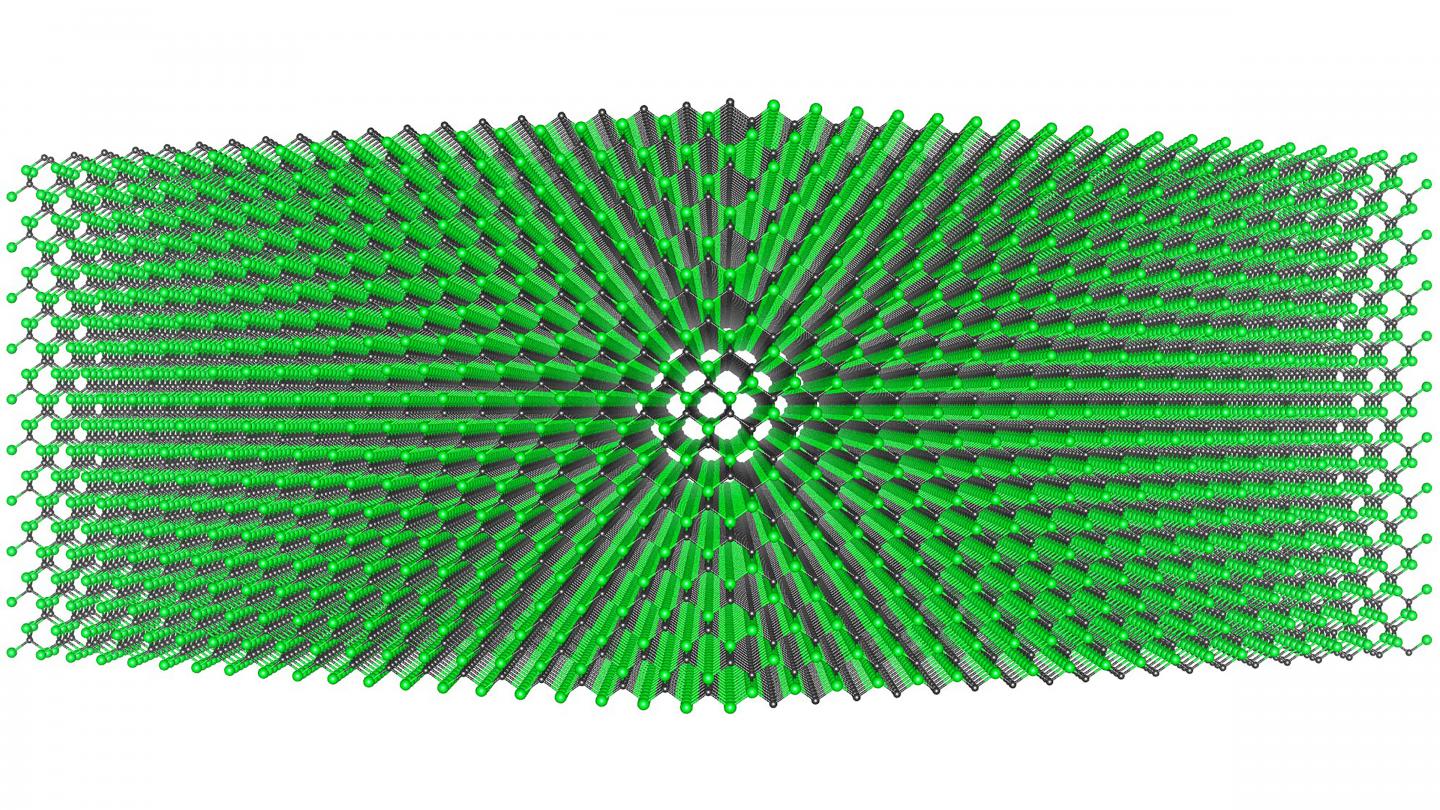
In the journal Applied Physics Reviews, from AIP Publishing, Giuseppe Fisicaro and an international team of researchers, led by Antonio La Magna, describe a theoretical and experimental study of the atomic mechanisms governing extended defect kinetics in cubic SiC (3C-SiC), which has a diamondlike zincblende (ZnS) crystal structure that manifests both stacking and anti-phase instabilities.
“Development of a technological framework for the control of crystalline imperfections within SiC for wide bandgap applications can be a game-changing strategy,” said Fisicaro.
The researchers’ study pinpoints the atomistic mechanisms responsible for extended defect generation and evolution.
“Anti-phase boundaries — planar crystallographic defects representing the contact boundary between two crystal regions with switched bonds (C-Si instead of Si-C) — are a critical source of other extended defects in a plethora of configurations,” he said.
Eventual reduction of these anti-phase boundaries “is particularly important to achieve good-quality crystals that can be used in electronic devices and enable viable commercial yields,” said Fisicaro.
So they developed an innovative simulation Monte Carlo code based on a superlattice, which is a spatial lattice that contains both the perfect SiC crystal and all crystal imperfections. It helped “shed light on the various mechanisms of defect-defect interactions and their impact on the electronic properties of this material,” he said.
Emerging wide bandgap semiconductor devices, such as the ones built with SiC, are significant because they have the potential to revolutionize the power electronics industry. They are capable of faster switching speeds, lower losses and higher blocking voltages, which are superior to those of standard silicon-based devices.
Huge environmental benefits are also involved. “If the world’s silicon power devices used within this range with were replaced by 3C-SiC devices, a reduction of 1.2×10^10 kilowatts per year could be obtained,” Fisicaro said.
“This corresponds to a reduction of 6 million tons of carbon dioxide emissions,” he said.
The researchers concluded that the low cost of the 3C-SiC hetero-epitaxial approach and the scalability of this process to 300-millimeter wafers and beyond make this technology extremely competitive for motor drives of electric or hybrid vehicles, air conditioning systems, refrigerators, and light-emitting diode lighting systems.
###
This work is part of the European Union’s Horizon 2020 CHALLENGE Program; HORIZON 2020-NMBP-720827).
The article, “Genesis and evolution of extended defects: The role of evolving interface instabilities in cubic SiC,” is authored by Giuseppe Fisicaro, Corrado Bongiorno, Ioannis Deretzis, Filippo Giannazzo, Francesco La Via, Fabrizio Roccaforte, Marcin Zielinski, Massimo Zimbone, and Antonino La Magna. It will appear in Applied Physics Reviews, April 28, 2020 (DOI: 10.1063/1.5132300). After that date, it can be accessed at https:/
ABOUT THE JOURNAL
Applied Physics Reviews features articles on significant and current topics in experimental or theoretical research in applied physics, or in applications of physics to other branches of science and engineering. The journal publishes both original research on pioneering studies of broad interest to the applied physics community, and reviews on established or emerging areas of applied physics. See https:/
Media Contact
Larry Frum
[email protected]
Related Journal Article
http://dx.