• HOME
  • NEWS
  • EXPLORE
    • CAREER
      • Companies
      • Jobs
    • EVENTS
    • iGEM
      • News
      • Team
    • PHOTOS
    • VIDEO
    • WIKI
  • BLOG
  • COMMUNITY
    • FACEBOOK
    • INSTAGRAM
    • TWITTER
Monday, May 11, 2026
BIOENGINEER.ORG
No Result
View All Result
  • Login
  • HOME
  • NEWS
  • EXPLORE
    • CAREER
      • Companies
      • Jobs
        • Lecturer
        • PhD Studentship
        • Postdoc
        • Research Assistant
    • EVENTS
    • iGEM
      • News
      • Team
    • PHOTOS
    • VIDEO
    • WIKI
  • BLOG
  • COMMUNITY
    • FACEBOOK
    • INSTAGRAM
    • TWITTER
  • HOME
  • NEWS
  • EXPLORE
    • CAREER
      • Companies
      • Jobs
        • Lecturer
        • PhD Studentship
        • Postdoc
        • Research Assistant
    • EVENTS
    • iGEM
      • News
      • Team
    • PHOTOS
    • VIDEO
    • WIKI
  • BLOG
  • COMMUNITY
    • FACEBOOK
    • INSTAGRAM
    • TWITTER
No Result
View All Result
Bioengineer.org
No Result
View All Result
Home NEWS Science News Chemistry

Why there is no speed limit in the superfluid universe

Bioengineer by Bioengineer
September 21, 2020
in Chemistry
Reading Time: 2 mins read
0
IMAGE
Share on FacebookShare on TwitterShare on LinkedinShare on RedditShare on Telegram

IMAGE

Credit: Lancaster University

Physicists from Lancaster University have established why objects moving through superfluid helium-3 lack a speed limit in a continuation of earlier Lancaster research.

Helium-3 is a rare isotope of helium, in which one neutron is missing. It becomes superfluid at extremely low temperatures, enabling unusual properties such as a lack of friction for moving objects.

It was thought that the speed of objects moving through superfluid helium-3 was fundamentally limited to the critical Landau velocity, and that exceeding this speed limit would destroy the superfluid. Prior experiments in Lancaster have found that it is not a strict rule and objects can move at much greater speeds without destroying the fragile superfluid state.

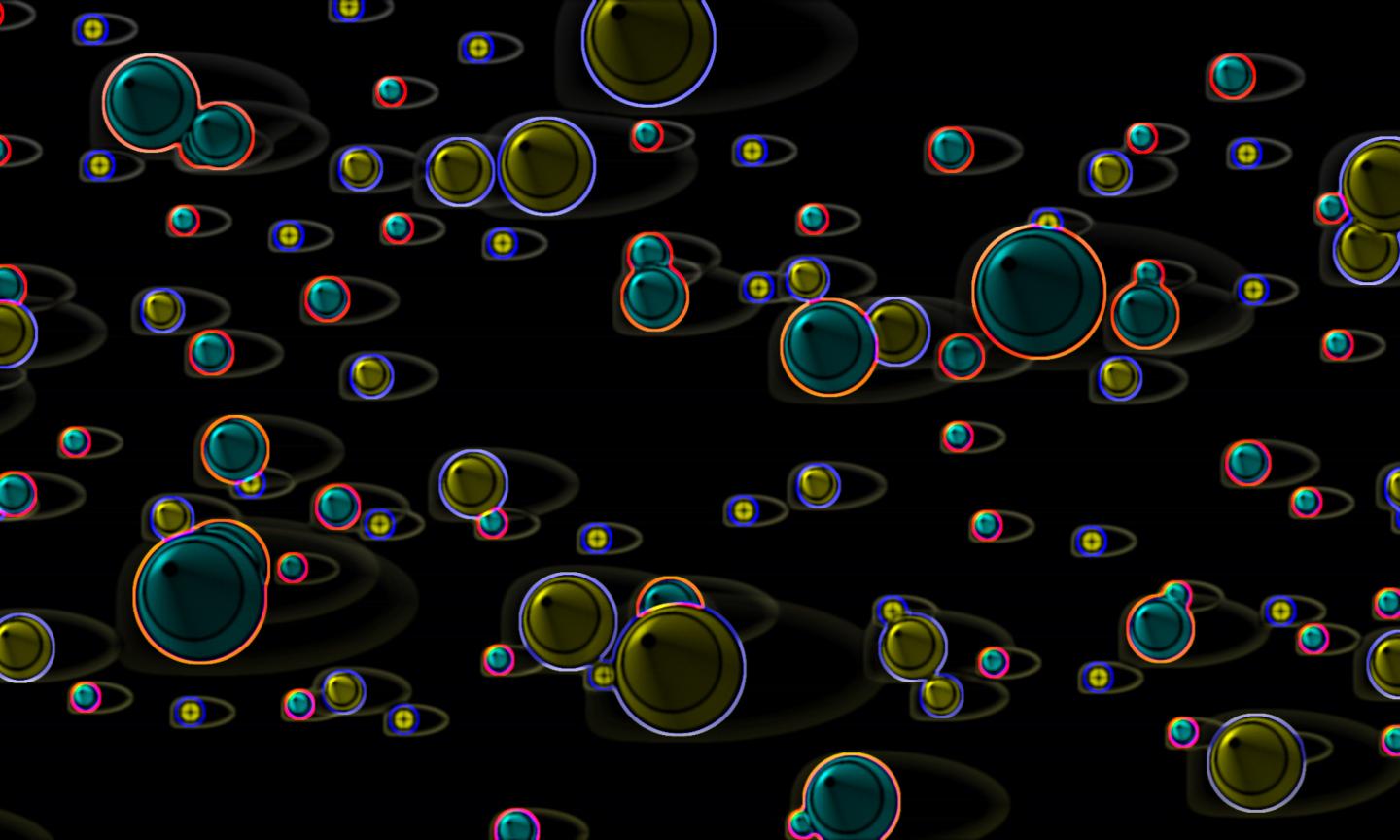
Now scientists from Lancaster University have found the reason for the absence of the speed limit: exotic particles that stick to all surfaces in the superfluid.

The discovery may guide applications in quantum technology, even quantum computing, where multiple research groups already aim to make use of these unusual particles.

To shake the bound particles into sight, the researchers cooled superfluid helium-3 to within one ten thousandth of a degree from absolute zero (0.0001K or -273.15°C). They then moved a wire through the superfluid at a high speed, and measured how much force was needed to move the wire. Apart from an extremely small force related to moving the bound particles around when the wire starts to move, the measured force was zero.

Lead author Dr Samuli Autti said: “Superfluid helium-3 feels like vacuum to a rod moving through it, although it is a relatively dense liquid. There is no resistance, none at all. I find this very intriguing.”

PhD student Ash Jennings added: “By making the rod change its direction of motion we were able to conclude that the rod will be hidden from the superfluid by the bound particles covering it, even when its speed is very high.”
“The bound particles initially need to move around to achieve this, and that exerts a tiny force on the rod, but once this is done, the force just completely disappears”, said Dr Dmitry Zmeev, who supervised the project.

###

The Lancaster researchers included Samuli Autti, Sean Ahlstrom, Richard Haley, Ash Jennings, George Pickett, Malcolm Poole, Roch Schanen, Viktor Tsepelin, Jakub Vonka, Tom Wilcox, Andrew Woods and Dmitry Zmeev. The results are published in Nature Communications.

Media Contact
Gillian whitworth
[email protected]

Related Journal Article

http://dx.doi.org/10.1038/s41467-020-18499-1

Tags: Atomic/Molecular/Particle PhysicsChemistry/Physics/Materials SciencesInternetMaterialsMolecular PhysicsNanotechnology/MicromachinesSuperconductors/Semiconductors
Share12Tweet8Share2ShareShareShare2

Related Posts

Miniature Sensor Uses Light to Detect Touch — Chemistry

Miniature Sensor Uses Light to Detect Touch

May 8, 2026
Iron Minerals Determine Whether Dissolved Organic Matter Fuels Microbes or Becomes Long-Term Carbon Storage — Chemistry

Iron Minerals Determine Whether Dissolved Organic Matter Fuels Microbes or Becomes Long-Term Carbon Storage

May 8, 2026

Kate Evans Appointed Associate Lab Director for Biological and Environmental Systems Science at ORNL

May 8, 2026

Advancing Multiscale Modeling and Overcoming Operational Challenges in Autothermal CO₂-to-Methanol Reactors

May 8, 2026
Please login to join discussion

POPULAR NEWS

  • Research Indicates Potential Connection Between Prenatal Medication Exposure and Elevated Autism Risk

    840 shares
    Share 336 Tweet 210
  • New Study Reveals Plants Can Detect the Sound of Rain

    727 shares
    Share 290 Tweet 181
  • Salmonella Haem Blocks Macrophages, Boosts Infection

    61 shares
    Share 24 Tweet 15
  • Breastmilk Balances E. coli and Beneficial Bacteria in Infant Gut Microbiomes

    57 shares
    Share 23 Tweet 14

About

We bring you the latest biotechnology news from best research centers and universities around the world. Check our website.

Follow us

Recent News

New Post-Hoc Analysis Explores Daily Oral Orforglipron Use in Adults Over 65 with Obesity, Regardless of Diabetes Status

Evaluating Digoxin Use in Patients with Symptomatic Rheumatic Heart Disease

Evaluating the Effectiveness and Safety of Digitalis Glycosides in Treating Heart Failure

Subscribe to Blog via Email

Enter your email address to subscribe to this blog and receive notifications of new posts by email.

Join 82 other subscribers
  • Contact Us

Bioengineer.org © Copyright 2023 All Rights Reserved.

Welcome Back!

Login to your account below

Forgotten Password?

Retrieve your password

Please enter your username or email address to reset your password.

Log In
No Result
View All Result
  • Homepages
    • Home Page 1
    • Home Page 2
  • News
  • National
  • Business
  • Health
  • Lifestyle
  • Science

Bioengineer.org © Copyright 2023 All Rights Reserved.