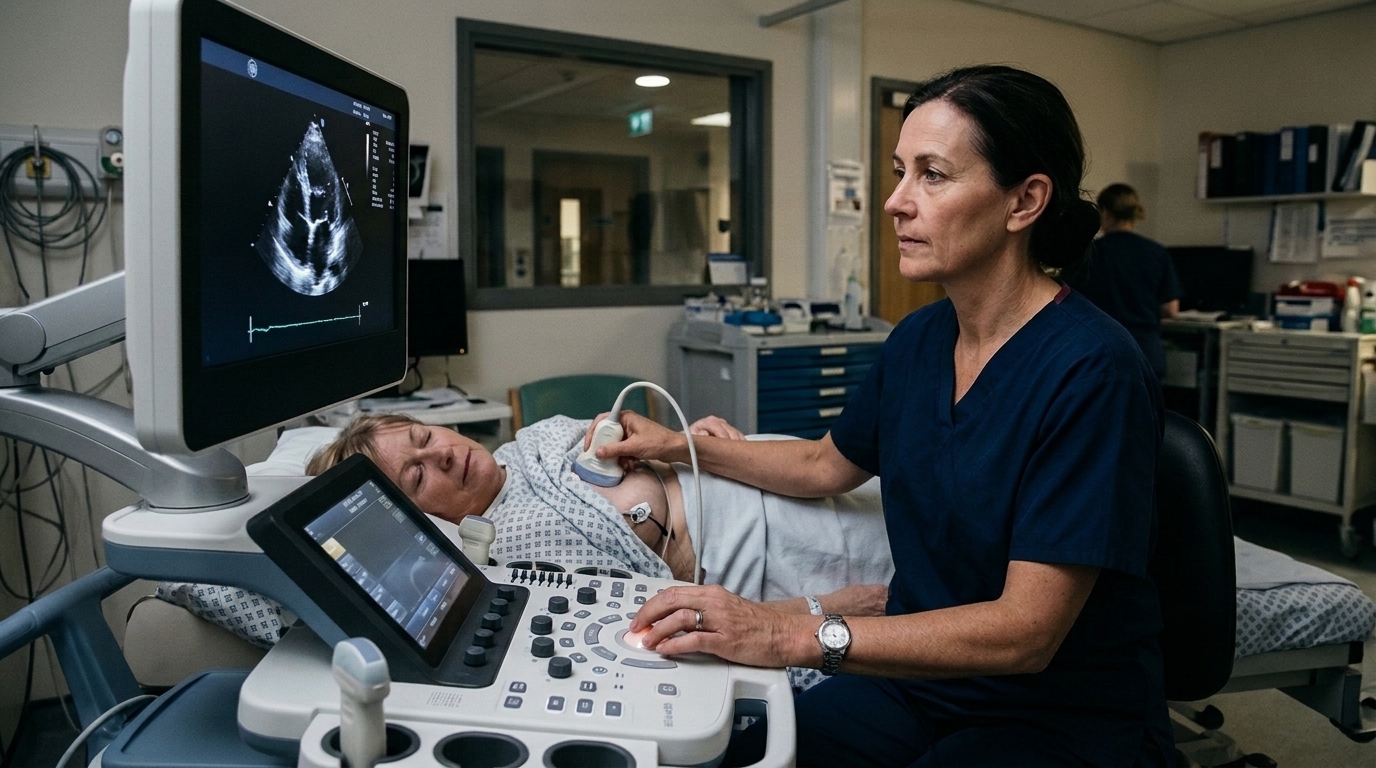
Retention of diagnostic imaging staff has become a pressing concern for the NHS, and echocardiography services sit at the sharp end of the problem. A study published in Echo Research & Practice on 2 November 2026 examined intention to leave among echocardiography staff in a large acute NHS trust and the factors that encourage them to stay. The work, led by Carla Croft, Charlotte Barry, Macarena Fernandez Diaz, Wafa Sehailia, Delfin Encarnacion, Sanjeev Bhattacharyya and Guy Lloyd, was conducted as a mixed-methods service evaluation rather than a formal research trial, and its findings point to a retention picture shaped far more by workload, support and career development than by pay alone.
The context is stark. According to the British Society of Echocardiography, the echocardiography workforce is experiencing what the society describes as a perfect storm of high demand, backlog pressures and workforce attrition, with many staff reporting overwork, inability to meet demands, low morale, fatigue and burnout. The broader NHS picture is similar: a national survey found that nearly half of all NHS healthcare workers, 48 percent, had considered leaving their role or taking early retirement. The Society of Radiographers has recently reported to parliament a 12.6 percent vacancy rate in diagnostic services, and many echocardiography departments across the country depend on locum staff to keep services running.
The study took an unusual route to its data. As part of business as usual, trust staff support psychologists offered to meet with echocardiography colleagues for a general support session and to advertise the services they offer. All echocardiography staff, roughly 60 whole time equivalents employed across a trust spanning five hospital sites including two general hospitals, a large teaching hospital and a specialist cardiovascular hospital, were invited to attend a facilitated two-hour group or individual session. Participation was voluntary, and attendees were released from normal clinical duties for the duration.
Forty-five staff took part: 37 Band 7 echocardiographers and 8 Band 8 team leaders. Four group sessions were conducted with the echocardiographers, each involving approximately ten participants, while two staff members opted for an individual session and one separate group session was held for the team leaders. Each session was facilitated by a practitioner psychologist from the trust’s psychological support service, with most co-facilitated by a trainee clinical psychologist. The first hour focused on data collection through a brief questionnaire covering job satisfaction, engagement and intention to remain within the trust or the profession, followed by an open group discussion whose key themes were documented in real time on a flipchart and later analysed thematically.
The second hour was dedicated to psychological support and wellbeing enhancement, beginning with a grounding exercise and including psychoeducation on stress management, reflective practice and the sharing of individual coping strategies. Participants were told this part was confidential and excluded from the analysis. The authors note that no measures were taken of the impact of this taster session, but the underlying approach rests on five years of service audit within the trust: the psychological support team has worked with 2,809 different individuals for one-to-one support and offered 29,801 points of contact in teams across trust sites. Among service users who gave feedback, 83 percent stated the support helped them cope better in their role, and 97 percent would recommend it to a colleague. External peer-reviewed evaluation found that contact with the team significantly reduced symptoms of burnout and general stress and improved mental wellbeing and team connection compared with colleagues who had no contact, using before-and-after measures over four months.
The headline quantitative result was a sharp divide by role. Retention among the Band 8 leaders appeared very strong, with 88 percent indicating they were unlikely to leave. This senior group, aged between 37 and 65 with trust tenure of 4 to 19 years and professional tenure of 15 to 29 years, cited a setting that provides good work-life balance, flexibility, supportive management, good team dynamics, fair pay and opportunities for professional growth, alongside a clear sense of passion for their work and value in feeling acknowledged. Among the 37 Band 7 echocardiographers, by contrast, retention was a concern, with 39 percent indicating potential intention to leave within two years. This group was primarily composed of individuals under 40, and younger staff were more likely to report thoughts of leaving, a pattern the authors note mirrors data from other sources.
The qualitative themes reinforced the quantitative split. Key retention factors across participants included supportive management, positive team relationships, individualised flexibility, professional autonomy and individualised plans around work-life balance. Barriers centred on workload pressure, burnout including musculoskeletal injury risk, limited career progression and financial concerns. Participants highlighted meaningful relationships with patients and colleagues as protective against disengagement, while also raising concerns about role narrowing and the future integration of artificial intelligence. Several echocardiographers said that as workload and demands increased, their jobs had become narrower and less varied, leaving them less able to prioritise their colleagues and their patients’ experience, with the nourishing connection with patients and colleagues described as key to restoration and helping them carry on.
Three facilitator impressions from the support component, offered without formal data, add texture. First, the meaning of concepts like flexible working and good work-life balance proved individual, with colleagues describing helpful rota patterns that differed widely between people. Second, individualised, targeted specialist support for workplace difficulties had helped, with several participants citing benefits from physiotherapy support inside and outside the trust, including massage treatment, and some already benefiting from the psychological support on offer. Third, time for connection with colleagues supported restoration: the majority of participants reflected that they rarely have time to be together and that these links protect them, expressing gratitude for being given the session time.
The authors are careful about the limits of their data. The research was conducted with physiologists in a single London trust, whose service runs as a single department that is unique and may make generalisation more difficult, and the London location offers more options for employment. At the time of data collection in summer 2025, local informatics showed all echocardiography posts were filled and the service was operating without significant backlogs, which could have influenced participants’ reflections in a variety of ways. The authors believe this stability was achieved through sustained focus on internal progression, including Band 6 to 7 progression and specialist accreditation support, consistent clinical supervision, individualised flexible working arrangements, early engagement with staff at risk of leaving, prompt backfilling of posts, and reduced reliance on agency staff, rather than short-term recruitment solutions.
The implications the authors draw are that focusing on a single lever is unlikely to succeed for this staff group. They argue for targeted interventions across a broad base, covering physical and mental wellbeing support, improved opportunity for professional growth, individualised flexibility that provides a good perceived work-life balance and reward structures, with clear promotion and career development pathways, attention to excessive workload and musculoskeletal injury risk, and a clear roadmap for AI integration to allay fears of job replacement or down-skilling. Retention among echocardiography staff, they conclude, is influenced by a complex interaction of organisational, professional and wellbeing factors rather than pay alone, and multifaceted, individualised, targeted strategies focusing on workload management, career development, psychological support and clear communication around service evolution are essential to sustaining this critical workforce.
Subject of Research: Intention to leave and retention factors among NHS echocardiography staff in a single acute trust service evaluation
Article Title: Staff retention in echocardiography: a formal exploration of workforce drivers
Article References: Croft, C., Barry, C., Diaz, M. F., Sehailia, W., Encarnacion, D., Bhattacharyya, S., & Lloyd, G. (2026). Staff retention in echocardiography: a formal exploration of workforce drivers. Echo Research & Practice, 13(1), Article 41. https://doi.org/10.1186/s44156-026-00137-z
Image Credits: AI Generated
DOI: 10.1186/s44156-026-00137-z
Keywords: echocardiography, NHS workforce, staff retention, intention to leave, burnout, workload pressure, psychological support, career progression, work-life balance, sonographers, diagnostic imaging, service evaluation
News Source: Ophelia Keating. (November 6, 2026). Why echocardiography staff stay or go: a single NHS trust maps the retention drivers. Scienmag.