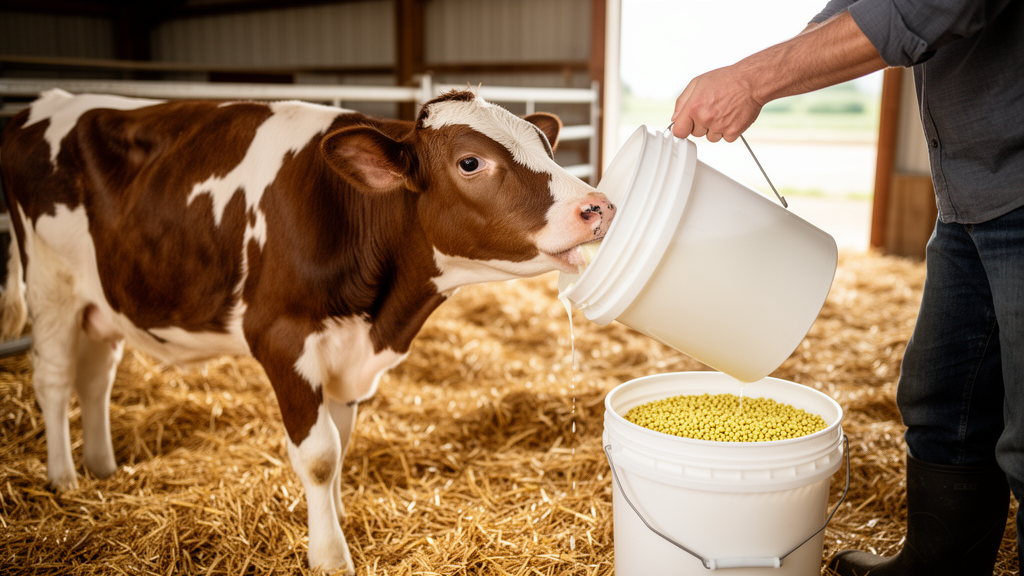
Replacing imported soybean meal with locally grown peas in calf starter feed sounds like a sustainability win, but a new controlled feeding trial from Germany suggests calves are not easily persuaded. In a study of forty-nine male German Holstein calves, researchers at the Friedrich-Loeffler-Institut found that a starter feed built on a mixture of pea and rapeseed extraction meal was eaten at only a fraction of the amount consumed by calves given a conventional soybean meal-based starter. During weaning, calves on the soybean starter ate roughly 673 grams of starter dry matter per day, while calves on the pea-rapeseed starter managed just 78 grams — a nearly ninefold difference that shaped nearly every intake measure in the trial.
The study, published in Frontiers in Animal Science, was designed as a two-by-two factorial experiment. Calves were randomly assigned at birth to receive one of two milk replacers — one formulated to resemble whole milk, based on whole milk and cream powder, and a commercially available skimmed milk replacer in which milk fat was largely replaced by palm and coconut oil — combined with one of the two calf starters. The pea-based starter contained 30 percent pea and 10 percent rapeseed extraction meal, while the soybean starter contained 30 percent soybean meal. Both starters were formulated to be approximately isoenergetic at about 12.6 megajoules of metabolizable energy per kilogram, and all calves had round-the-clock access to milk replacer through automatic feeders, with intake recorded individually via ear transponders.
The central problem with the pea-rapeseed starter was not its energy content but its acceptance. Over the entire 42-day trial, calves in the soybean groups consumed a total of about 23 kilograms of starter dry matter, roughly seven times the 3 kilograms recorded in the pea-rapeseed groups. Preweaning intake was low in all groups, as is typical for young calves, but the gap widened dramatically once milk replacer allowance was progressively reduced during weaning from experimental day 30 to 42. Calves fed the soybean starter ramped up solid feed consumption to compensate for the shrinking milk allowance; calves on the pea-rapeseed starter did not, and their combined dry matter and energy intake from milk replacer plus starter consequently fell well short of the other groups during the late weaning phase.
The authors point to several possible explanations, while cautioning that none can be confirmed from the data collected. Soybean meal is known to be highly palatable to calves and contains glutamate and other amino acids associated with the umami taste, which has been shown to enhance feed intake in young animals. Peas and rapeseed, by contrast, may contain bitter-tasting tannins and other antinutritional factors, although the pea variety used was a white-flowering, low-tannin cultivar, and modern rapeseed varieties are bred with greatly reduced glucosinolate levels. The researchers also note a major nutritional difference: the soybean starter contained 21 percent crude protein on a dry matter basis, within the range typically associated with good calf growth, while the pea-rapeseed starter contained only 15.1 percent — a level considerably below values documented in prior studies. Because the trial deliberately preserved the natural properties of the feedstuffs rather than reformulating for equal protein, the intake gap may reflect protein content, palatability, or both.
What makes the findings striking is that the dramatic difference in starter intake produced only minor effects on growth. Body weight, average daily gain, withers height, hip height, heart girth, body length, back fat thickness and rib fat thickness were all unaffected by starter type. The researchers suggest several possible explanations: the calves on the pea-rapeseed starter may have used nutrients efficiently, may have compensated by eating more of the hay and partial mixed ration offered ad libitum — intakes that were unfortunately not recorded — or the trial may simply have been too short for the lower protein supply to manifest as growth differences. Previous work suggests lower crude protein in starter feed can affect long-term rumen development and later performance, so the authors explicitly caution that longer-term effects cannot be excluded.
The milk replacer side of the experiment told a clearer story. Calves fed the whole-milk-based replacer showed higher body weight throughout the trial, greater back length over time, and higher average daily gain during the preweaning period, with the most pronounced differences appearing around experimental day 21. Because recorded dry matter intake from milk replacer did not differ between the replacer groups, the growth advantage was attributed to formulation rather than consumption. A key factor was energy: the whole-milk replacer contained 3.1 megajoules more metabolizable energy per kilogram than the skimmed milk replacer, owing to its higher fat content from milk fat rather than plant oils. Differences in fatty acid composition between milk fat and the palm and coconut oil blend in the skimmed replacer may also have contributed, the authors suggest, citing prior work indicating that calf performance responds not only to total fat but to the type of fat supplied.
Blood metabolites traced the metabolic transformation of weaning in all four groups. Glucose concentrations, stable through the preweaning period, declined significantly by the end of weaning, while β-hydroxybutyrate — a ketone body that rises as the developing rumen begins fermenting solid feed — increased in every group. Non-esterified fatty acids remained stable at about 0.31 millimoles per liter, which the researchers interpret as evidence that the BHB rise reflected rumen development and diet composition rather than energy deficiency. Total protein was unaffected by treatment despite the large differences in protein intake between starter groups, and triglycerides and lactate changed over time but not between treatments.
The most persistent metabolic signature came from the milk replacer fat source. Calves fed the skimmed, vegetable-fat-based replacer showed markedly higher concentrations of total cholesterol, HDL cholesterol and LDL cholesterol from day 28 onward, and a higher LDL-to-HDL cholesterol ratio, compared with calves on the whole-milk-based replacer. The skimmed replacer derived about 23 percent of its composition from vegetable fats, predominantly palm and coconut oil, with only minor milk fat, while the whole-milk replacer was based on whole milk and cream powder. The authors conclude that fatty acid composition, rather than total fat concentration alone, appears to influence lipid metabolism in young calves — a finding consistent with earlier studies of plant-fat milk replacers and one they flag as deserving dedicated follow-up research.
Rumen development, assessed descriptively, followed the expected trajectory: no rumen contractions were detectable in the first three weeks, but by days 35 and 42 an increasing proportion of calves in all groups showed rumen contractions and palpable rumen fill. The soybean-fed calves, which began eating starter about ten days earlier than the pea-fed groups, showed an approximately twofold rise in BHB along with indications of increased rumen activity, yet by day 42 BHB concentrations were similar across groups, suggesting the marker integrates diet, metabolic status and rumen development rather than tracking starter intake alone.
The overall verdict from the trial is sobering for proponents of regional protein self-sufficiency in calf rearing, at least in its current form. Under the conditions of this study — a 42-day window covering preweaning and weaning in Holstein bull calves — the pea-rapeseed starter did not support starter and milk replacer-derived nutrient intake during weaning and cannot be considered a suitable replacement for soybean meal-based starter. The authors stress that the low acceptance should not be extrapolated to other ruminant species or older animals, noting that peas and rapeseed proteins have proven suitable in diets of weaned calves and adult cattle in prior research. Their recommendations are concrete: future formulations should target palatability by adjusting the proportions of rapeseed and legume components, and longer studies tracking total solid feed intake, rumen development and health are needed before native legumes can be judged viable alternatives. In the meantime, the trial offers a practical takeaway for producers: whole-milk-type replacers can enhance early growth, and replacing soybean in starter feed requires more than a simple ingredient swap.
Subject of Research: Effects of milk replacer composition and pea-rapeseed versus soybean calf starter on intake, growth and blood metabolites in German Holstein bull calves
Article Title: Concentrate feed intake, metabolic response and growth in German Holstein bull calves vary depending on the composition of milk replacer and starter feed
Article References: Buhrow, F., Scholz, P., Kersten, S., Meyer, U., Hüther, L., Zentek, J., Dänicke, S., & Frahm, J. (2026). Concentrate feed intake, metabolic response and growth in German Holstein bull calves vary depending on the composition of milk replacer and starter feed. Frontiers in Animal Science, 7, Article 2009013. https://doi.org/10.3389/fanim.2026.2009013
Image Credits: AI Generated
DOI: 10.3389/fanim.2026.2009013
Keywords: dairy calves, calf starter, milk replacer, soybean meal, pea, rapeseed, weaning, growth performance, blood metabolites, rumen development, cholesterol, German Holstein
News Source: Daisy Hatcher. (October 29, 2026). Whole milk replacer boosts calf growth, but pea starter falls short. Scienmag.