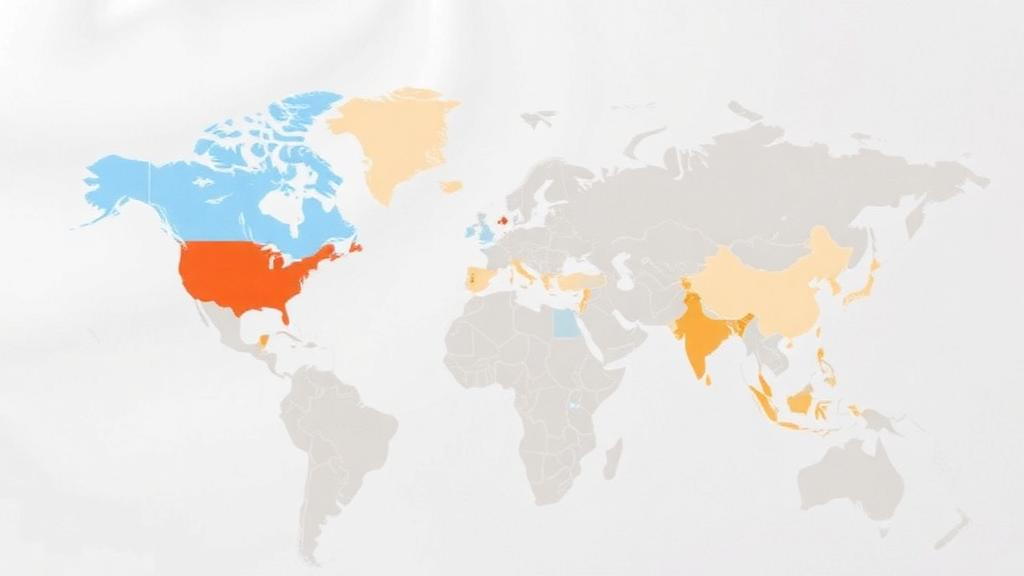
Death is universal, but the care that surrounds it is not. A new international study published in Nature Communications has delivered one of the most comprehensive cross-national pictures yet of how well — or how badly — societies meet the care needs of older adults in their final phase of life. Drawing on harmonized end-of-life survey data collected between 2010 and 2021, the research team led by Chengxu Long of Huazhong University of Science and Technology and Shanquan Chen of the University of Hong Kong compared the United States, 28 European countries, South Korea, China, and Mexico, focusing on older adults living with activity limitations, the population most dependent on help from others as death approaches.
The central metric of the study is unmet end-of-life care need: the gap between the assistance a dying person requires and the assistance they actually receive. The researchers separated this gap into two components. Formal care refers to professional services — paid home helpers, nursing care, hospice teams, and institutional facilities. Informal care refers to unpaid support, typically from spouses, children, and other relatives. By measuring both forms of care across very different welfare systems, the team could ask a question that single-country studies cannot answer: does a strong professional care sector, a strong family care sector, or some combination of the two determine whether older people get the help they need at the end of life?
The headline finding is striking and, on its face, counterintuitive. The United States, Europe, and South Korea — all wealthy societies with comparatively developed formal care systems — showed higher overall unmet end-of-life care needs than China and Mexico, countries where formal long-term care provision remains limited. The explanation lies in substitution. In China and Mexico, where professional services are scarce, families absorb the shortfall, and high levels of informal care compensate for the thin formal infrastructure. In richer countries, the expectation and availability of professional care appear to coexist with larger residual gaps, suggesting that formal systems have not scaled to match the full burden of need among functionally limited older adults.
This pattern speaks to one of the most consequential demographic transitions of the century. Populations across the study regions are aging rapidly, and the number of people surviving into periods of severe functional limitation is rising in parallel. Families in high-income countries are simultaneously shrinking and dispersing: fertility decline means fewer adult children per aging parent, urbanization and labor migration scatter siblings across cities and borders, and rising female labor-force participation reduces the availability of the traditional backbone of informal care. The study’s results imply that as informal care capacity erodes in wealthy nations, the formal systems that were supposed to replace it have not fully filled the void — leaving measurable unmet need even amid abundant healthcare resources.
Place of death emerged as a second powerful axis of variation. The researchers found that dying in an institution — a hospital, nursing home, or hospice — was associated with lower overall unmet end-of-life care needs in the United States and South Korea. This makes mechanistic sense: institutional settings concentrate professional staff, equipment, and round-the-clock monitoring, capabilities that home environments struggle to replicate even with dedicated family caregivers. Yet the association was not universal. Mexico presented a clear exception, where institutional death did not translate into lower unmet need, a result the authors’ framework suggests reflects the uneven quality and accessibility of institutional care in settings where formal provision is limited and institutions may not be resourced to deliver comprehensive end-of-life support.
Geography within countries mattered as well. In Europe and South Korea, older adults in urban areas experienced lower unmet formal end-of-life care needs than their rural counterparts. The urban-rural divide is a persistent structural feature of health systems: professional caregivers, specialist palliative services, and care institutions cluster in cities, while rural regions face recruitment difficulties, longer travel distances, and thinner service networks. For a dying person with mobility limitations, a two-hour drive to the nearest hospice is not an abstraction — it is a concrete barrier that converts a theoretical entitlement to care into an unmet need. The finding suggests that national averages conceal deep spatial inequities that policy designed at the capital-city level can easily miss.
Family structure produced some of the study’s most nuanced results. Marriage, often assumed to be protective because spouses are the default caregivers in later life, showed a significant association with lower overall unmet end-of-life care need in only one jurisdiction: Mexico. In the United States, Europe, and South Korea, married and unmarried individuals fared similarly overall. The authors interpret this through the lens of system context — where formal care is weak, a spouse becomes the critical substitute, whereas in countries with more developed formal sectors, the presence or absence of a spouse matters less for total care adequacy. The finding is a caution against exporting assumptions about family-based safety nets across borders without accounting for what each care system actually provides.
Children, by contrast, were consistently linked to lower unmet informal end-of-life care needs across the United States, Europe, and South Korea. This consistency across three very different high-income contexts suggests a robust mechanism: adult children, wherever they live in societies with developed formal systems, remain the primary suppliers of hands-on informal help — assistance with bathing, dressing, feeding, and medication management — for their dying parents. But the finding carries a demographic warning. As childlessness rises and family sizes shrink across the developed world, the pool of available adult children per dependent elder is contracting. A care model that quietly relies on daughters and sons to close the gap left by formal services is built on a foundation that is visibly eroding.
The study’s methodological strength lies in its harmonization. End-of-life surveys are notoriously difficult to compare because countries define care needs, caregiving, and even death timing differently. By aligning instruments and measures across the United States, 28 European countries, South Korea, China, and Mexico over a 2010 to 2021 window, the team created a rare like-for-like comparison of care adequacy in the final months of life. The work was supported in part by grants from the U.S. National Institutes of Health, and the authors report no competing interests. The corresponding authors are Wei Yang of King’s College London, Xi Chen of Yale University, and Shanquan Chen of the University of Hong Kong.
The policy implications are as complex as the findings. The researchers argue that no single lever — more hospices, more family allowances, more nursing home beds — will suffice on its own. Instead, they call for tailored approaches that strengthen formal and informal care systems in tandem while directly addressing sociodemographic disparities in access. For high-income countries, that means closing the residual gaps that persist despite formal provision, investing in rural service networks, and supporting family caregivers whose contributions remain indispensable. For countries like China and Mexico, it means building formal capacity before demographic and urbanization pressures overwhelm the family-based model that currently holds the system together. What the study makes unmistakably clear is that how a society cares for its dying is not a fixed cultural constant but a policy choice — one that, in every country examined, is currently leaving too many older people without the help they need at the end.
Subject of Research: Cross-national disparities in unmet end-of-life care needs among older adults with activity limitations
Article Title: Unmet care needs at the end-of-life among older adults with activity limitations
Article References: Unmet care needs at the end-of-life among older adults with activity limitations. (n.d.). https://doi.org/10.1038/s41467-026-74719-0
Image Credits: AI Generated
DOI: 10.1038/s41467-026-74719-0
Keywords: end-of-life care, palliative care, unmet care needs, older adults, informal caregiving, formal care, long-term care, health policy, geriatrics, cross-national comparison, rural-urban disparities, family structure
News Source: Ophelia Keating. (October 13, 2026). Where End-of-Life Care Fails: Global Study Maps Unmet Needs of Older Adults. Scienmag.