Deep inside a hall in Cologne filled with 900 tons of simulated lunar soil, eighteen volunteers steered a real rover across craters and obstacle courses while scientists tracked their hearts, their brains, and their sense of effort. The experiment, conducted at the LUNA Analog Facility built by the European Space Agency and the German Aerospace Center, marks the first human-subject teleoperation study ever run in that facility. Its central finding is deceptively simple but operationally important: simulating the harsh lunar environment made operators feel and physiologically respond as if they were working much harder, yet their actual driving performance did not measurably fall apart. For mission planners designing future lunar robotic systems, that gap between what operators experience and what telemetry records may be the most consequential result of all.
The study, published in Frontiers in Space Technologies, was designed to capture two very different ways humans will one day control robots on the Moon. In the constrained Lunar condition, participants wore dust-protection personal protective equipment, including a full-body suit, gloves, boots, and a ventilated protective helmet, and faced the regolith field under the facility’s solar simulator, which produced the harsh, directional, high-contrast lighting typical of the lunar surface. In the Control Center condition, the same participants wore minimal protective gear, sat behind a fake rock wall with no view of the terrain, and worked under bright, uniform overhead lighting. The researchers stress that the PPE did not replicate true spacesuit pressurization, joint torque, or glove-induced dexterity loss, so the results reflect dust-protection constraints rather than a full extravehicular activity suit.
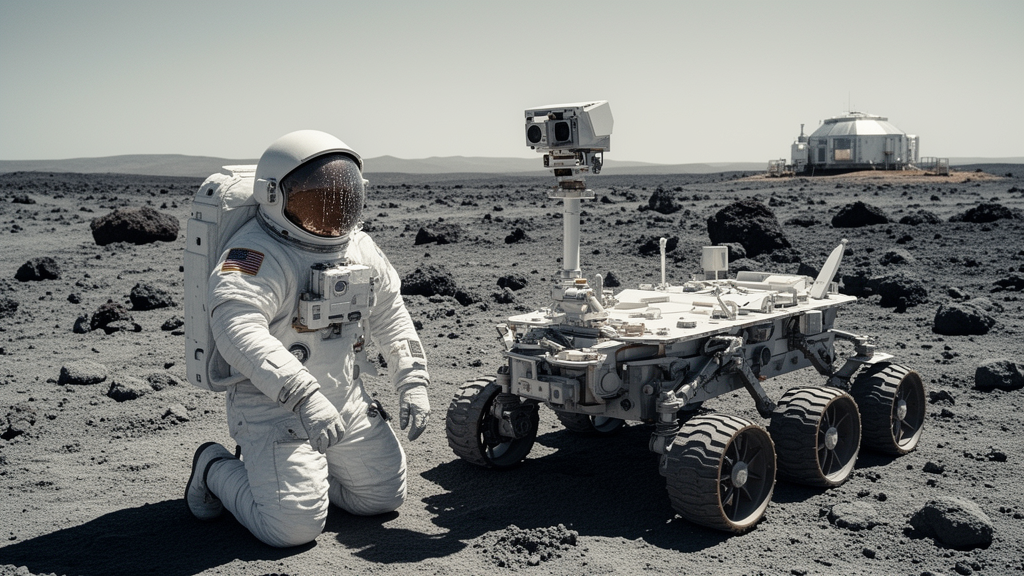
Each participant teleoperated an Argonaut Recycling Demonstrator rover built by Orbit Recycling, a machine designed to carve furrows for cable lines on the Moon. Control was deliberately spartan: an Xbox gamepad with only four directional keys, a computer console, and a live video stream from the rover’s onboard camera. The tasks came in two flavors. The Flat Navigation Task required driving one and a half loops between a large rock and a flag on level regolith, hugging the left side of the course while avoiding obstacles. The Obstacle Course Task took place in the facility’s Deep Floor Area, a sunken zone roughly three meters deep with slopes simulating crater terrain, where nine metal rings planted vertically in the regolith formed a zigzag slalom that operators had to weave through without knocking anything over. Every trial was capped at fifteen minutes, and two-minute resting baselines were recorded before each run.
The measurement strategy was genuinely multimodal. Objective performance was extracted from the rover’s command log as completion time, path length, and steering reversal rate, the last a marker of oversteering and repetitive correction. Subjective workload was captured with the NASA Task Load Index, a validated questionnaire spanning mental demand, physical demand, temporal demand, performance, effort, and frustration. Physiological strain was tracked with a chest-belt electrocardiograph, yielding heart rate and two heart-rate-variability metrics, and with functional near-infrared spectroscopy, an optical technique that measured oxygenated and deoxygenated hemoglobin changes in the prefrontal cortex through two forehead optodes. All participants received a brief training run around a boulder before data collection, and task order was pseudorandomized and counterbalanced across the group.
The performance results were striking in their uniformity: nothing significant. Across completion time, path length, and steering reversal rate, the analysis found no significant effects of condition, task, or presentation order for the thirteen participants with complete performance data. A few marginal higher-order interactions hinted that task sequencing might matter, but with only two to four participants per order group, the authors explicitly treat those trends as exploratory. The hypothesis that the lunar environment would degrade driving skill was not supported. Notably, no trial hit the fifteen-minute limit, meaning every participant eventually completed every task regardless of whether they were sweating inside a ventilated helmet under simulated sunlight or sitting comfortably behind the rock wall.
Workload told a completely different story. NASA-TLX scores were significantly and substantially higher in the Lunar condition and significantly higher during the Obstacle Course than during Flat Navigation, and the Lunar-Obstacle combination produced higher workload than every other pairing while Control-Navigation produced the lowest. In other words, operators were paying a steep subjective price for the environment even when their commands to the rover showed no measurable penalty. The authors interpret this as compensatory effort: participants may have maintained performance at the cost of increased cognitive and physical exertion, particularly in the most punishing condition. Subjective workload scales, previous research suggests, often act as more sensitive detectors of perceived challenge than performance metrics in complex, low-feedback settings, and this study fits that pattern neatly.
The physiological data painted a nuanced, partly cautionary picture. Raw heart rate was significantly elevated in the Lunar condition in the full sample of eighteen, averaging about 2.4 beats per minute higher than in Control, consistent with covert physiological stress that objective performance did not reveal. Heart rate variability, however, showed no significant differences between conditions for either the SDNN or RMSSD indices. Crucially, a sensitivity analysis revealed fragility: the raw heart rate effect disappeared when the three experimenter-participants were excluded, but so did most other possible three-participant exclusions, suggesting the loss of significance reflects the small sample rather than biased data. Intriguingly, the heart-rate-variability results moved the opposite way, becoming significant only after the experimenters were removed, implying that these terrain-familiar participants may have responded differently to the conditions than naive volunteers.
The fNIRS findings carry a lesson that extends well beyond lunar analogs. Only eight of the eighteen participants yielded usable brain-oxygenation data, because the optical sensor malfunctioned partway through the campaign, a failure the authors attribute to the dusty hall conditions. For those eight, neither condition nor task significantly changed prefrontal oxy- or deoxyhemoglobin concentrations. More revealing were the forensic analyses that followed. Applying progressively stricter short-channel regression and the correlation-based signal improvement method progressively weakened the condition-by-task interaction in the HbO signal, indicating that the original effect depended heavily on extracerebral contamination. Frequency-domain analysis localized the remaining differences to the respiratory and very-low-frequency bands, pointing toward systemic respiratory and thermoregulatory confounds, plausibly driven by heat buildup inside the sealed, actively ventilated helmet, rather than genuine changes in cortical activation. Heart rate change itself did not correlate with HbO change, ruling out one simple explanation.
The authors are candid about the limitations that temper these conclusions. Connectivity problems prevented running the Control condition from the actual LUNA control room, so both conditions took place inside the hall, without the latency and physical separation that characterize true remote teleoperation from Earth. Precise rover trajectories could not be reconstructed because no motion-capture or lidar localization was available, forcing reliance on broad command-log proxies. Illuminance, ambient temperature, and communication latency were never directly quantified, the participant pool of young graduate trainees and interns was demographically homogeneous, and events like knocked-over rings or a stuck rover went unrecorded. The study was, by design, an exploratory proof of concept with limited statistical power, particularly for interaction effects.
Even with those caveats, the practical implications are clear and somewhat counterintuitive. A lunar-like environment, with its glare, deep shadows, protective encumbrance, and restricted situational awareness, reliably inflated operators’ perceived workload and modestly elevated their physiological stress, yet left their visible task output untouched. For agencies planning surface operations, that means engineering systems for the Moon cannot be judged by completion times alone; operator state, fatigue, and environmental strain must be monitored independently, because telemetry can look clean while the human inside the suit is quietly burning reserves. The team also frames the work as a psychophysiological baseline for future hybrid concepts of operation that mix manual control with autonomy and supervisory control: knowing how much a human spends under manual conditions is the prerequisite for measuring how much cognitive offloading automated assistance actually delivers. Future campaigns at LUNA, the authors argue, should add longer tasks, real communication delays, true remote control, professional operators, and direct measurement of temperature and illuminance. Until then, the study stands as both a promising start and a methodological warning: in analog environments, even the sensors need dust protection.
Subject of Research: Human factors and neuro-physiological responses during lunar rover teleoperation in a high-fidelity analog facility
Article Title: Human-in-the-loop proof of concept for lunar teleoperation: performance, workload, and neuro-physiological insights from the LUNA Analog Facility
Article References: Lopez-Contreras, E., Delaunoit, L., Coulon, A., Boyer, L., Paillet, A., Roy, R. N., Cowley, A., & Peysakhovich, V. (2026). Human-in-the-loop proof of concept for lunar teleoperation: performance, workload, and neuro-physiological insights from the LUNA Analog Facility. Frontiers in Space Technologies, 7, Article 1920649. https://doi.org/10.3389/frspt.2026.1920649
Image Credits: AI Generated
DOI: 10.3389/frspt.2026.1920649
Keywords: lunar teleoperation, LUNA Analog Facility, human-robot interaction, operator workload, NASA-TLX, fNIRS, heart rate variability, lunar analog, rover control, physiological monitoring, ESA, space human factors
News Source: Denise Maddox. (October 16, 2026). When the Moon Makes You Sweat: Harsh Analog Conditions Drive Stress Even as Rover Skills Hold Steady. Scienmag.