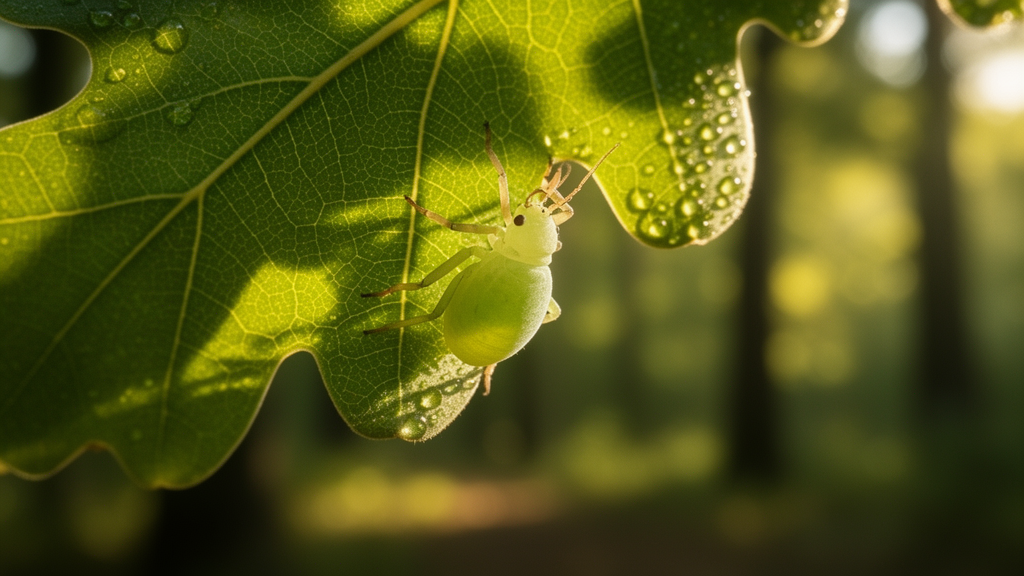
On the underside of a young oak leaf in a quiet corner of Jinju, in South Korea’s Gyeongsangnam-do province, a colony of pale green insects has quietly resolved a taxonomic puzzle that has lingered since 1965. The insects are aphids of the genus Kurisakia, a small and poorly studied lineage within the subfamily Thelaxinae, and a new study has confirmed through detailed morphological examination that the species living on Korean oaks is Kurisakia querciphila Takahashi, 1960, not the closely related Kurisakia onigurumii that had long occupied its place in the national literature. The finding, published in the Biodiversity Data Journal, provides the first modern, illustrated re-description of the apterous viviparous female of K. querciphila based on Korean material, and it supplies the formal taxonomic evidence needed to restore the species to the National Species List of Korea, from which it has been conspicuously absent.
The story begins in Japan, where Takahashi described the insect in 1960 not as a full species but as a subspecies, naming it Kurisakia onigurumii querciphila from specimens gathered on Quercus acutissima, the sawtooth oak. The subspecies was later elevated to species rank by subsequent authors, reflecting growing recognition that it differed consistently from K. onigurumii in ways that went beyond minor geographic variation. Meanwhile, on the other side of the Yellow Sea, the Korean entomologist Paik recorded K. onigurumii from Korea in 1965, collecting the aphids from Q. acutissima and Castanea crenata. Decades later, taxonomic authorities reviewing the global literature referred that Korean record to K. querciphila, effectively arguing that the insect Paik had found was never the walnut-associated K. onigurumii at all. Yet the correction never trickled down into the official national checklist: the current National Species List of Korea, maintained by the National Institute of Biological Resources, still lists only K. onigurumii within the genus, leaving K. querciphila in a strange limbo where it was recognized internationally as present in Korea but formally unrecorded by the country itself.
The genus Kurisakia is not a large one. Belonging to Thelaxinae, a subfamily that encompasses just four genera and 21 valid species worldwide, Kurisakia currently contains seven accepted species. What unites them is a shared taste for woody hosts: members of the genus feed primarily on plants in the families Fagaceae, which includes the oaks and chestnuts, and Juglandaceae, the walnuts and wingnuts. Despite this ecological coherence, the biology of these aphids remains surprisingly opaque. Information on their sexual morphs and complete life cycles is lacking for most species, a gap that makes every documented population valuable for understanding the group’s evolution and biogeography. It is precisely this scarcity of reliable morphological data that made the Korean specimens so important to document thoroughly.
In June 2024, researchers collected colonies of the aphids from the undersides of young leaves of Quercus variabilis, the Oriental cork oak, growing in Gajwa-dong in the city of Jinju. The specimens were hand-collected and immediately preserved in 95% alcohol before being cleared and mounted in Canada balsam on glass slides following standard aphid preparation procedures. Under a Leica DM3000 LED light microscope, the slide-mounted insects revealed a suite of characters that matched Takahashi’s original description of K. querciphila with striking fidelity. Eleven apterous females were examined and deposited in the collection of the Institute of Agriculture & Life Science at Gyeongsang National University, ensuring that the identification can be independently verified by future researchers.
The re-description itself is a painstaking piece of comparative anatomy, quantifying features that distinguish this species from its relatives. In life, the apterous viviparous female is pale yellowish-green with a pair of green vertical streaks running along the dorsum of the body, while the antennae, the brown processus terminalis at the antenna’s tip, and the tarsi are darker. On mounted specimens the body appears pale brown and oval, measuring between 1.82 and 1.99 millimeters in length. The head is fused with the prothorax, and the eyes are rudimentary, consisting of only three facets, a reduced condition typical of many aphids that reproduce parthenogenetically. The antennae are five-segmented and pale brown, with the distal end of the fourth segment and roughly half of the fifth darkened, and measure 0.64 to 0.73 millimeters overall, a substantial 0.31 to 0.41 of the length of the base of the fifth segment occupied by the processus terminalis.
Other diagnostic details fill out the portrait. The ultimate rostral segment, the needle-like tip of the aphid’s piercing mouthparts, tapers narrowly and measures 0.12 to 0.14 millimeters, long enough to extend past the second pair of legs at their coxae, and carries five to eight accessory setae. The hind femur is fused with the trochanter and smooth on its dorsal surface but spinulose beneath, while the hind tibia is also spinulose. The siphunculi, the paired tubes that exude defensive wax and alarm pheromones, are small at 0.05 to 0.07 millimeters in diameter. The cauda, the tail-like structure at the rear of the abdomen, bears eight to sixteen setae with a mean of twelve and is only about a quarter to a third as long as its own width. Each of these measurements, however mundane it may seem, contributes to a quantitative template against which any future specimen can be checked.
The single most decisive character, however, lies in the feet. Takahashi’s original work noted that the first tarsal segment of K. querciphila carries seven to eight setae, whereas its congener K. onigurumii carries only five or six. In the Korean specimens, the count came back squarely at seven to eight, confirming the species-level identification through the very feature that separates the two taxa. Supporting evidence came from live coloration, with the yellowish-green bodies and paired longitudinal green stripes matching published accounts of K. querciphila, in contrast to the green bodies with pale legs and antennae described for K. onigurumii. Host association tells the same story: K. querciphila is consistently associated with oaks in the genus Quercus, while K. onigurumii is principally recorded from Juglans and Pterocarya, the walnuts and wingnuts, so an aphid colony thriving on the leaves of Quercus variabilis fits the expected host profile of K. querciphila rather than that of its lookalike.
The study did not stop at morphology. Total genomic DNA was extracted from a single apterous viviparous female, and a partial sequence of the mitochondrial cytochrome c oxidase subunit I gene, the workhorse barcode region of animal DNA taxonomy, was amplified using the standard Folmer primer pair LCO1490 and HCO2198. The amplification protocol involved an initial denaturation at 94 degrees Celsius for five minutes, followed by 34 cycles of one minute each at 94, 48 and 72 degrees, and a final extension of five minutes at 72 degrees. The resulting product was verified by electrophoresis on a 1.5% agarose gel, purified and sequenced, then assembled and aligned using SeqMan and MEGA version 12. The sequence has been deposited in GenBank under accession number PZ336710, creating a permanent molecular reference linked to morphologically identified material. The authors are candid that molecular sampling was limited to a single individual, since the goal was to provide a reference sequence rather than to assess genetic variation within the colony; intraspecific COI diversity remains an open question for future work.
The broader significance of the study lies in what it repairs. By anchoring the species to verified, slide-mounted specimens with precise locality data, host-plant records, detailed illustrations and a DNA barcode, the researchers have converted a half-century-old, second-hand literature record into a confirmed occurrence backed by physical and molecular evidence. The findings clarify the taxonomy of Kurisakia in the Korean fauna and establish a firm basis for updating the National Species List of Korea to include K. querciphila, finally aligning the national checklist with the international taxonomic consensus. For aphidologists and biodiversity surveyors, the re-description also raises practical questions that extend beyond a single species: how many other national records rest on identifications that were corrected in the global literature but never verified against fresh material? In the case of this small oak-dwelling aphid, the answer required only a field trip to a cork oak in Jinju, a set of microscope slides, and a careful count of the setae on a segment of the foot smaller than a pinhead. The result is a species restored to its rightful place in Korea’s biodiversity inventory, and a reminder that even the humblest insects can carry stories of taxonomic mystery worth telling.
Subject of Research: Morphological re-description and confirmation of the aphid species Kurisakia querciphila in South Korea
Article Title: Morphological re-description of Kurisakia querciphila Takahashi, 1960 ( Hemiptera , Aphididae , Thelaxinae ) from South Korea, with notes on its Korean record
Article References: Morphological re-description of Kurisakia querciphila Takahashi, 1960 ( Hemiptera , Aphididae , Thelaxinae ) from South Korea, with notes on its Korean record. (n.d.). https://doi.org/10.3897/BDJ.14.e210973
Image Credits: AI Generated
Keywords: Kurisakia querciphila, aphids, Thelaxinae, Hemiptera, taxonomy, South Korea, Quercus variabilis, morphological re-description, COI barcode, National Species List of Korea, biodiversity, host plants
News Source: Gavin Prescott. (October 16, 2026). A Tiny Oak-Dwelling Aphid Officially Returns to South Korea’s Species List After Six Decades of Taxonomic Confusion. Scienmag.