• HOME
  • NEWS
  • EXPLORE
    • CAREER
      • Companies
      • Jobs
    • EVENTS
    • iGEM
      • News
      • Team
    • PHOTOS
    • VIDEO
    • WIKI
  • BLOG
  • COMMUNITY
    • FACEBOOK
    • INSTAGRAM
    • TWITTER
Sunday, May 17, 2026
BIOENGINEER.ORG
No Result
View All Result
  • Login
  • HOME
  • NEWS
  • EXPLORE
    • CAREER
      • Companies
      • Jobs
        • Lecturer
        • PhD Studentship
        • Postdoc
        • Research Assistant
    • EVENTS
    • iGEM
      • News
      • Team
    • PHOTOS
    • VIDEO
    • WIKI
  • BLOG
  • COMMUNITY
    • FACEBOOK
    • INSTAGRAM
    • TWITTER
  • HOME
  • NEWS
  • EXPLORE
    • CAREER
      • Companies
      • Jobs
        • Lecturer
        • PhD Studentship
        • Postdoc
        • Research Assistant
    • EVENTS
    • iGEM
      • News
      • Team
    • PHOTOS
    • VIDEO
    • WIKI
  • BLOG
  • COMMUNITY
    • FACEBOOK
    • INSTAGRAM
    • TWITTER
No Result
View All Result
Bioengineer.org
No Result
View All Result
Home NEWS Science News

When gold turns invisible

Bioengineer by Bioengineer
May 31, 2017
in Science News
Reading Time: 2 mins read
0
Share on FacebookShare on TwitterShare on LinkedinShare on RedditShare on Telegram
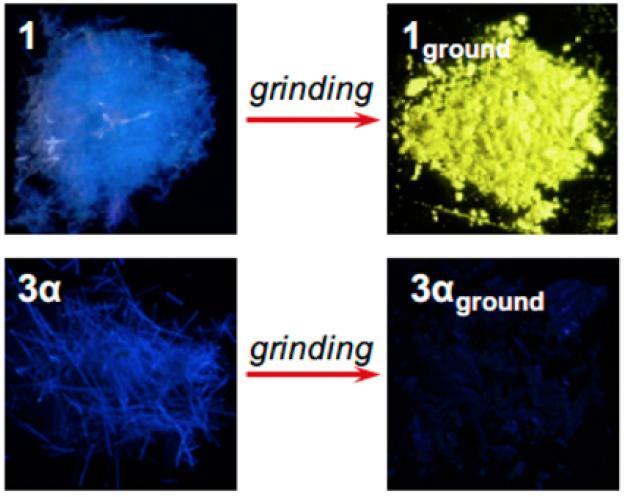
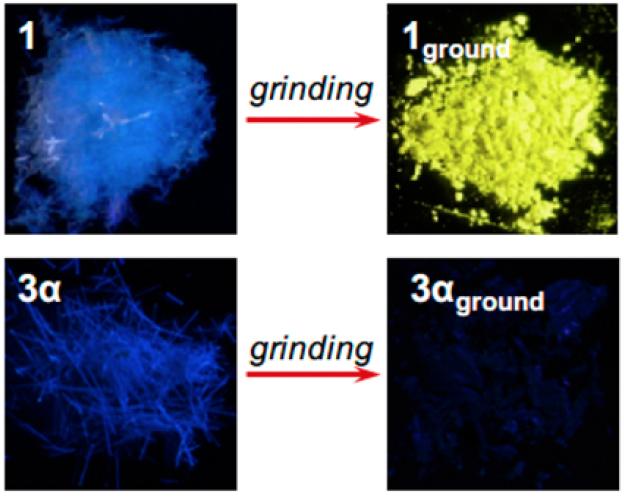
IMAGE

Credit: Seki T. et al., Journal of the American Chemical Society, May 2, 2017

A gold compound shifts from a visible fluorescence to emitting infrared when ground – a big shift with potential applications in bioimaging and security inks.

Some materials luminesce, changing their color and intensity when under mechanical forces such as grinding or rubbing. These luminescent "mechanochromic" materials can produce various emission colors in the visible light spectrum, from blue to red. Their color-shifts under force are well documented, and are caused by changes to the molecules' crystal structures.

Recently, a big shift from the visible spectrum to the infrared has been identified and described in the Journal of the American Chemical Society. Such a large change is unprecedented and is exciting because of its potential applications for bioimaging and invisible inks.

In an attempt to develop new mechanochromic compounds, a research group at Hokkaido University in Japan found a gold compound called 9-anthryl gold(I) isocyanide complex has a unique feature. In its original form, the substance produced a visible blue fluorescence with a wavelength of 448 nanometres (nm). After being ground up into a fine powder, the substance produced infrared emissions (phospholescence) with a wavelength of 900 nm. The infrared emissions are invisible to the naked eye.

"This is the first time a material has been reported to make such a dramatic shift – a change of 452 nm – that also reaches into the infrared part of the light spectrum," says Tomohiro Seki, the lead and corresponding author of the paper.

The research group's X-ray crystallographic analyses revealed that the large shift is based on a crystalline-to-amorphous phase transition which should create strong intermolecular interactions between the gold ions.

"The development of infrared emissive materials is generally difficult, and appropriate design strategies remain limited. However, in this case, simple grinding can afford an infrared emissive material," says Hajime Ito, the corresponding author. "Infrared is invisible to the naked eye but detectable using a spectrometer. So, our material has a great potential for bioimaging and security inks."

###

Media Contact

Naoki Namba (Media Officer)
81-117-062-185
@hokkaido_uni

https://www.global.hokudai.ac.jp/

############

Story Source: Materials provided by Scienmag

Share12Tweet8Share2ShareShareShare2

Related Posts

Noncanonical Sulfur Metabolism, Immunity Altered in Down Syndrome — Technology and Engineering

Noncanonical Sulfur Metabolism, Immunity Altered in Down Syndrome

May 17, 2026

Physical Resilience Linked to Aging Views in Chinese Elders

May 17, 2026

Tau T205 Phosphorylation Controls Memory and Engrams

May 17, 2026

Phocaeicola dorei Eases Liver Fibrosis via Efferocytosis

May 17, 2026
Please login to join discussion

POPULAR NEWS

  • Research Indicates Potential Connection Between Prenatal Medication Exposure and Elevated Autism Risk

    844 shares
    Share 338 Tweet 211
  • New Study Reveals Plants Can Detect the Sound of Rain

    730 shares
    Share 291 Tweet 182
  • Salmonella Haem Blocks Macrophages, Boosts Infection

    62 shares
    Share 25 Tweet 16
  • Breastmilk Balances E. coli and Beneficial Bacteria in Infant Gut Microbiomes

    58 shares
    Share 23 Tweet 15

About

We bring you the latest biotechnology news from best research centers and universities around the world. Check our website.

Follow us

Recent News

Noncanonical Sulfur Metabolism, Immunity Altered in Down Syndrome

Physical Resilience Linked to Aging Views in Chinese Elders

Tau T205 Phosphorylation Controls Memory and Engrams

Subscribe to Blog via Email

Enter your email address to subscribe to this blog and receive notifications of new posts by email.

Join 82 other subscribers
  • Contact Us

Bioengineer.org © Copyright 2023 All Rights Reserved.

Welcome Back!

Login to your account below

Forgotten Password?

Retrieve your password

Please enter your username or email address to reset your password.

Log In
No Result
View All Result
  • Homepages
    • Home Page 1
    • Home Page 2
  • News
  • National
  • Business
  • Health
  • Lifestyle
  • Science

Bioengineer.org © Copyright 2023 All Rights Reserved.