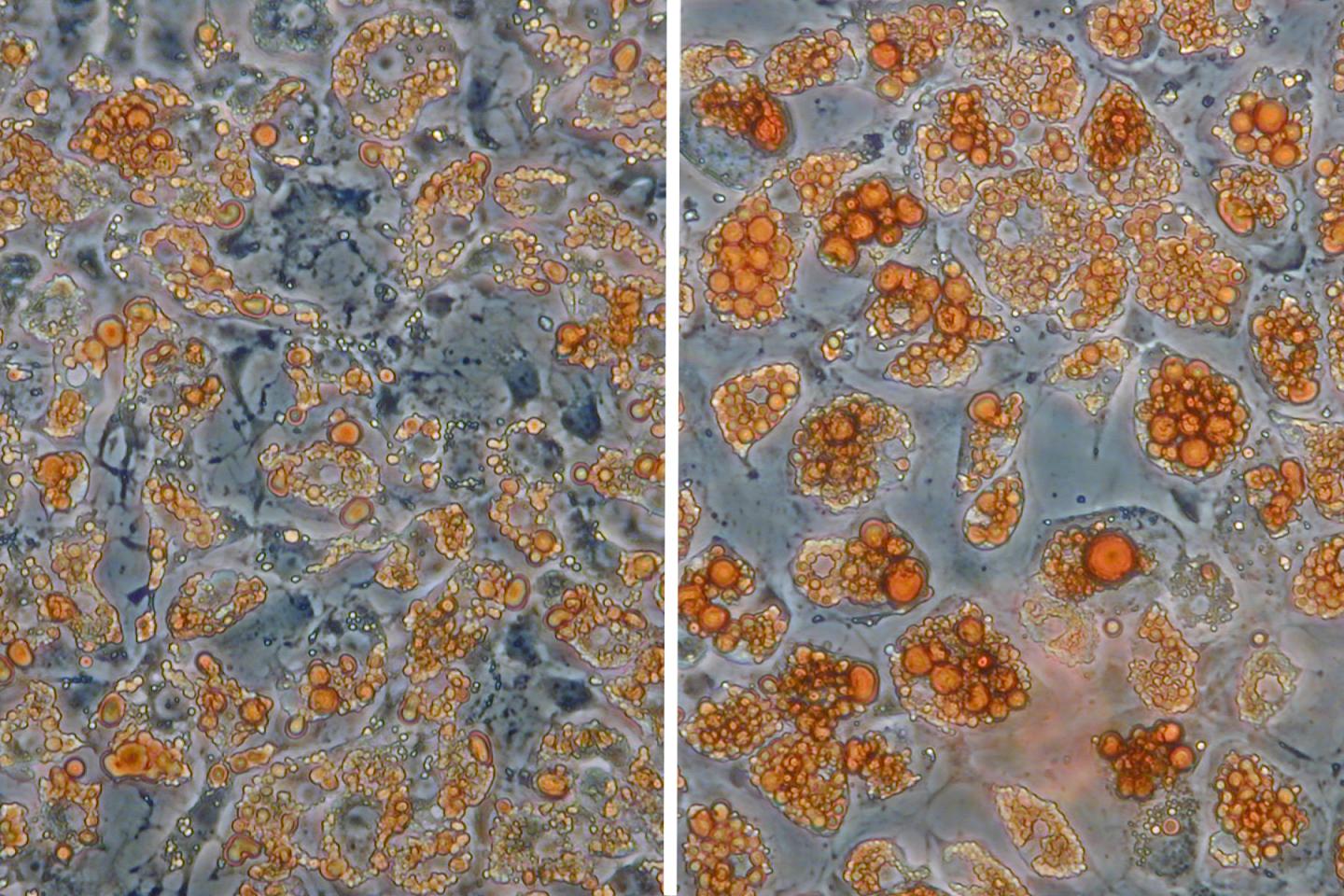
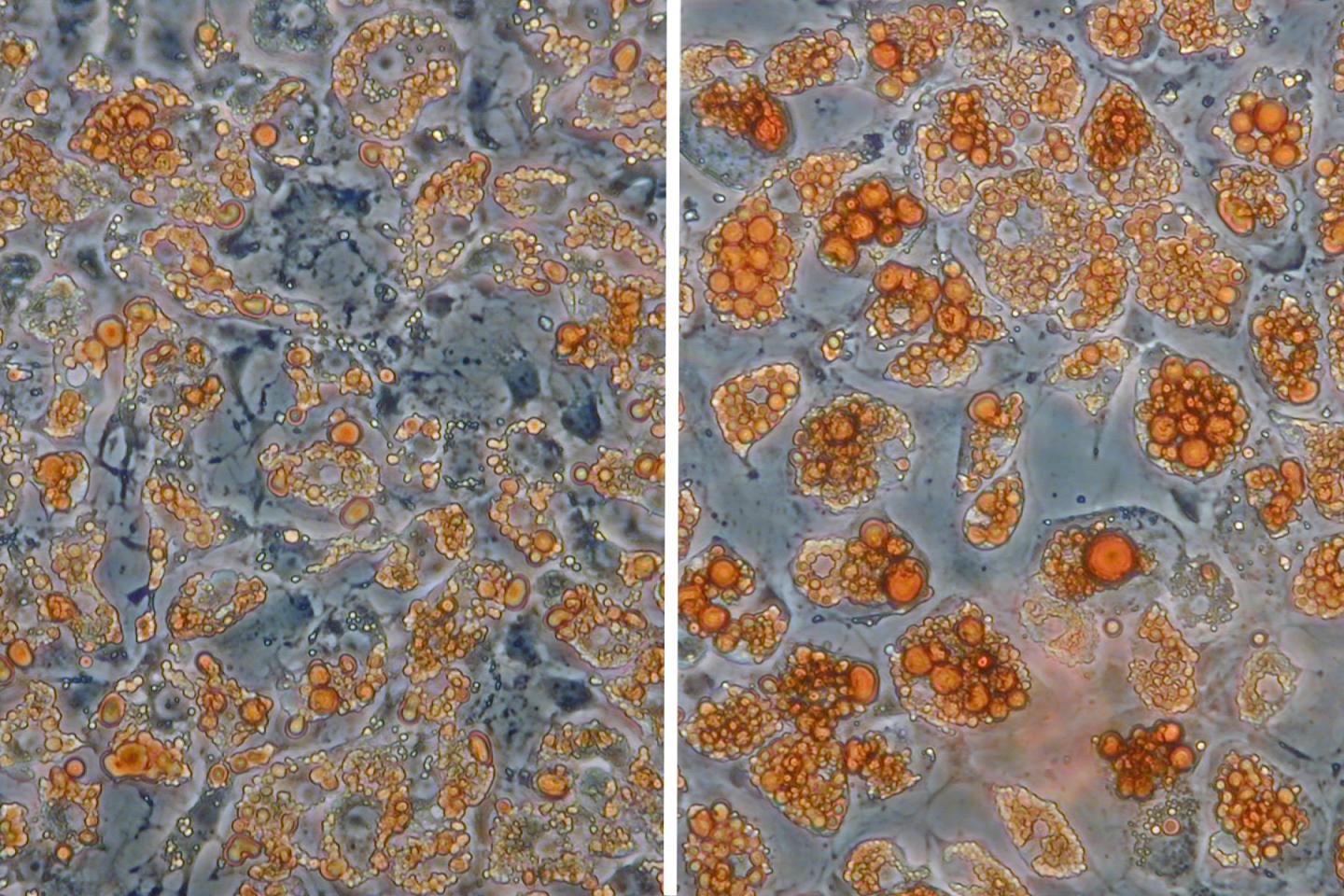
Credit: Delphine Duteil
In mammals, three types of adipose tissues exist. White adipocytes are mainly located in the abdominal and subcutaneous areas of the body and highly adapted to store excess energy. Conversely, beige and brown adipocytes are highly energy-expending by generating heat. A team with the Freiburg researchers Prof. Dr. Roland Schuele and Dr. Delphine Duteil has now shown that the epigenetic enzyme lysine-specific demethylase 1 (Lsd1) plays a key role in maintaining the metabolic properties of brown fat. "The changes induced by Lsd1 ablation have secondary effects on body weight gain and glucose tolerance with aging," explains Prof. Schuele. The researchers selectively ablated Lsd1 and inactivated its catalytic activity in brown adipocytes, which triggered a profound whitening of brown adipose tissue: The colour of the brown fat cells became paler, their size increased and they started to store energy instead of expending it. By understanding these processes, scientists want to develop new strategies to counteract obesity and diabetes.
Lsd1 influences fat cells by using a dual mechanism, as the researchers from Freiburg revealed in their study. The enzyme inhibits the expression of the genes which contain the information for white adipocytes. Simultaneously, Lsd1 promotes the expression of genes containing information for brown adipocytes. The analyses by the team have shown that these opposing functions of Lsd1 are orchestrated by distinct complexes involving the enzyme.
Furthermore, according to the researchers' analyses, Lsd1 is necessary to regulate metabolism, for example for fatty acid oxidation. If Lsd1 is inhibited in mice, the animals' cells take up more glucose, their capacities to convert glucose into energy increases, and they use less fatty acid, for example. Thus, the animals significantly gain weight. An accumulation of intermediates of glycolysis – the process of the breakdown of glucose – in the organism contributes to the observed whitening of brown fat tissue. However, the study has also shown that mice in which Lsd1 was ablated are protected against glucose intolerance, which is often observed in the case of type-2 diabetes. In this illness, insulin cannot sufficiently regulate the blood sugar after glucose feed. Lsd1 inhibitors have already entered clinical trials, for which the findings of the Freiburg research team could also be useful.
###
Roland Schuele and Delphine Duteil are from the Department of Urology and the Clinical Research Center at the Medical Center – University of Freiburg. Schuele is a member of the Cluster of Excellence BIOSS Centre for Biological Signalling Studies at the University of Freiburg.
Original publication:
D. Duteil, M. Tosic, F. Lausecker, H.Z. Nenseth, J.M. Müller, S. Urban, D. Willmann, K. Petroll, N. Messaddeq, L. Arrigoni, T. Manke, J.W. Kornfeld, J.C. Brüning, V. Zagoriy, M. Meret, J. Dengjel, T. Kanouni, R. Schüle (2016). Lsd1 Ablation Triggers Metabolic Reprogramming of Brown Adipose Tissue. Cell Rep. 18;17(4):1008-1021. doi: 10.1016/j.celrep.2016.09.053.
Article about Roland Schuele's research in "uni'wissen": http://www.pr2.uni-freiburg.de/publikationen/uniwissen/uniwissen-2014-1/#/8
Contact:
Prof. Dr. Roland Schuele
Department of Urology and Clinical Research Center
Medical Center – University of Freiburg
BIOSS Centre for Biological Signalling Studies
University of Freiburg
Phone: +49 (0)761/270-63100
E-Mail: [email protected]
Media Contact
Katrin Albaum
[email protected]
49-761-203-97662
@BIOSSFreiburg
http://www.bioss.uni-freiburg.de