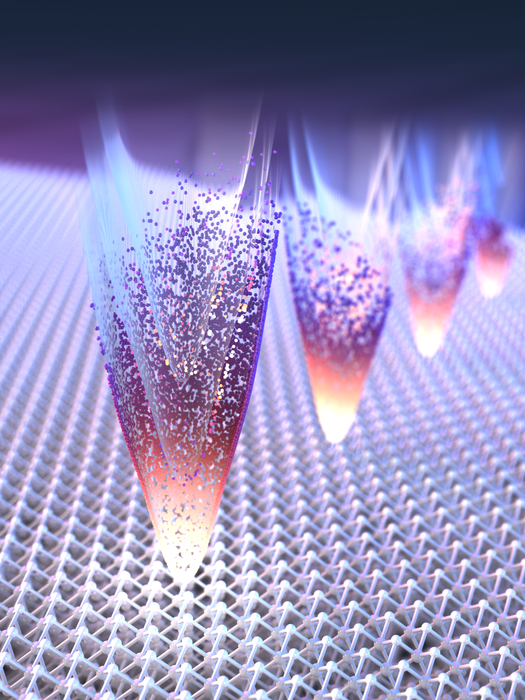
“The discovery of new material properties usually depends on our ability to control the chemical composition of the material,” says Ulrich Höfer, professor of experimental physics at Philipps-Universität Marburg and visiting professor at the University of Regensburg. “The purely optical manipulation of material properties, on the other hand, could take physics into a new era by enabling new functions on demand.”Exciting electrons periodically with strong light leads to exotic quantum effects: The periodic perturbations from the strong light field cause the electrons to have not just one fixed energy state, but many evenly spaced energy states. “The original energy state surrounds itself, as it were, with several envelopes of light,” explains Rupert Huber, professor at the Institute for Experimental and Applied Physics at the University of Regensburg and joint lead author. Experts refer to this state as a Floquet state. “However, the dynamic properties of such states – for example, the question of how long it takes the electrons to ‘clothe’ themselves with light – have remained unknown until now,” Huber elaborates.
Credit: Brad Baxley (parttowhole.com)
“The discovery of new material properties usually depends on our ability to control the chemical composition of the material,” says Ulrich Höfer, professor of experimental physics at Philipps-Universität Marburg and visiting professor at the University of Regensburg. “The purely optical manipulation of material properties, on the other hand, could take physics into a new era by enabling new functions on demand.”Exciting electrons periodically with strong light leads to exotic quantum effects: The periodic perturbations from the strong light field cause the electrons to have not just one fixed energy state, but many evenly spaced energy states. “The original energy state surrounds itself, as it were, with several envelopes of light,” explains Rupert Huber, professor at the Institute for Experimental and Applied Physics at the University of Regensburg and joint lead author. Experts refer to this state as a Floquet state. “However, the dynamic properties of such states – for example, the question of how long it takes the electrons to ‘clothe’ themselves with light – have remained unknown until now,” Huber elaborates.
The Collaborative Research Centres Structure and Dynamics of Internal Interfaces and Emergent Relativistic Effects in Condensed Matter of the German Research Foundation at the Universities of Marburg and Regensburg offer ideal conditions to close these research gaps. The team chose photoelectron spectroscopy to study the surface of a crystal. “With our measurements, we went beyond the limit of what could be realized with this spectroscopy to date in terms of time resolution in strong light fields,” emphasizes Suguru Ito, postdoc at Philipps University Marburg and the paper’s lead author. As a result, the team made an unforeseen discovery, he says: “Surprisingly, the Floquet bands form after a single optical cycle, a very short time.”
“The reviewers could hardly believe this at first!” adds Höfer. But the clear experimental results are supported by theoretical modelling, carried out by Michael Schüler from the Paul Scherrer Institute in Villigen, Switzerland, and Michael Sentef, then group leader at the Max Planck Institute for the Structure and Dynamics of Matter in Hamburg, Germany, and now Professor of Solid State Physics at the University of Bremen.
The work provides important new information on the evolution of Floquet bands, explains Sentef: “The dressing of electrons with light is often particularly difficult in solids because the energy introduced is quickly converted into heat. By demonstrating that such dressing happens after just a single optical cycle, we pave the way for changing solid-state properties very quickly and very strongly with light.”
“Our experiment opens up the possibility of visualizing a wide range of transient quantum states,” adds Huber. “This paves the way towards tailored quantum functions and ultrafast electronics.”
In addition to the research groups from Marburg and Regensburg, scientists from the MPSD, the Paul Scherrer Institute, and the A. V. Rzhanov Institute in Novosibirsk, Russia, participated in the publication. The cooperation with the Russian colleague took place prior to the Ukraine war. The German Research Foundation funded participating scientists through collaborative research centers in Marburg and Regensburg and through the Emmy Noether program. Several international funding organizations provided further financial support.
Text: Philipps University Marburg / University Regensburg / MPSD
Journal
Nature
DOI
10.1038/s41586-023-05850-x
Article Title
Build-up and dephasing of Floquet–Bloch bands on subcycle timescales