This study is led by Prof. Han Zhang (Institute of Microscale Optoelectronics, College of Physics and Optoelectronic Engineering, Shenzhen University) and Supervised by Dr. Zhongjian Xie, Dr. Xiaopeng Ma (Shenzhen Children’s Hospital) and Dr. Yaqing He (Shenzhen Center for Disease Control and Prevention).
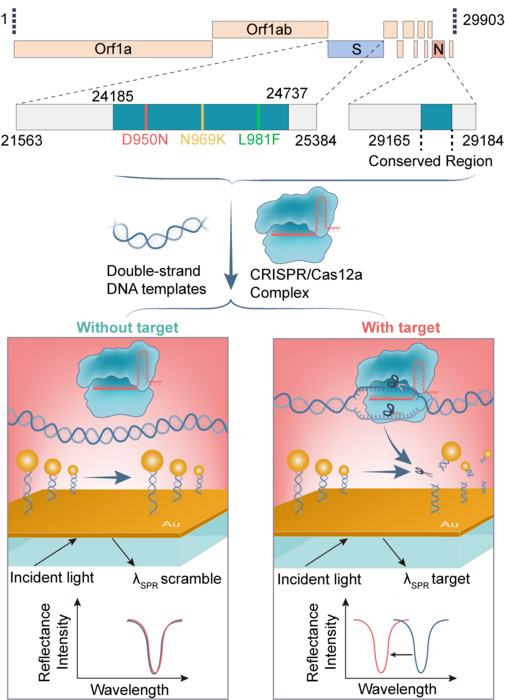
Credit: ©Science China Press
This study is led by Prof. Han Zhang (Institute of Microscale Optoelectronics, College of Physics and Optoelectronic Engineering, Shenzhen University) and Supervised by Dr. Zhongjian Xie, Dr. Xiaopeng Ma (Shenzhen Children’s Hospital) and Dr. Yaqing He (Shenzhen Center for Disease Control and Prevention).
The outbreak of the COVID-19 pandemic is partially due to the challenge of identifying asymptomatic and pre-symptomatic carriers of the virus, and thus highlights a strong motivation for diagnostics that can be rapidly deployed with high sensitivity. On the other hand, several concerned SARS-CoV-2 variants, including the Omicron, are required to be identified as soon as the samples are identified as ‘positive’. Unfortunately, a traditional PCR test does not allow their specific identification.
Clustered regularly interspaced short palindromic repeat (CRISPR) system is a well-known microbial natural adaptive immune system and developed as a revolutionary genomic editing tool. The widely known mechanism of the CRISPR technology is while CRISPR-associated (Cas) nuclease combined with a chimeric guide RNA (gRNA), such complex can bine to gene locus with protospacer-adjacent motif (PAM), recognize and cleave a site-specific nucleotide sequence. This mechanism has been widely applied in gene therapies. At the same time, gene detecting methodologies that use different types of Cas nucleases have been developed and used widely. For example, SHERLOCK is a method employing Cas12 or Cas13 to detect pre-amplified DNA or RNA sequences. Other methods like HOLMES, HOLMESv2, CONAN, etc., are presenting the advantages of high specificity and flexibility.
Surface plasmon resonance (SPR)-sensing technology is a well-known versatile technique within the region of optical sensing platforms. It is widely used in research of molecular interactions, including antigen-antibody, drug-target, protein-nucleic acid, protein-protein, and protein-lipid, by monitoring the refractive index change on the sensor surface caused by the surface change of weight.
“What if combining CRISPR and SPR?”. Dr. Zhi Chen, a post-doctoral researcher at Shenzhen University, who specialized in medical science and molecular biology, grasped this spark. This idea was promptly appraised by the leader of his research group, Prof. Han Zhang. Another researcher, Dr. Jingfeng Li, was willing to cooperate with Dr. Zhi Chen and finish this research. After a huge amount and repeating tests for this study, a prototype of the CRISPR-empowered SPR sensing platform was finally built. More and more co-workers joined in and supported this research, including the Shenzhen Center for Disease Control and Prevention.
Dr. Zhi Chen, Dr. Jingfeng Li, and Prof. Han Zhang named this platform MOPCS (Methodologies Of Photonic CRISPR Sensing), which combines an optical sensing technology-surface plasmon resonance (SPR), and the ‘gene scissors’ CRISPR technique to achieve both high sensitivity and specificity of viral variants’ measurement. MOPCS is a low-cost, CRISPR/Cas12a system-empowered SPR gene detecting platform that can analyze viral RNA, without the need for amplification, within 38 min from sample input to results output, and achieve a limit of detection of 15 fM. Besides, MOPCS achieves a highly sensitive analysis of SARS-CoV-2 and mutations appear in variants B.1.617.2 (Delta), B.1.1.529 (Omicron), and BA.1 (a subtype of Omicron). This platform was also used to analyze some recently collected patient samples from a local outbreak in Shenzhen City and identified by the Centers for Disease Control and Prevention. This innovative CRISPR-empowered SPR platform will further contribute to various fast, sensitive, and accurate detection of target nucleic acid sequences with single-base mutations.
###
See the article:
A CRISPR/Cas12a empowered surface plasmon resonance platform for rapid and specific diagnosis of the Omicron variant of SARS-CoV-2
https://doi.org/10.1093/nsr/nwac104
Journal
National Science Review
DOI
10.1093/nsr/nwac104