• HOME
  • NEWS
  • EXPLORE
    • CAREER
      • Companies
      • Jobs
    • EVENTS
    • iGEM
      • News
      • Team
    • PHOTOS
    • VIDEO
    • WIKI
  • BLOG
  • COMMUNITY
    • FACEBOOK
    • INSTAGRAM
    • TWITTER
Monday, May 11, 2026
BIOENGINEER.ORG
No Result
View All Result
  • Login
  • HOME
  • NEWS
  • EXPLORE
    • CAREER
      • Companies
      • Jobs
        • Lecturer
        • PhD Studentship
        • Postdoc
        • Research Assistant
    • EVENTS
    • iGEM
      • News
      • Team
    • PHOTOS
    • VIDEO
    • WIKI
  • BLOG
  • COMMUNITY
    • FACEBOOK
    • INSTAGRAM
    • TWITTER
  • HOME
  • NEWS
  • EXPLORE
    • CAREER
      • Companies
      • Jobs
        • Lecturer
        • PhD Studentship
        • Postdoc
        • Research Assistant
    • EVENTS
    • iGEM
      • News
      • Team
    • PHOTOS
    • VIDEO
    • WIKI
  • BLOG
  • COMMUNITY
    • FACEBOOK
    • INSTAGRAM
    • TWITTER
No Result
View All Result
Bioengineer.org
No Result
View All Result
Home NEWS Science News Chemistry

When chemistry with green light mimics what happens in life

Bioengineer by Bioengineer
December 14, 2020
in Chemistry
Reading Time: 3 mins read
0
IMAGE
Share on FacebookShare on TwitterShare on LinkedinShare on RedditShare on Telegram

IMAGE

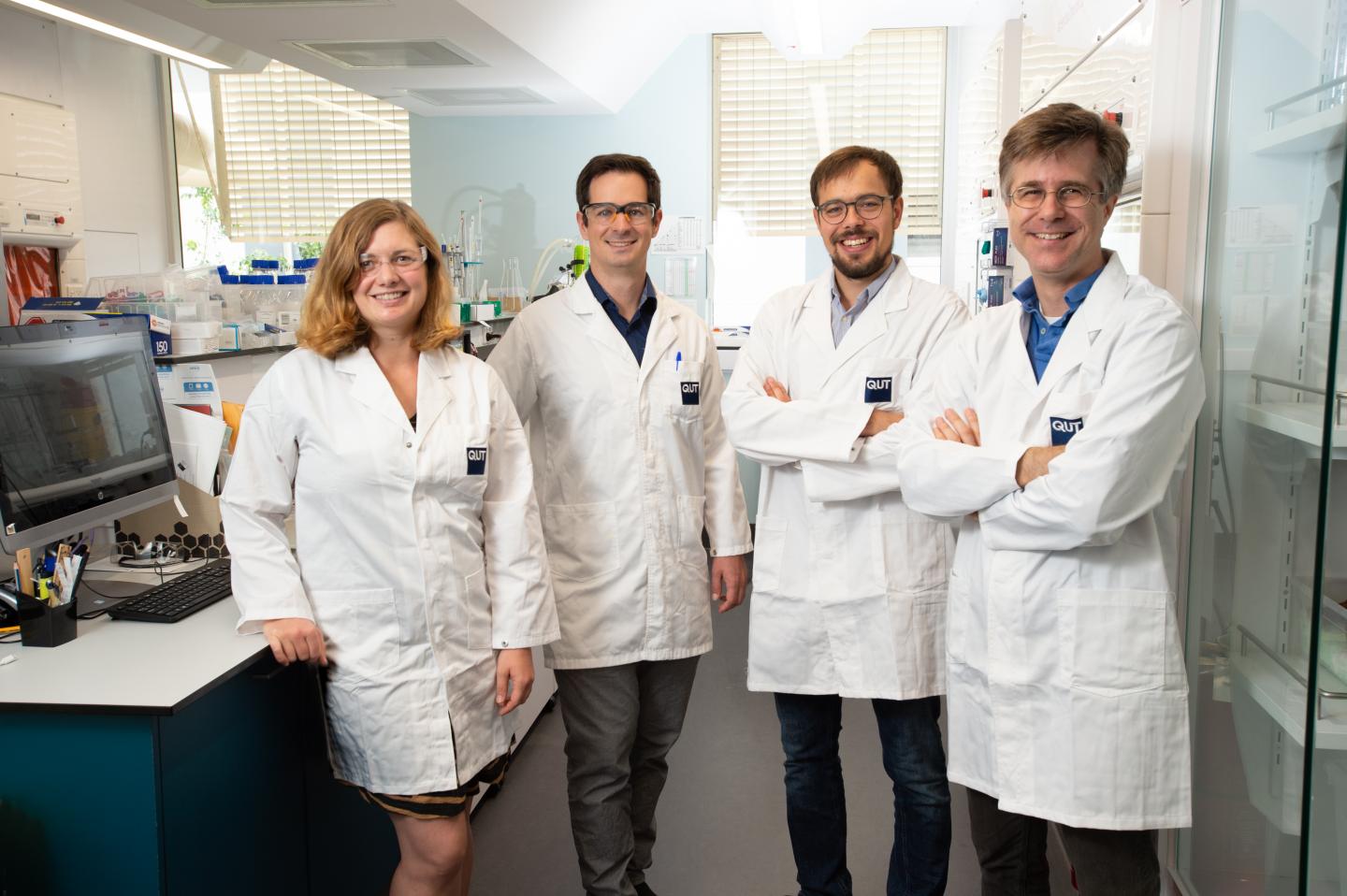
Credit: QUT

Scientists frequently look at how molecules behave in nature to help them design chemical processes, and that’s what Queensland University of Technology (QUT) and Ghent University researchers did to create a green light-stabilised 3D polymer structure that unfolds itself when left in darkness.

The team has reported on this world-first example of a reversible, light-triggered process to fold polymers into single chain nanoparticles in the flagship journal of the Royal Society of Chemistry, Chemical Science.

The research was conducted by lead author and QUT PhD student Daniel Kodura, with QUT’s Australian Research Council (ARC) DECRA Fellow Dr Hendrik Frisch, Dr Anja Goldmann, PhD student Fabian Bloesser and ARC Laureate Fellow Professor Christopher Barner-Kowollik, from the Soft Matter Materials Laboratory in QUT’s Centre for Materials Science, in collaboration with Professor Filip Du Prez and Dr Hannes Houck from the Polymer Chemistry Research group at Ghent University, Belgium.

“What we have done is look to proteins, which are biological polymers that enable most of the chemistry in our bodies’ cells and are essential to life, and mimic with synthetic polymers one of the ways that proteins function,” Mr Kodura said.

Proteins are large complex molecules of amino acids that are connected to each other in long chains, and these chains naturally fold themselves, sometimes with a helper molecule, into a 3D structure that performs a function, like making your muscles move.

“What we did was use green LED light as the helper to fold synthetic polymer chains into a structure,” he said. “The light was the fuel for the process and, importantly, it also kept the structure stable. As long as the light was on, the structure held its shape. Without the light, in the dark and at room temperature, the structure relaxed and unfolded.”

“This has never been achieved before,” added Dr Frisch. “Also, folding the chains with light into a structure and then unfolding them in the dark could be successfully repeated several times.”

Professor Christopher Barner-Kowollik said the chemical process was “akin to a living process of its own”.

“Living organisms need to consume an energy source, like light, to survive and this 3D structure is the same. It consumes light as a fuel to maintain itself,” he said.

“This is an example of fundamental, instructive science. It shows what’s possible when you use the interplay of light and darkness for complex macromolecular designs.”

Dr Goldmann said while scientists have shown how to fold chemical substrates with light into a structure before “it’s always been permanently locked in. This is the first example of a truly light-stabilised 3D single-stranded polymer structure.”

The fundamental principle behind the chemical process is the same as team members used previously in creating what they have termed light-stabilised dynamic materials (LSDMs) – a new class of materials.

“What we previously created was something you can see and touch,” Professor Du Prez and Dr Houck said. “This is different and deals with transformations at the single chain level, meaning nanometre size which can be up to one-billionth of a metre, or 100,000 times smaller than a human hair.”

###

The full paper, Light-fueled dynamic covalent crosslinking of single polymer chains in non-equilibrium states, is available here:
https://pubs.rsc.org/en/Content/ArticleLanding/2021/SC/D0SC05818A#!divAbstract

Chemical Science has chosen the paper as its ChemSci Pick of the Week.

Media Contact
Karen Milliner
[email protected]

Original Source

https://www.qut.edu.au/news?id=171768

Related Journal Article

http://dx.doi.org/10.1039/d0sc05818a

Tags: Atomic/Molecular/Particle PhysicsChemistry/Physics/Materials SciencesMaterialsPolymer Chemistry
Share12Tweet8Share2ShareShareShare2

Related Posts

Miniature Sensor Uses Light to Detect Touch — Chemistry

Miniature Sensor Uses Light to Detect Touch

May 8, 2026
Iron Minerals Determine Whether Dissolved Organic Matter Fuels Microbes or Becomes Long-Term Carbon Storage — Chemistry

Iron Minerals Determine Whether Dissolved Organic Matter Fuels Microbes or Becomes Long-Term Carbon Storage

May 8, 2026

Kate Evans Appointed Associate Lab Director for Biological and Environmental Systems Science at ORNL

May 8, 2026

Advancing Multiscale Modeling and Overcoming Operational Challenges in Autothermal COâ‚‚-to-Methanol Reactors

May 8, 2026
Please login to join discussion

POPULAR NEWS

  • Research Indicates Potential Connection Between Prenatal Medication Exposure and Elevated Autism Risk

    840 shares
    Share 336 Tweet 210
  • New Study Reveals Plants Can Detect the Sound of Rain

    727 shares
    Share 290 Tweet 181
  • Salmonella Haem Blocks Macrophages, Boosts Infection

    61 shares
    Share 24 Tweet 15
  • Breastmilk Balances E. coli and Beneficial Bacteria in Infant Gut Microbiomes

    57 shares
    Share 23 Tweet 14

About

We bring you the latest biotechnology news from best research centers and universities around the world. Check our website.

Follow us

Recent News

New Post-Hoc Analysis Explores Daily Oral Orforglipron Use in Adults Over 65 with Obesity, Regardless of Diabetes Status

Evaluating Digoxin Use in Patients with Symptomatic Rheumatic Heart Disease

Evaluating the Effectiveness and Safety of Digitalis Glycosides in Treating Heart Failure

Subscribe to Blog via Email

Enter your email address to subscribe to this blog and receive notifications of new posts by email.

Join 82 other subscribers
  • Contact Us

Bioengineer.org © Copyright 2023 All Rights Reserved.

Welcome Back!

Login to your account below

Forgotten Password?

Retrieve your password

Please enter your username or email address to reset your password.

Log In
No Result
View All Result
  • Homepages
    • Home Page 1
    • Home Page 2
  • News
  • National
  • Business
  • Health
  • Lifestyle
  • Science

Bioengineer.org © Copyright 2023 All Rights Reserved.