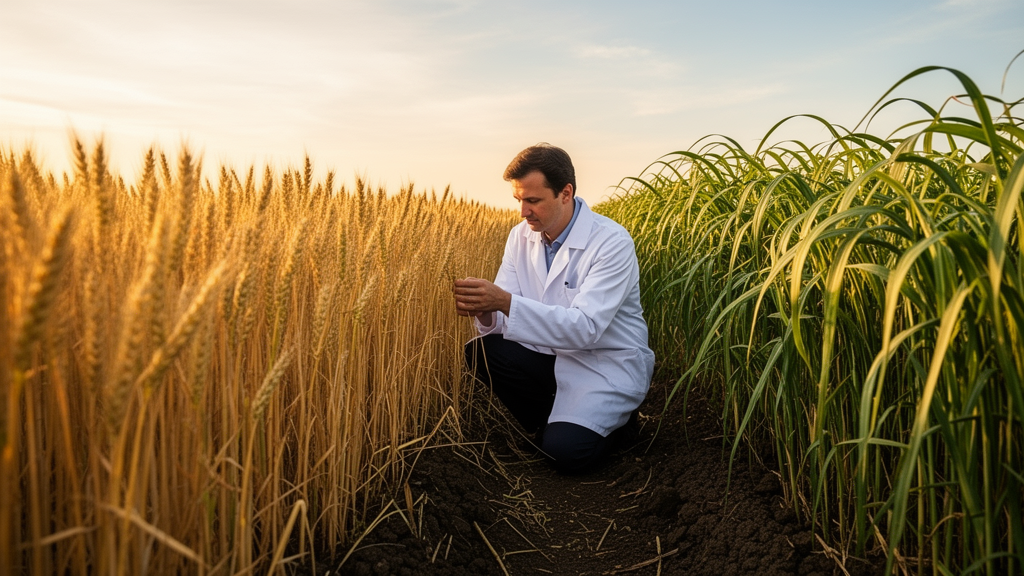
Scientists have created wheat plants that hold their leaves in an upright, vertical posture by switching off a single hormone-producing gene, and crucially, the change comes with almost none of the yield-sapping side effects that have long plagued similar strategies. The finding, published in Theoretical and Applied Genetics, points to the brassinosteroid biosynthesis gene DWARF4 as a promising breeding target for dense-planting systems, where an erect canopy can distribute sunlight more evenly across a crop and support higher grain production per hectare.
Brassinosteroids are steroid hormones that shape many traits of direct agronomic value in cereals, including stem elongation, leaf angle and grain size. By driving cell elongation at the lamina joint, the hinge-like region where a leaf blade meets its sheath, these hormones determine how far a leaf tilts away from the stem. When brassinosteroid activity drops, leaves stand more upright. But broad suppression of the pathway has repeatedly proven costly: brassinosteroid-deficient and brassinosteroid-insensitive plants in rice, barley and maize often show reduced fertility and shrunken grains, drawbacks that have limited their usefulness in breeding programmes.
The research team, whose author list includes Manpartik S. Gill, Andrew L. Phillips, Stephen G. Thomas and Peter Hedden among others, took a more surgical approach. Rather than dampening the whole hormone pathway, they targeted individual biosynthesis enzymes. In the brassinosteroid pathway, DWARF1 encodes a C-24 reductase that converts 24-methylenecholesterol to campesterol, the first committed sterol precursor of the hormones, while DWARF4 and DWF11 encode 22α-hydroxylase cytochrome P450 enzymes that catalyse rate-limiting steps later in the pathway and, in cereals, partially back each other up. Because two enzymes share the later step, removing only one might trim brassinosteroid levels in specific tissues without collapsing the entire pathway.
To test this idea, the researchers mined an EMS-mutagenesis population of the spring bread wheat cultivar Cadenza for premature stop codons in each of the three homoeologous copies of DWF1 and DWF4, which bread wheat carries on its A, B and D genomes. The dwf1 mutant alleles encode truncated proteins lacking either the flavin adenine dinucleotide-binding or transmembrane domains, while the dwf4 alleles lack the conserved heme-binding domain required for enzymatic activity. They combined single mutations into double and triple knockouts, backcrossed twice to non-mutagenized Cadenza to purge background mutations, and generated lines lacking functional copies of all three homoeologues of either gene. The resulting triple mutants, dwf1-abd and dwf4-abd, were then compared against wild-type null segregants and Cadenza in glasshouse and field experiments, with genotyping confirmed by homoeologue-specific PCR and KASP assays.
Both triple mutants produced dramatically more upright leaves. Flag leaf angles at anthesis were significantly reduced in both lines relative to controls, and anatomical work explained why. Scanning electron microscopy and laser ablation tomography revealed that cells in the auricle region of the lamina joint were significantly shorter in both mutants, likely restricting the longitudinal elongation that normally lets a leaf bend away from the stem. The lamina joint was also significantly thicker, with more cell layers adjacent to both the abaxial and adaxial surfaces, echoing features reported in erect-leaf brassinosteroid mutants of rice and maize. The leaf blade was also more tightly packed around the ligule in both mutants, a phenotype resembling the wheat compact plant architecture mutant, in which loss of TaSPL8 downregulates genes in the brassinosteroid and auxin signalling pathways.
The similarities ended there. The dwf1-abd mutant was severely compromised: in the 2022 field trial it stood roughly 50 percent shorter than Cadenza, produced fewer tillers and spikelets per spike, and yielded grains that were significantly smaller and lighter. High-throughput imaging under the Field Scanalyzer at Rothamsted Research confirmed that dwf1-abd plots carried lower canopy cover throughout the growing season, including during flowering, and lower spike density at the end of flowering, with height reductions of about 30 percent at mid-flowering and 25 percent at maturity in the winter-sown experiment. Metabolite profiling by UHPLC-ESI-MS/MS showed why: concentrations of campesterol in dwf1-abd seedlings were 126-fold lower than in the null segregant, with downstream precursors campestanol and 6-oxocampestanol reduced 12.8-fold and 3.7-fold respectively. The bioactive brassinosteroids castasterone and brassinolide fell below the detection limit, and the mutant responded hypersensitively to exogenous 24-epibrassinolide in lamina joint inclination assays, all hallmarks of deep brassinosteroid deficiency.
The dwf4-abd mutant told a very different story. It showed a significant reduction in flag leaf angle and a modest height reduction of about 14 percent in the field, driven mainly by a shorter peduncle and spike, yet grain area and thousand grain weight did not differ significantly from Cadenza. Tiller number was only slightly reduced. Consistent with this mild phenotype, brassinosteroid precursor levels in dwf4-abd seedlings were not reduced; the substrate campestanol was unchanged, and the products 6-deoxocathasterone and 6-deoxytyphasterol actually accumulated to significantly higher levels, a pattern the authors attribute to functional redundancy with DWF11. In rice, knocking out both OsDWF4 and OsDWF11 produces severe dwarfism and malformed leaves, but the single osdwf4 mutant alters leaf angle alone, and the wheat data mirror that division of labour.
The result builds on encouraging precedents in other cereals. In maize, a null allele of the DWF4 orthologue called lac1 maintains photosynthetic efficiency at high planting densities and delivers higher yields than the wild type in densely sown plots. In wheat itself, a haploblock loss affecting the ZnF-B gene, which encodes a RING-type E3 ligase that targets a brassinosteroid-signalling repressor, confers a compact upright canopy and higher grain yields without pleiotropic costs. Similarly, rice lines carrying a mutation that activates the brassinosteroid catabolic gene BRD3 specifically in developing panicles show increased panicle branching and grain number without effects on grain size. The new study extends this logic from signalling and catabolic components to biosynthesis enzymes, and the authors note that DWF4’s low expression in developing grains, in contrast to DWF1, may explain why grain development escaped unscathed in the dwf4 mutant.
Several caveats temper the enthusiasm. Residual EMS-induced mutations may still have contributed to the observed phenotypes despite the backcrossing, and the researchers could not reliably quantify castasterone, brassinolide, typhasterol or dolichosterone because they fell below the detection limit. It also remains unclear how campesterol and later intermediates are produced at all in the absence of DWF1, although the shrinking difference in precursor concentrations between dwf1-abd and its null segregant along the pathway suggests compensatory homeostatic mechanisms involving up-regulation of multiple biosynthesis genes. Whole-seedling brassinosteroid measurements likewise failed to detect the changes that the dwf4 leaf phenotype implies; the authors suggest that brassinosteroid depletion in dwf4-abd may be confined to the lamina joint itself, as seen in the maize lac1 mutant’s ligule region, and call for spatially and temporally resolved metabolite analysis across a broad range of organs. Environmental conditions also matter, since the height deficit of dwf1-abd in the spring 2022 field trial was roughly double that seen in the earlier winter-sown experiment.
The most important test still lies ahead. The dwf4 mutation did not increase thousand grain weight relative to Cadenza in the field trial, so any yield benefit would have to come from improved light capture and photosynthesis at high sowing densities rather than from heavier grains per spike. The authors state that large-plot field experiments comparing dwf4-abd and null segregant yields across different planting densities will be needed to confirm whether the erect canopy translates into harvestable gains, and space limitations meant the dwf4 line could not be assessed for canopy cover under the Field Scanalyzer. If those trials succeed, introducing natural or induced allelic variation in DWF4 could offer breeders a rare combination: an architecture optimised for the crowded fields of modern intensive wheat production, achieved by editing a single biosynthetic step and leaving the grain untouched.
Subject of Research: Effects of knocking out brassinosteroid biosynthesis genes DWARF1 and DWARF4 on wheat canopy architecture, plant height and grain traits
Article Title: Knocking-out the brassinosteroid biosynthesis genes DWARF1 or DWARF4 produces upright canopy architecture in wheat
Article References: Gill, M. S., Phillips, A. L., Tarkowská, D., Addy, J., Virlet, N., Foulkes, M. J., Wells, D. M., Atkinson, J. A., Pearce, S., Thomas, S. G., & Hedden, P. (2026). Knocking-out the brassinosteroid biosynthesis genes DWARF1 or DWARF4 produces upright canopy architecture in wheat. Theoretical and Applied Genetics, 139(11), 313. https://doi.org/10.1007/s00122-026-05418-z
Image Credits: AI Generated
DOI: 10.1007/s00122-026-05418-z
Keywords: wheat, brassinosteroids, DWARF4, DWARF1, leaf angle, canopy architecture, lamina joint, plant hormones, crop breeding, high-density planting, grain weight, mutagenesis
News Source: Alan Morgan. (October 24, 2026). Wheat Gene Knockouts Deliver Upright Leaves Without Yield Penalties. Scienmag.