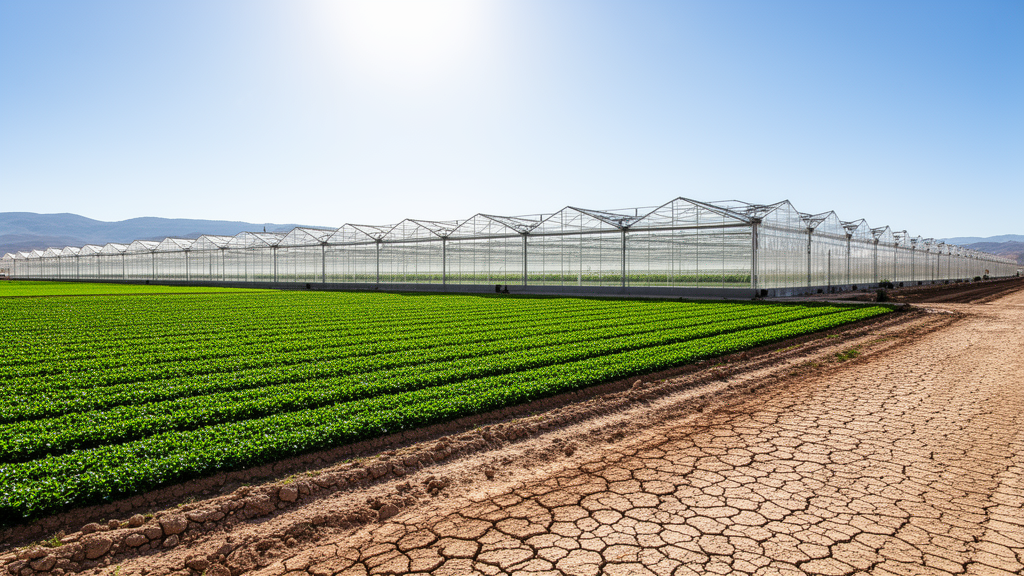
In the Campo de Dalías, a coastal plain in southwest Almería, Spain, one of the world’s densest concentrations of greenhouses sits atop an aquifer system that was drained to near collapse before desalination arrived to keep the industry alive. A study published in npj Sustainable Agriculture by Wan Izar Haizan Wan Rosely and Nikolaos Voulvoulis traces this trajectory in detail and asks two pointed questions: whether the region’s celebrated water-efficiency gains were large enough for water use to absorb the much higher cost of desalinated water, and whether investing in those technologies earlier could have prevented the depletion of the aquifer. The answers are sobering. Efficiency per tonne of produce improved dramatically, but total water consumption kept rising, and the counterfactual analysis suggests that earlier adoption of efficient irrigation would at best have delayed, not prevented, the crossing of the region’s sustainable abstraction threshold.
The findings speak directly to a paradox with global resonance. Agriculture is a dominant pressure on freshwater worldwide: annual global withdrawals exceed four trillion cubic metres, with groundwater supplying between 21 and 30 percent of that total, a share that keeps growing. More than a quarter of the world’s population and over 40 percent of global agricultural production already depend on unsustainable groundwater extraction. Groundwater depletion, the excess of withdrawal over recharge, is projected to reach 887 cubic kilometres by 2050, roughly 61 percent more than in 2021, with consequences including saltwater intrusion, stream depletion, land subsidence as aquifers compact, and degradation of groundwater-dependent ecosystems. Against that backdrop, Campo de Dalías offers an unusually complete record of what happens when innovation, markets, and governance collide over decades.
The region’s transformation began in the 1940s, when state-led agricultural colonisation after the Spanish Civil War framed newly discovered groundwater as an instrument of national economic development. Early abstraction was modest, around 5 to 6 million cubic metres per year, constrained by poverty, shallow wells, and limited infrastructure. From the 1950s to the 1980s, everything changed. Irrigation infrastructure expanded, pumping technology improved, and the introduction of enarenado soil-mulching techniques and plastic greenhouses turned Campo de Dalías into a year-round production system, effectively decoupling water demand from seasonal rainfall. Electrified pumping and a proliferation of wells drove abstraction up sixfold by the 1960s, reaching nearly 100 million cubic metres by the mid-1980s. That marked a transition from adaptive groundwater use to structural overuse, with extraction exceeding natural recharge even in non-drought years.
Crucially, the study argues, overexploitation was not driven by demand alone but enabled by access and infrastructure. Landowners effectively controlled the groundwater beneath their properties, and extraction was largely unregulated. Spain’s 1985 Water Law moved water into the public domain and introduced a concessional system, which slowed greenhouse construction until 1989, but weak enforcement, illegal wells, inconsistent fee collection, and limited monitoring severely blunted its effect. Later infrastructure, including the Benínar Reservoir, deep community wells, and eventually desalination plants, layered new supplies onto an already stressed system, reinforcing a path dependency rather than curbing over-abstraction. Water quality degradation compounded the problem: seawater intrusion and nitrate pollution exceeding 100 milligrams per litre shrank the volume of usable groundwater, prompting farmers to drill deeper wells and blend sources, which intensified pressure rather than relieving it.
The 1990s and 2000s brought a wave of efficiency investment. Drip irrigation, fertigation, soilless cultivation, and closed-loop systems reduced water use per unit of output so substantially that Campo de Dalías became one of Europe’s most water-efficient intensive agricultural regions. But the gains were largely absorbed by production intensification and spatial expansion rather than absolute reductions in water use. Greenhouse coverage expanded inland and along the coast until nearly all available land was occupied. The quantitative analysis, covering 1975 to 2018, puts numbers on this divergence: water consumption per tonne of produce fell by 59 percent and yields per hectare rose by 131 percent, yet greenhouse area expanded by 231 percent, total production by 666 percent, and total water consumption by 213 percent. This pattern is consistent with the rebound effect, also known as the irrigation efficiency paradox or Jevons’ paradox, in which efficiency functions primarily as a mechanism of economic resilience rather than conservation.
The efficiency gains did, however, change the economics of water. Before modernization, producing one tonne of melons required roughly 673 cubic metres of water, costing farmers about €108 per tonne at a groundwater price of €0.16 per cubic metre. Modernised systems need only about 65 cubic metres of desalinated water per tonne; even at €1 per cubic metre, the water cost falls to roughly €65 per tonne. Overall, the study estimates a 75 to 90 percent reduction in water consumption per tonne of horticultural output compared with early greenhouse monoculture. Because the volume required per tonne fell so sharply, the total water cost of production remained stable or even declined despite the unit price of water rising more than sixfold, and subsidies and blended supplies reduced it further. Higher water prices, the analysis suggests, provided the price signal that drove adoption of water-saving techniques.
Desalination itself arrived only after alternatives had been exhausted. Spain’s AGUA programme, launched in 2004, shifted national policy from large inter-basin transfers to desalination, and the Campo Dalías Desalination Plant, completed in 2015, uses a two-step reverse osmosis process to treat seawater and reduce toxic boron levels. But energy costs of €0.60 to €1.00 per cubic metre discouraged exclusive reliance, so farmers blended desalinated water with groundwater and rainwater, masking scarcity signals and allowing continued extraction. Desalinated water’s share of the region’s irrigation supply rose from 50 percent to 80 percent in just over two decades, yet energy-intensive reverse osmosis accounts for over half of operating costs, keeping the water expensive, up to €1.20 per cubic metre in March 2022. Farmers actually pay less than €0.60 per cubic metre, with the difference subsidised, a further example of pricing that mutes the incentives demand-side reform would require.
To test whether earlier efficiency investment could have changed history, the authors ran a counterfactual using a mean annual aquifer recharge estimate of about 50 million cubic metres, with a range of 30 to 60 million cubic metres, and recalculated historical water demand assuming post-modernization consumption rates but the same production levels and crop mix. Reconstructed abstraction rose from 7.45 million cubic metres per year in 1975 to roughly 60 million cubic metres by 2008. Under the counterfactual, annual abstraction would have been reduced by about 14 million cubic metres, delaying the crossing of the sustainability threshold, estimated around 2009 using linear interpolation between observations from 2008 and 2012, into the late 2000s. The authors are explicit that this estimate is conditional on a fixed production trajectory; it illustrates the effect of irrigation efficiency rather than predicting how an alternative development path would have unfolded.
The environmental and social ledger of the Almería model extends well beyond the aquifer. Monoculture expansion sharply reduced vulnerable habitats, including scrubland supporting Maytenus senegalensis subsp. europaea, while plastic greenhouse coverings degrade rapidly in the coastal climate, generating agricultural plastic waste that risks soil and water contamination. Desalination shifts burdens to coastal and energy systems through brine discharge and greenhouse gas emissions, and planned capacity expansions risk reinforcing what the authors call an illusion of abundance that delays demand-side reform. The study also documents serious labour concerns: the sector depends heavily on migrant workers from Africa, Eastern Europe, and Roma communities, who face documented abuses including irregular contracts, wage theft, unsafe housing, pesticide exposure, and, disproportionately affecting women, gender-based exploitation. As water costs rose, economic pressures were frequently shifted onto labour rather than resolved through reduced resource use.
The wider lesson, the authors argue, is that technological interventions are necessary but insufficient. Comparable patterns of field-level efficiency gains without basin-scale reductions have been reported in Australia’s Murray-Darling Basin, the United States’ High Plains Aquifer, northern and western China, and Pakistan’s Indus Basin. What distinguishes Campo de Dalías is its closed groundwater system and export-oriented horticulture embedded in global supply chains, which make the divergence unusually visible. The study recommends integrated, participatory water governance that pairs efficiency with demand management, abstraction limits grounded in robust water accounting and ecological thresholds, ecosystem service valuation through natural capital accounting, and reuse of reclaimed wastewater, a technique Spain already leads in. Evidence from Colorado’s San Luis Valley shows that even politically difficult measures such as self-imposed pumping fees can gain acceptance when water users help design the institutions themselves. Without such systemic approaches, efficiency gains may continue to paradoxically facilitate the very intensification that depletes the resource on which agriculture, and the communities it sustains, ultimately depend.
Subject of Research: Water-use efficiency, aquifer depletion, and the rebound effect in intensive greenhouse agriculture in Campo de Dalías, Almería, Spain
Article Title: Campo de Dalías and the “Almeria miracle”: a cautionary tale of the value of water in agriculture
Article References: Wan Rosely, W. I. H., & Voulvoulis, N. (2026). Campo de Dalías and the “Almeria miracle”: a cautionary tale of the value of water in agriculture. npj Sustainable Agriculture, 4(1), Article 87. https://doi.org/10.1038/s44264-026-00196-z
Image Credits: AI Generated
DOI: 10.1038/s44264-026-00196-z
Keywords: groundwater depletion, irrigation efficiency, rebound effect, desalination, greenhouse agriculture, Almería, Spain, water governance, drip irrigation, Jevons paradox, water scarcity, sustainable agriculture
News Source: Alan Morgan. (October 24, 2026). Almeria’s Greenhouse Miracle Shows Water Efficiency Alone Cannot Save Aquifers. Scienmag.