Team of researchers from Germany and China unveils how the organisation of global maritime transport networks impacts economy by using methods from brain network analysis.
Credit: © BIOTEC/TU Dresden
Around 80 per cent of global trade by volume is transported by sea, and thus the connectivity network of the maritime transportation system is fundamental to the world economy and to the functioning of society. To better exploit new international shipping routes, the current ones need to be analysed: What are the principles behind their network organisation? What mechanisms determine the complex system association with international trade? However, there is another complex system that, similarly to maritime transportation systems, links the navigability of its network structure and organisation to its efficient performance in the environment. This complex system is: the brain. The motivation for this comparative and trans-disciplinary research came from the exchange during an international network science conference, followed by three years of collaborative work on the topic.
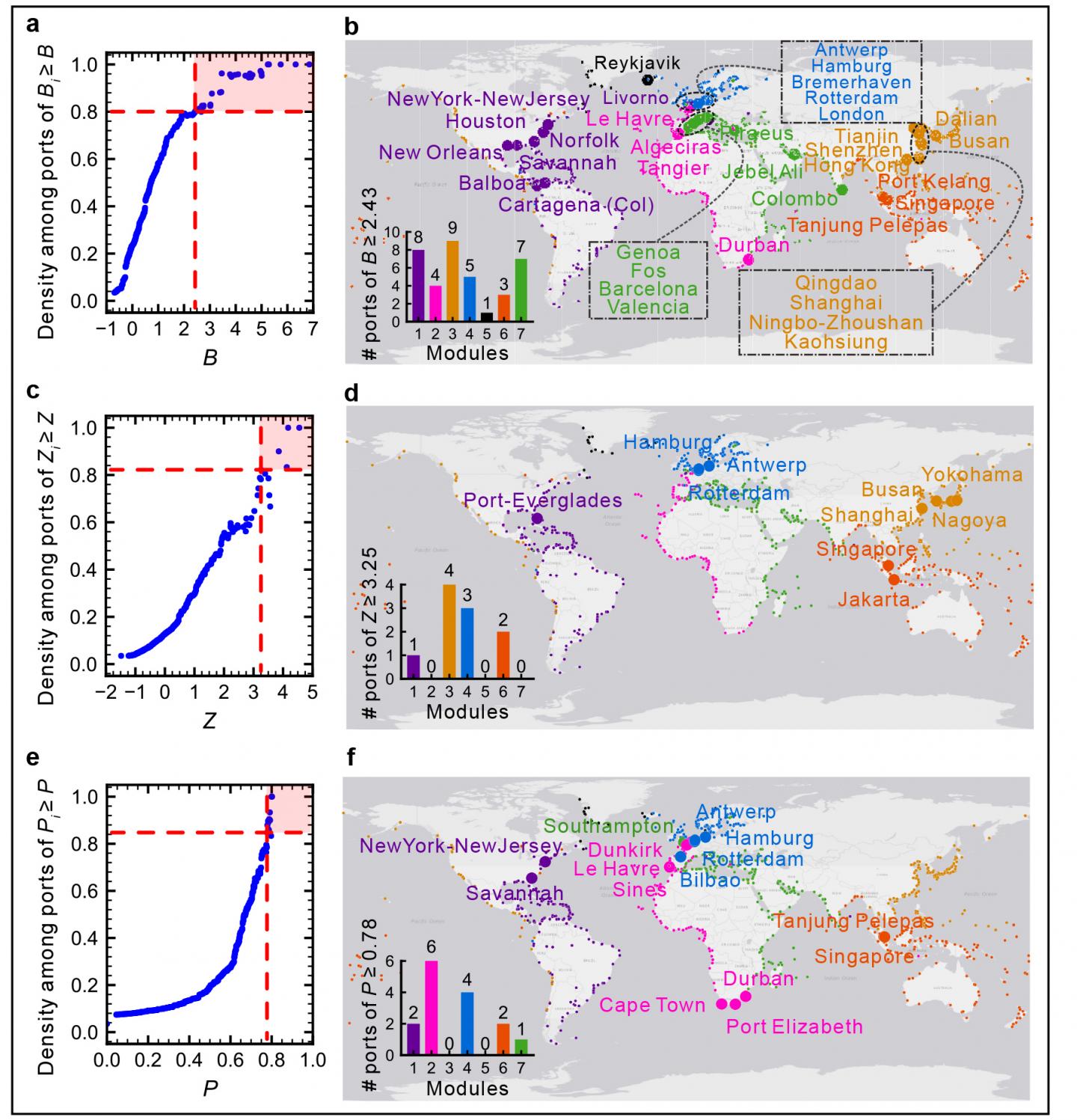
“Many complex systems share basic rules of self-organisation and economical functionality. When I examined the maritime network structure of the Chinese colleagues at the conference, I advanced the hypothesis that its structure displays a trade-off between high transportation efficiency and low wiring cost, similarly to the one we know is present in brain networks. We combined our knowledge in network science, maritime science and data processing, which led to new insights into the maritime network structural organisation complexity and its relevance to international trade”, explains Dr. Cannistraci, research group leader for biomedical cybernetics at BIOTEC, TU Dresden. “An important result of this study is the development of new computational network measures for the investigation of modular connectivity and structural core organisation within complex networks in general, which here we applied to maritime science. In future projects, I plan to use these newly developed methods in my research at the BIOTEC where I focus on computational and network systems in biomedicine. They might turn out to be particularly useful for brain network organization analysis and the development of markers for brain diseases, such as depression and Alzheimer.”
###
The study was conducted in collaboration with Dr. Mengqiao Xu, M.S. Qian Pan and Dr. Haoxiang Xia from the Dalian University of Technology (China) and Dr. Alessandro Muscoloni from the Biomedical Cybernetics lab at BIOTEC, TU Dresden (Germany). It was funded by an Independent Group Leader Starting Grant for Carlo Vittorio Cannistraci from BIOTEC and by the Tsinghua Laboratory of Brain and Intelligence, Tsinghua University, Beijing (China). The study was supported by Alphaliner S.A.R.L. (France), which provided comprehensive data on global liner shipping.
Publication:
Nature Communications: “Modular gateway-ness connectivity and structural core organization in maritime network science”, authors: Mengqiao Xu, Qian Pan, Alessandro Muscoloni, Haoxiang Xia and Carlo Vittorio Cannistraci
The Biotechnology Center (BIOTEC) was founded in 2000 as a central scientific unit of the TU Dresden with the goal of combining modern approaches in molecular and cell biology with the traditionally strong engineering in Dresden. Since 2016, the BIOTEC is part of the central scientific unit “Center for Molecular and Cellular Bioengineering” (CMCB) of the TU Dresden. The BIOTEC is fostering developments in research and teaching within the Molecular Bioengineering research field and combines approaches in cell biology, biophysics and bioinformatics. It plays a central role within the research priority area Health Sciences, Biomedicine and Bioengineering of the TU Dresden.
http://www.
http://www.
Media Contact
Carlo Vittorio Cannistraci
[email protected]
Related Journal Article
http://dx.