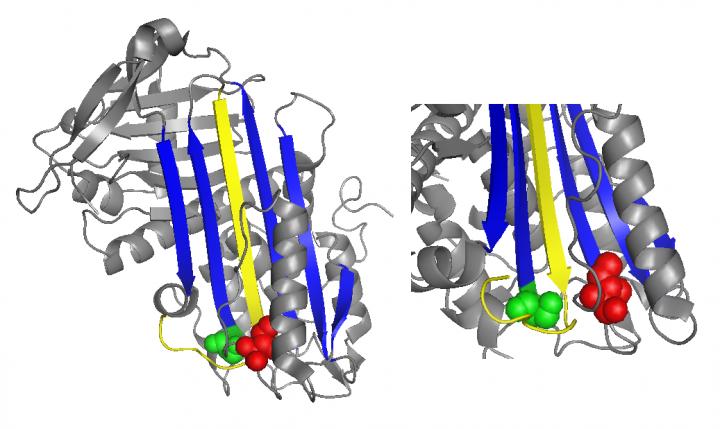
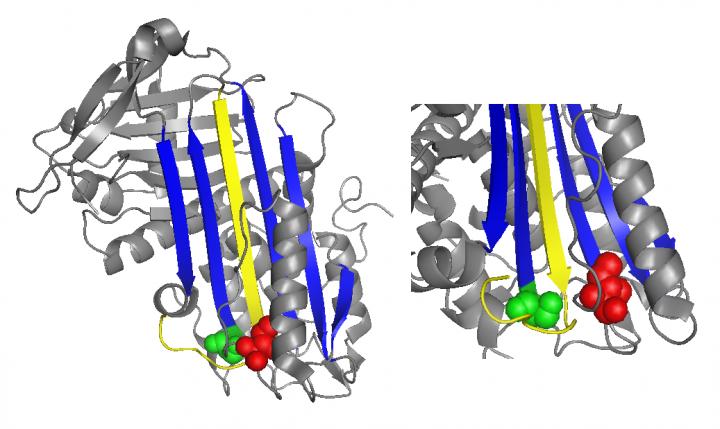
Credit: Irene Martinez-Martinez
When a person is injured, blood clotting is essential. However, once the danger has passed, it is equally essential to stop the clotting response in order to prevent thrombosis, or the obstruction of blood flow by clots. A protein called antithrombin is responsible for stopping coagulation, but about one in two thousand people have a hereditary deficiency in antithrombin that puts them at much higher risk of life-threatening blood clots.
A group of researchers in Spain have analyzed the mutations in the antithrombin proteins of these patients and discovered that a section of the protein plays an unexpected role in its function. This insight into how antithrombin works could lead to treatments not only for patients with antithrombin deficiency, but also to better-designed drugs for other blood disorders. The research will be published in the Oct. 6 issue of the Journal of Biological Chemistry.
The Centro Regional de Hemodonacion and Hospital Universitario Morales Meseguer of the Universidad de Murcia in Spain is a reference center for the diagnosis of antithrombin deficiency. For over 15 years, researchers at the laboratory have been receiving samples from patients with diverse mutations that affect how their antithrombin works.
Antithrombin normally inhibits thrombin by inserting a loop-shaped region, called the reactive center loop, into the active site of the thrombin protein, preventing thrombin from catalyzing clot formation by distorting the shape of the thrombin's active site. Many antithrombin mutations that cause clotting diseases directly or indirectly affect the reactive center loop. However, biochemical studies led by Irene Martinez-Martinez discovered that mutations in a completely different part of the antithrombin also contributed to its dysfunction.
"We saw that we [had] mutants that were affecting the function of the protein even though they were very far from the main part of the protein that is in charge of the inhibition," Martinez-Martinez said. "People thought that the antithrombin function was mainly focused on one domain of the protein. With this work, we have realized that is not true."
The researchers' analyses of the new mutations suggested that domain of the antithrombin at the opposite end of the reactive center loop help keep the thrombin trapped in its final, distorted form. When there were specific mutations in this region, the thrombin was more often able to return to its active form and degrade and release the antithrombin.
Martinez-Martinez hopes that understanding the importance of this region of the antithrombin could lead to better drugs for preventing blood clotting by activating antithrombin or preventing bleeding by inhibiting it. She also emphasizes that the essential nature of this domain of the protein could not have been predicted from simply studying the sequences of healthy antithrombins.
"This work has been possible thanks to the characterization of mutations identified in patients," Martinez-Martinez said.
The work was funded by the foundations Instituto de Salud Carlos III and FEDER as well as Fundación Séneca.
###
About the Journal of Biological Chemistry
JBC is a weekly peer-reviewed scientific journal that publishes research "motivated by biology, enabled by chemistry" across all areas of biochemistry and molecular biology. The read the latest research in JBC, visit http://www.jbc.org/.
About the American Society for Biochemistry and Molecular Biology
The ASBMB is a nonprofit scientific and educational organization with more than 12,000 members worldwide. Most members teach and conduct research at colleges and universities. Others conduct research in various government laboratories, at nonprofit research institutions and in industry. The Society's student members attend undergraduate or graduate institutions. For more information about ASBMB, visit http://www.asbmb.org.
Media Contact
Sasha Mushegian
[email protected]
@asbmb
http://www.asbmb.org
Related Journal Article
http://dx.doi.org/10.1074/jbc.m117.787325