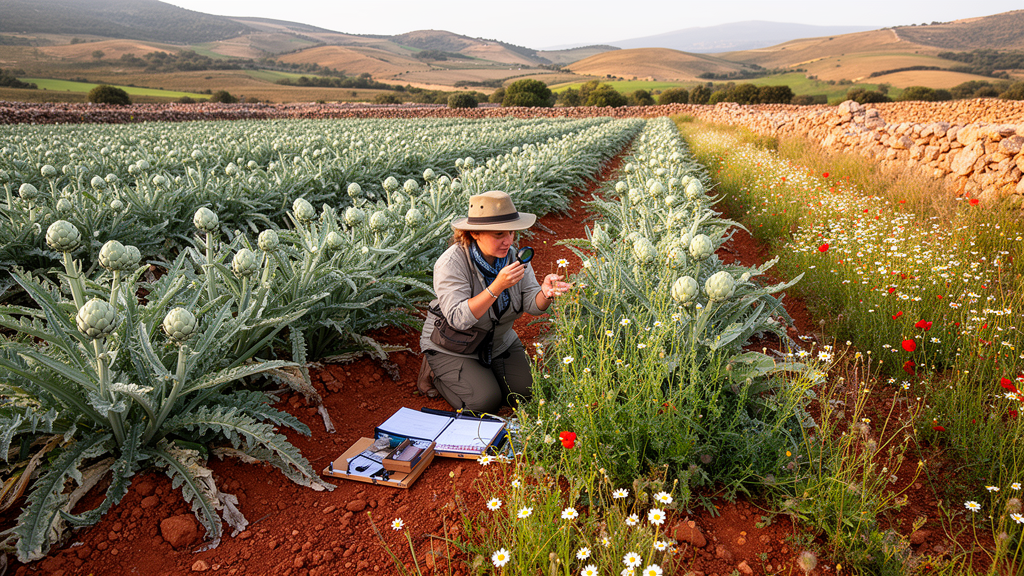
In the irrigated artichoke fields of Sardinia, the plants that grow between the rows have finally been counted. A three-year survey, published in the journal Italian Botanist, has produced the first comprehensive inventory of the segetal flora — the community of wild plants that live within cropped land — associated with globe artichoke (Cynara cardunculus L.) cultivation on the Italian island. The study, conducted between 2019 and 2021 across four farms spread along a north–south gradient, recorded 113 vascular plant taxa and revealed a flora dominated by native Mediterranean species but increasingly infiltrated by aggressive non-native newcomers.
The distinction between the plant groups recorded in the survey rests on a classification scheme that botanists use to describe how long a non-native species has been present in a given territory. Archaeophytes are taxa introduced by human activity before 1500 CE, often arriving with the earliest waves of agriculture, and they are frequently treated as part of the traditional cultural landscape even though they are not truly indigenous. Neophytes, by contrast, arrived after that threshold, typically through trade, horticulture, or accidental transport in modern times, and they are the group most often associated with invasive behavior. Cryptogenic species occupy an intermediate and somewhat ambiguous position: their region of origin is unknown or unresolved, so ecologists cannot say with confidence whether they are native, ancient introductions, or recent arrivals. Applying this framework to the artichoke fields of Sardinia, the researchers found that the overwhelming majority of the recorded taxa — 91 of the 113 — were native to the Italian flora, while only one archaeophyte, five cryptogenic species, and sixteen neophytes were present. Within that small neophyte contingent, however, eleven species were classified as invasive in Sardinia, four as naturalized, and one as casual, a proportion that signals a meaningful degree of biological pressure on the native segetal community even though the invaders remain numerically a minority.
The life-form analysis of the surveyed flora offers a window into the ecological strategies that prevail in this disturbed agricultural habitat. Following the Raunkiaer system, which classifies plants according to the position of their surviving buds during the unfavorable season, the artichoke field flora was overwhelmingly composed of therophytes — 83 of the 113 taxa. Therophytes are annual plants that complete their entire life cycle within a single favorable season, surviving harsh periods as seeds. This strategy is exceptionally well suited to arable land, where soil disturbance, tillage, and crop management repeatedly reset the vegetation, creating open niches that short-lived, fast-reproducing species exploit before the next intervention. Hemicryptophytes, which keep their buds at or just below the soil surface, accounted for 23 taxa, while geophytes, which survive underground as bulbs, tubers, or rhizomes, contributed six. A single chamaephyte, with buds held just above the soil surface, completed the spectrum. The dominance of therophytes is a classic signature of Mediterranean segetal communities, where the combination of a hot, dry summer and recurrent agricultural disturbance favors annuals over perennial growth forms.
The chorological spectrum — the geographic distribution pattern of the recorded species — further illuminates the biogeographic character of these field communities. Mediterranean species dominated with 52 taxa, a finding consistent with Sardinia’s position at the heart of the Mediterranean Basin, one of the world’s recognized biodiversity hotspots. Widely distributed species, those with broad ranges spanning multiple biogeographic regions, came second with 20 taxa, followed by Eurasian elements with nine. This distribution reflects the interplay between the island’s native flora and the cosmopolitan weed species that have followed human agriculture across continents for millennia. The fact that Mediterranean natives still constitute the largest chorological group suggests that, despite decades of agricultural intensification, the segetal flora of Sardinian artichoke fields retains a substantial measure of regional biogeographic identity rather than having been entirely replaced by widespread generalist weeds.
Among the most frequent and abundant species recorded in the survey, a mix of native and non-native plants emerged as the characteristic companions of the artichoke crop. Three native species — Calendula arvensis, Convolvulus arvensis, and Lolium rigidum — ranked alongside the archaeophyte Avena fatua and two neophytes, Oxalis pes-caprae and Veronica persica, as the dominant elements of the field flora. Calendula arvensis, the field marigold, is a winter-annual therophyte whose bright orange flowers are a familiar sight in Mediterranean cropland and whose presence supports pollinating insects during the cooler months. Convolvulus arvensis, field bindweed, is a perennial climbing weed with an extensive root system that makes it notoriously difficult to control mechanically. Lolium rigidum, rigid ryegrass, is a widespread Mediterranean grass that has become one of the most herbicide-resistant weed species globally, posing serious management challenges in cereal and horticultural systems alike. Avena fatua, wild oat, has accompanied cereal agriculture since antiquity and exemplifies the archaeophyte category — a species whose fortunes are inseparable from the history of settled farming. Oxalis pes-caprae, the Bermuda buttercup, is a South African geophyte that has spread aggressively across the Mediterranean Basin since its introduction, reproducing almost exclusively vegetatively through bulbils and forming dense carpets that suppress native seedlings. Veronica persica, the bird’s-eye speedwell, is a Middle Eastern native that has naturalized throughout Europe and thrives in winter cereals and vegetable crops.
The coexistence of these dominant species alongside the artichoke crop illustrates the complex competitive dynamics that govern segetal communities. Globe artichoke is a perennial crop whose growing cycle may span multiple years or be managed as an annual, depending on the varietal type and cultivation area. In Sardinia, the spiny artichoke cultivar Spinoso sardo is typically planted in summer, between June and July in the northern part of the island and in August in the south, with the aid of sprinkler or drip irrigation. This summer planting, combined with the slow initial growth of the young plants, makes the crop particularly vulnerable to weed competition during the post-emergence stages, when fast-growing annual weeds can rapidly outcompete the developing artichoke for water, nutrients, and light. The three-year sampling design adopted by the researchers — with surveys conducted at least three times per year between mid-May, early July, and the end of October — was specifically designed to capture this temporal variability in weed emergence, since therophytes complete their life cycles and produce mature seeds at different points throughout the year. A single survey would inevitably miss species whose phenology falls outside the sampling window, underestimating the true floristic richness of the fields.
The methodological choice of randomly located, georeferenced plots of one square meter within each field deserves attention, as it reflects standard practice in vegetation science for quantifying species presence and abundance at a scale fine enough to detect even small and inconspicuous plants. By randomizing plot locations within each field and using different plots for each season and each year, the researchers maximized the number of species recorded and minimized the risk of bias from localized patches of particular weeds. The use of twelve plots per field across four farms provided a reasonable sampling effort for a first inventory, though the authors acknowledge that the true segetal flora of Sardinian artichoke fields may include additional species not captured by this design. The georeferencing of plots also allows future researchers to revisit the same locations and assess temporal changes in the flora, creating a baseline against which the effects of climate change, evolving management practices, or new invasions can be measured.
The broader ecological significance of segetal flora extends well beyond its role as a competitor of crops. Segetal communities provide nectar and pollen resources for pollinators, including wild bees and hoverflies, at times of the year when few other floral resources are available in simplified agricultural landscapes. They offer habitat and food for ground-dwelling arthropods, granivorous birds, and small mammals, contributing to the trophic structure of the agroecosystem. Their root systems help maintain soil structure, reduce erosion, and support microbial communities that cycle nutrients. Some segetal species are themselves crop wild relatives or harbor genetic diversity that could prove valuable for future breeding programs, particularly as agriculture faces the challenges of climate change and the need for crops adapted to hotter, drier conditions. The preservation of segetal diversity is therefore not merely an aesthetic or conservation concern but a matter of maintaining the ecological infrastructure upon which sustainable agriculture depends.
At the same time, the pressures acting on segetal flora are intensifying. The intensification of agricultural practices — including reduced crop rotation, deep tillage, intensive fertilization, landscape simplification, abandonment of low-productivity sites, and heavy reliance on chemical weed control — has been shown across Europe to reduce the richness of native segetal species while favoring a small number of highly competitive generalists and promoting the spread of neophytes and herbicide-resistant biotypes. Studies in other Italian regions have documented a homogenization trend in which native taxa and archaeophytes are displaced by neophytes, leading to a floristic structure that is increasingly similar from field to field and region to region. This biotic homogenization represents a loss not only of species but of the distinctive regional character of agricultural landscapes, replacing locally adapted communities with a cosmopolitan assemblage of aggressive weeds. The Sardinian artichoke fields, with their still-dominant Mediterranean flora, may represent a relatively favorable situation compared to more intensively managed systems elsewhere, but the presence of eleven invasive neophytes among the recorded taxa indicates that the same processes are at work.
The economic context of globe artichoke cultivation in Sardinia adds urgency to these findings. Southern Europe holds approximately forty percent of world artichoke production, and the crop has deep cultural and culinary roots in the region, with Sardinia’s spiny cultivar prized for its distinctive flavor and texture. The sustainability of this production system depends in part on managing the segetal flora in ways that balance weed control with the conservation of the beneficial components of the field community. Approaches such as cover cropping, which has been shown to suppress weed growth while enhancing soil fertility, and diversified crop rotations, which limit the spread of aggressive weed species, offer pathways toward this balance. The allelopathic properties of artichoke itself — demonstrated in laboratory studies to inhibit seed germination and seedling growth of several weed species — suggest that the crop may possess some intrinsic capacity to modulate its own weed environment, a trait that could be further explored in breeding programs aimed at reducing herbicide dependence.
The documentation of Sardinia’s broader botanical context underscores the value of this inventory. The island hosts 2,482 native plant species, of which 341 taxa — approximately fourteen percent — are endemic, found nowhere else. This high level of endemism has led to Sardinia being classified as a meso-hotspot of plant diversity within the broader Tyrrhenian macro-hotspot that encompasses Corsica, Sicily, the Balearic Islands, and the Tuscan Archipelago. While the segetal flora of artichoke fields is composed primarily of widespread Mediterranean species rather than narrow endemics, the agricultural landscapes of the island can serve as refugia for elements of the native flora that have been displaced from more natural habitats by land-use change. Maintaining the floristic richness of these field communities is therefore part of a wider strategy for conserving the island’s botanical heritage, one that recognizes the ecological value of traditionally managed agricultural systems as reservoirs of biodiversity in an increasingly intensively farmed Mediterranean landscape.
Future research building on this first inventory could explore several directions. Comparative studies across different cropping systems, management intensities, and landscape contexts would help identify the factors that most strongly shape segetal community composition in Sardinian agriculture. Long-term monitoring of the same fields would reveal trends in species turnover, invasion dynamics, and responses to climate variability. Functional trait analyses could clarify which plant strategies are favored under different management regimes and how these relate to ecosystem services such as pollination support or pest regulation. Seed bank studies would illuminate the reservoir of species present in the soil but not expressed in the standing vegetation, providing a more complete picture of the floristic potential of these fields. Together, such work would transform this initial inventory from a snapshot into the foundation for a deeper understanding of the ecological dynamics that sustain — or erode — the botanical diversity of one of the Mediterranean’s most iconic cropping systems.
Subject of Research: Segetal flora of globe artichoke fields in Sardinia
Article Title: The segetal flora of Cynara cardunculus L. (globe artichoke) fields in Sardinia
Article References: Lozano, V. (2025). The segetal flora of Cynara cardunculus L. (globe artichoke) fields in Sardinia. Italian Botanist, 19, 171-183. https://doi.org/10.3897/italianbotanist.19.149222
Image Credits: AI Generated
DOI: 10.3897/italianbotanist.19.149222
Keywords: segetal flora, globe artichoke, Cynara cardunculus, Sardinia, neophytes, invasive species, agroecosystems, Mediterranean flora, weed ecology, biodiversity, therophytes, archaeophytes
News Source: Alan Morgan. (October 17, 2026). Weeds of the artichoke patch: first full inventory of Sardinia’s segetal flora. Scienmag.