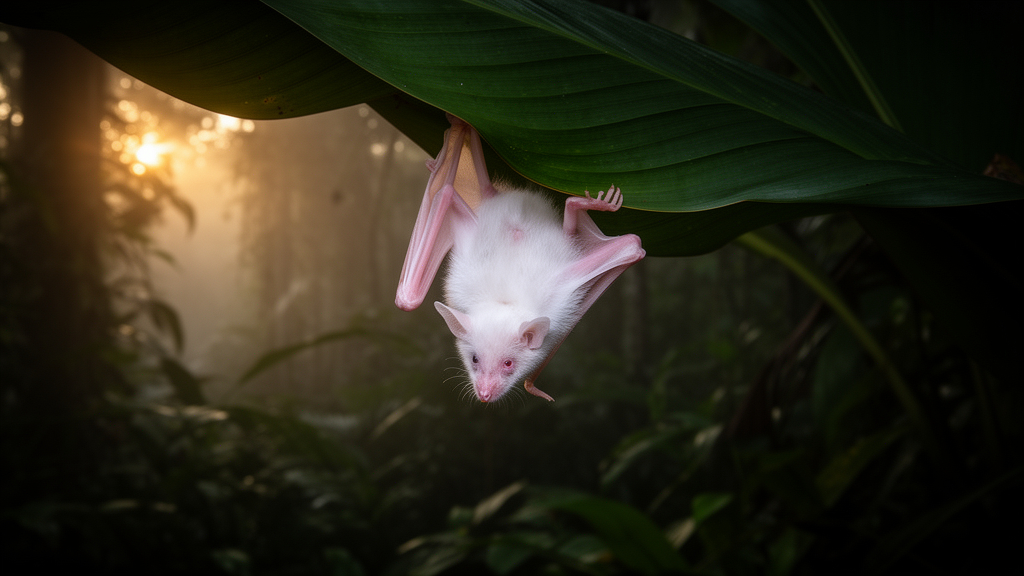
Deep in the Maya Mountains of Belize, a field technician clearing a trail stumbled onto one of the most unusual sights in Neotropical mammalogy: a tiny bat, barely heavier than a coin, dressed entirely in white. The animal was a Spix’s disc-winged bat, Thyroptera tricolor, a species normally cloaked in dark brown fur with a pale underside. Its ghostly appearance was not albinism but leucism, a chromatic disorder in which pigment is missing from the fur while the eyes keep their normal color. A new study published in the journal Neotropical Biology and Conservation documents this individual and confirms it as the first recorded case of leucism not only in this species but in its entire family, Thyropteridae, a milestone that sheds light on how rare pigment anomalies surface in some of the tropics’ most elusive mammals.
The distinction between leucism and its better-known cousins matters for interpreting the find. In albinism, pigment fails in both the integument and the retina, producing the familiar red-eyed, snow-white phenotype. Leucism, by contrast, strips pigment from the fur, skin, or feathers but leaves the eyes untouched. Piebaldism, which is frequently mistaken for leucism in the scientific literature, affects only small patches of the body, giving a patchy rather than uniform appearance. The Belizean bat showed uniformly white pelage with normally colored eyes, placing it firmly in the leucistic category. Such disorders are considered rare in most wild vertebrate populations, though they appear to be disproportionately common in cetaceans and in microchiropteran bats, where more than 450 individuals with total or partial loss of pigmentation have been documented.
Spix’s disc-winged bat is one of the strangest and most specialized mammals in the Neotropics. Weighing just three to four grams, it is instantly recognizable by the adhesive discs on its palms and soles, evolutionary suction cups that allow it to cling inside the smooth interior of young, rolled Heliconia leaves. Because these roosts are ephemeral, a leaf is suitable for only about 24 hours before it unfurls too wide to hold the bats, the species must find a new roost nearly every day. That dependence ties its distribution tightly to the availability of fresh Heliconia foliage, stretching from southern Mexico through Central America to northern coastal Brazil. In Belize, the species is neither numerous nor widespread, having been documented at only four locations, and it is listed as vulnerable in the country. Threats include climate change and localized commercial harvesting of Heliconia leaves, traditionally used to wrap tamales.
The first encounter came on the morning of 22 March 2023 at the Toucan Ridge Ecology and Education Society (T.R.E.E.S) research station in the Stann Creek District. As a technician cut vegetation along a trail, a rolled Heliconia roost fell to the ground along with its occupants. At least one of the bats that scattered was completely white, and a leucistic male was photographed, though no measurements or precise coordinates were taken during that incidental observation. Because the rest of the group flew off immediately, the team could not determine whether more than one white individual had been present. The sighting, however, was enough to launch a targeted search of a small Heliconia patch on the property, covering just 0.0774 hectares.
Over the following year, researchers located and sampled three roosts within that patch. On 15 August 2023, three of five bats were captured from a roost, all with normal coloration: two lactating females and one scrotal male, with no pups found attached to the mothers. On 15 December 2023, a leucistic adult male was captured, while three others escaped before their dorsal fur could be checked. Finally, on 19 April 2024, the team captured all four occupants of a third roost: one leucistic adult male alongside one normal male and two pregnant, normal-colored females. The roosts were a maximum of 22 meters apart. Morphometric data collected with digital scales and calipers showed the leucistic male was a typical adult, with a forearm length of 35.3 to 36.4 millimeters and body weight ranging from 2.9 to 4 grams across captures, confirming that the abnormal coloration had not stunted his development.
The repeated appearance of a leucistic male in the same tiny patch of Heliconia strongly suggests a single individual rather than several. The patch is smaller than the species’ average home range of roughly 0.19 hectares, and disc-winged bats are known for territorial behavior and remarkably sedentary social lives. Groups of four to fourteen individuals maintain close, long-lasting associations, often composed of one or two matrilines with high retention of offspring of both sexes. Residence times in an area can span 492 to 1238 days. The group composition recorded in April 2024, two normal females, one normal male, and one leucistic male, mirrors the ratio seen in the first capture, further supporting the hypothesis that researchers were repeatedly meeting the same white-furred resident as he moved between his daily roosts.
Why had leucism never been documented in this family before? The authors point to a likely surveying bias. Previous reviews found leucism reported more often in cave-dwelling bats than in tree- and foliage-roosting species, but that pattern may simply reflect how much easier caves are to survey than roosts hidden in vegetation. A bat that changes roosts every day, tucked inside a rolled leaf in dense tropical forest, is extraordinarily difficult to monitor. The rarity of records for foliage-roosting species may therefore say more about where scientists look than about where leucistic bats actually live. The Belize discovery hints that chromatic disorders in canopy-dwelling species could be undercounted across the Neotropics.
The bigger question is whether being white carries a survival cost. Leucism has been hypothesized to reduce reproductive success, disrupt social interactions, and increase predation risk. A recent case involving a leucistic greater sac-winged bat pup offers a sobering counterpoint: the pup behaved normally and integrated into its colony without aggression, but disappeared at around six weeks of age after beginning to forage independently, possibly falling to a predator. Yet the overall evidence that leucism significantly reduces bat fitness is thin. Leucistic adults have been documented reproducing successfully, including pregnant leucistic individuals, and bats with albinism and piebaldism have likewise been observed breeding. Most tellingly, several Neotropical species are white by nature: the Honduran white bat, Ectophylla alba, and ghost bats of the genus Diclidurus are entirely white, with that coloration presumed to serve as camouflage in leaf tents or as mimicry of wasp nests. If whole species can thrive in white, a single leucistic bat may pay little penalty.
Indeed, the authors propose an intriguing twist: T. tricolor itself has a white venter, and they hypothesize this pale underside may function as camouflage inside the rolled Heliconia roost, just as it does in naturally white leaf-roosting relatives. A leucistic individual, in effect, may simply extend that natural pattern across its whole body. The fact that the Belizean leucistic male was captured as a healthy adult on multiple occasions over more than a year, and was roosting alongside pregnant females, suggests he was holding his own in a demanding ecological niche.
The researchers emphasize that much remains to be resolved. DNA analysis is needed to confirm whether the leucistic bats recorded on the property represent one individual or several, and to assess their genetic relationships to the normal-colored bats sharing their roosts. Given the species’ documented high natal philopatry, with both male and female offspring remaining in their birth groups for extended periods, the small group at T.R.E.E.S is likely genetically related, making such analysis doubly valuable for understanding how a rare pigment mutation persists within a matrilineal lineage. If multiple leucistic individuals were ever found together, studying their social behavior could reveal whether abnormal coloration affects group dynamics or reproductive success. For now, the white bat of the Maya Mountains stands as a reminder that even in well-studied tropical ecosystems, the forest canopy still conceals firsts, and that a three-gram bat with suction-cup hands can rewrite the natural history of an entire family with nothing more than a change of coat.
Subject of Research: First documented case of leucism in the Spix's disc-winged bat in Belize
Article Title: First record of leucism in the Spix’s disc-winged bat, Thyroptera tricolor ( Chiroptera , Thyropteridae ), in Belize
Article References: Martin, V. I., Kilburn, V. L., Charette, M., & Miller, B. W. (2025). First record of leucism in the Spix’s disc-winged bat, Thyroptera tricolor (Chiroptera, Thyropteridae), in Belize. Neotropical Biology and Conservation, 20(1), 37-45. https://doi.org/10.3897/neotropical.20.e140661
Image Credits: AI Generated
DOI: 10.3897/neotropical.20.e140661
Keywords: leucism, Spix's disc-winged bat, Thyroptera tricolor, Thyropteridae, Belize, bats, chromatic disorders, Heliconia roosts, Maya Mountains, Neotropics, pigmentation, wildlife conservation
News Source: Margaret Porter. (October 17, 2026). Rare White Bat Spotted in Belize Marks First Leucism Record for Its Entire Family. Scienmag.