Social interaction researchers have gained an unusual new resource: a publicly available dataset recording close-contact encounters at a wedding cocktail hour, complete with labels describing how each guest related to the marrying couple. The data note, published in Discover Networks, describes what its authors present as the first public temporal proximity network dataset from a privately hosted social event with contextual, relationship-based group membership.
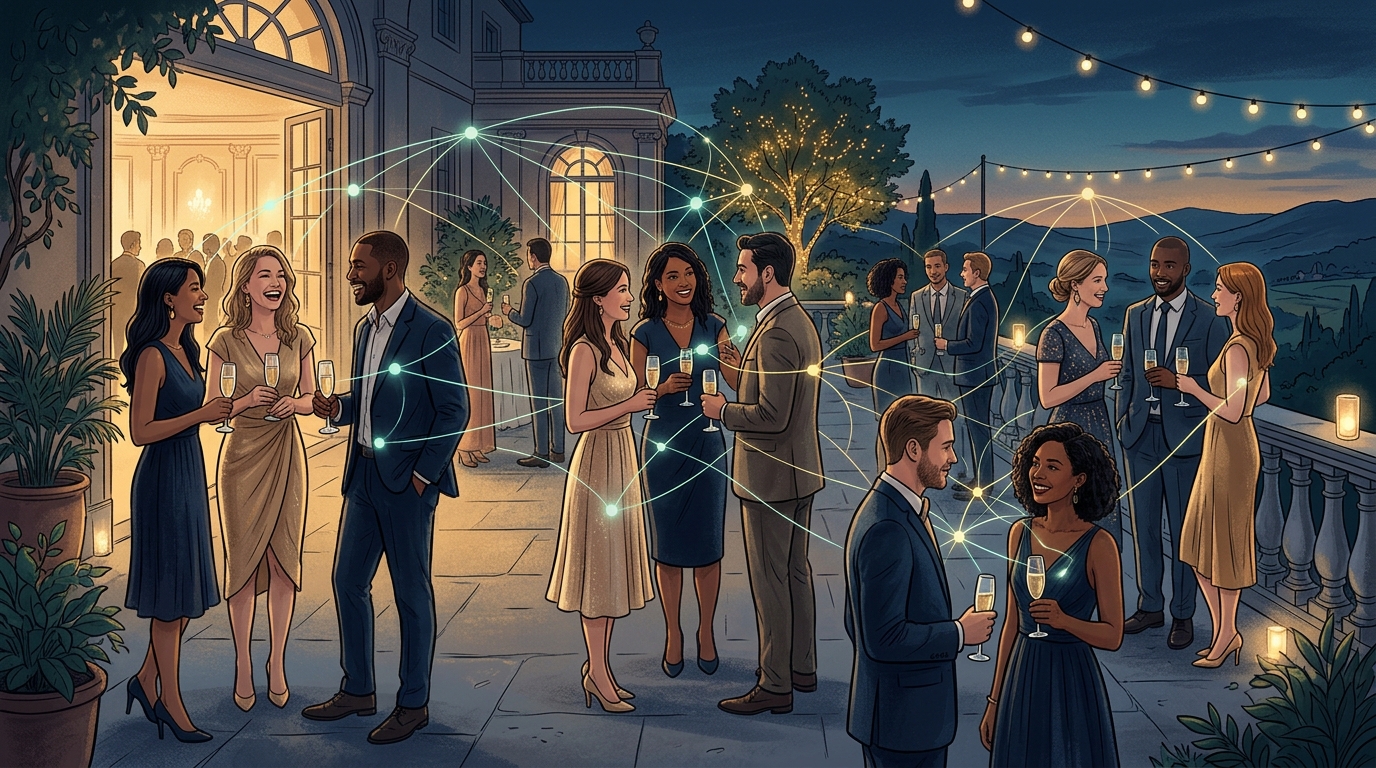
During the outdoor cocktail hour, 95 participants wore sensor badges that detected other badge-wearers within roughly 1.5 meters, logging encounters at 5-second intervals. The released dataset, coarsened into 10-second temporal bins, contains 7,213 contact events spanning 2,760 observed dyads. Alongside the contact records, participants self-reported their relationship category with respect to the wedding couple, enabling analyses of how different relationship-based groups mixed during the event.
The motivation behind the collection lies in a gap in the study of face-to-face interaction. Prior proximity datasets gathered in conferences, classrooms, hospitals, and workplaces have revealed characteristic network signatures, including heterogeneous contact rates, clustering, and bursty temporal dynamics. But the authors note that schedules, room assignments, and authority roles in these institutional settings may obscure unstructured social group dynamics. Studies of group mixing, meanwhile, often rely on demographic proxies such as gender or on assigned categories like school classes rather than on relationship-based groups.
By capturing fine-grained interaction data with socially meaningful group labels from a setting free of institutional structure, the dataset is intended to test whether the temporal network signatures observed in structured environments generalize to unstructured social interaction. Beyond that question of generalizability, the authors point to applications ranging from contact tracing to social-space design, for which models of how people congregate and move at social events could prove useful.
As a data note, the publication documents the resource itself rather than reporting new analytical findings; no results from mixing analyses or event modeling are presented in the abstract. The article is open access, authored by Joshua Z. Stadlan, Richard B. Kahn, and Michelle Birkett, and was published on 10 August 2026.
Subject of Research: A temporal proximity network dataset with relationship labels collected at a wedding cocktail hour
Article Title: A temporal proximity network dataset from a wedding cocktail hour with relationship category labels
Article References: Stadlan, J. Z., Kahn, R. B., & Birkett, M. (2026). A temporal proximity network dataset from a wedding cocktail hour with relationship category labels. Discover Networks, 2(1), Article 28. https://doi.org/10.1007/s44354-026-00044-z
Image Credits: AI Generated
DOI: 10.1007/s44354-026-00044-z
Keywords: temporal networks, proximity sensors, social interaction, wedding, contact tracing, dataset, network science, human behavior, group mixing, data note, temporal, proximity
News Source: Glenn Wilkins. (November 4, 2026). Wedding Cocktail Hour Yields First Public Dataset of Unstructured Social Contact. Scienmag.